Day February 5, 2026

How Colour Blind Electricians Work Safely: Mitigations and Real-World Practice 
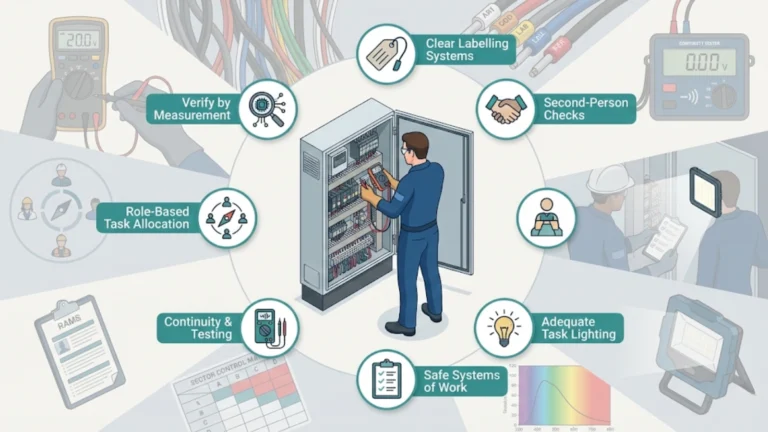
Illustrated electrician working onsite with icons and text explaining systematic electrical safety practices including testing labelling lighting teamwork and documentation

If you're researching how colour blind electricians actually do the work, you're asking the right question. Here's the thing: colour vision matters in electrical work, the industry doesn't pretend it doesn't. Conductors are colour-coded for a reason, phase identification relies on visual cues, indicator lights use red-green-amber systems. But here's what matters more: electrical safety in the UK (and internationally) is built on verification, not assumption. The fundamental principle that keeps people alive isn't "identify the brown wire by looking at it," it's "test to confirm what you're working on before you touch it."
Should You Become an Electrician If You’re Colour Blind? 

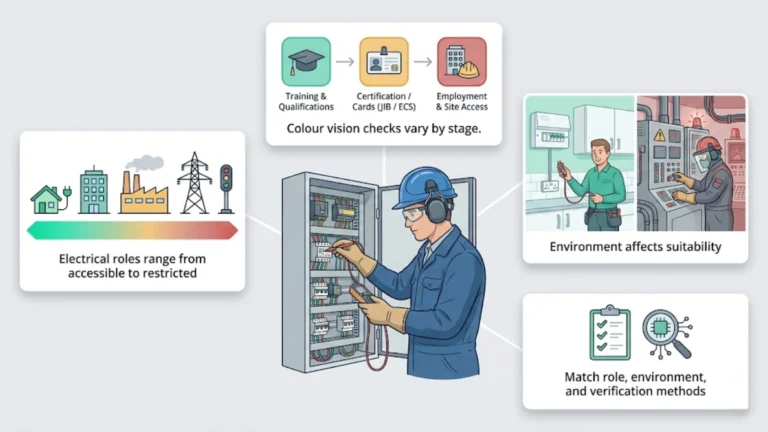
Illustrated overview of electrician career pathways, environments, and colour vision considerations

If you're colour blind and researching whether to pursue electrical work, you're probably encountering contradictory information. Some sources say it's impossible. Others claim colour vision doesn't matter at all. Forums are full of "I've been doing it for 20 years" stories alongside "I got rejected from training" warnings. Here's what's actually happening: electrical work isn't one job, it's a spectrum of roles with dramatically different colour-vision requirements, and the gatekeeping happens at multiple points (training, certification, employment) with different standards at each.

Engineering Project Management: Learning from the Hoover Dam’s Lasting Legacy By Charanjit Mannu (Vocational Education, Employability & Green Technology)

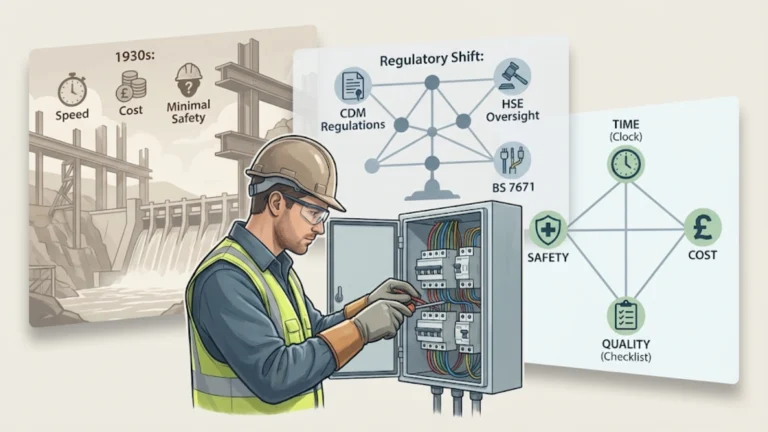
Illustrated featured image showing an electrician working onsite with icons and diagrams representing safety, time, cost, and quality across modern project management

The Hoover Dam gets referenced constantly in project management circles, usually with the same tired narrative about "when projects were done properly" or "before regulations slowed everything down." Strip away the nostalgia, though, and you're left with something more useful: a 1930s megaproject that pioneered integrated delivery under extreme constraints, killed 96 confirmed workers in the process, and created lessons we're still applying in modern construction and installation work today.

8 Years Since That 5% Pay Jump: What’s Really Changed for UK Electricians?

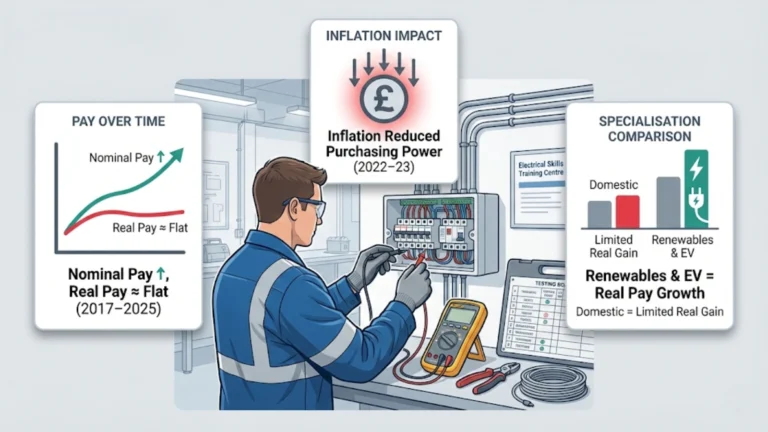
Illustrated electrician working onsite with infographic panels showing pay trends, inflation impact, and specialisation differences

Back in 2019, electricians were headline news. Trade salary surveys showed a 5% pay jump in a single year, with electricians firmly "top of the league" among UK trades. The median went from £31,500 to £32,745, comfortably beating the 1.4% inflation rate and delivering actual purchasing power gains. That was then. Eight years of data later, the story looks considerably different. Nominal median earnings have climbed an impressive 32%, from £30,805 in 2017 to £40,800 in 2025.

Are Electricians Really Earning £156k a Year? 

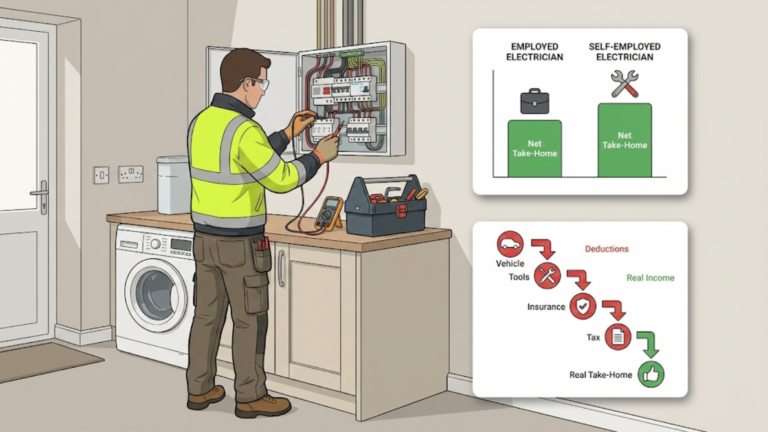
Illustrated electrician working onsite with icons explaining real take-home pay and business costs

You've probably seen the claims. Social media posts showing electricians driving new Mercedes vans, marketing ads promising six-figure incomes after a fast-track course, recruiters talking about £600 day rates like they're standard across the industry. Here's what you actually need to know: the £156k figure floating around social media isn't a salary. It's not even close to what most electricians take home. It's a mathematical ghost created by multiplying high-end day rates by 260 working days, ignoring holidays, sick days, quiet periods, unpaid admin time, and the considerable costs of actually running a trade business. 

Will Colour Blindness Fail a Medical Board for Electrical Trainee Roles? 

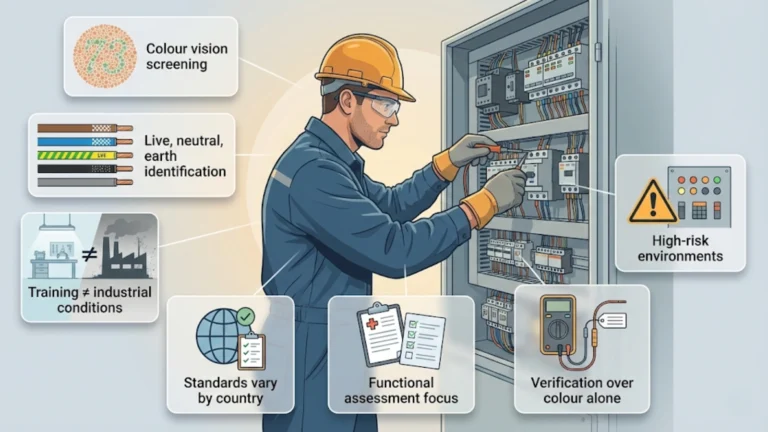
Illustrated overview showing an electrician at work with icons explaining colour vision screening, wiring identification, safety risks, standards, and workplace adaptations

If you're researching whether colour vision deficiency will prevent you from working as an electrical trainee, particularly in heavy industry, shipyards, or rail, you're asking the right question at the right time. Here's the thing: colour blindness doesn't automatically disqualify you from electrical work, but it can lead to role-specific restrictions in safety-critical environments where the consequences of misidentifying a conductor or signal could be fatal. Medical boards assess fitness for specific duties, not whether you're capable of learning the trade.

Learners are Studying level 2 Electrician Course

Guaranteed Work Placement for Your NVQ

No experience needed. Get started Now.

Prefer to call? Tap here

Learners are Studying level 2 Electrician Course

Guaranteed Work Placement for Your NVQ

No experience needed. Get started Now.

Prefer to call? Tap here

Learners are Studying level 2 Electrician Course

Guaranteed Work Placement for Your NVQ

No experience needed. Get started Now.

Prefer to call? Tap here

Learners are Studying level 2 Electrician Course

Guaranteed Work Placement for Your NVQ

No experience needed. Get started Now.

Prefer to call? Tap here