

All New Homes & Offices in the UK to Have EV Charging Points Installed from 2022

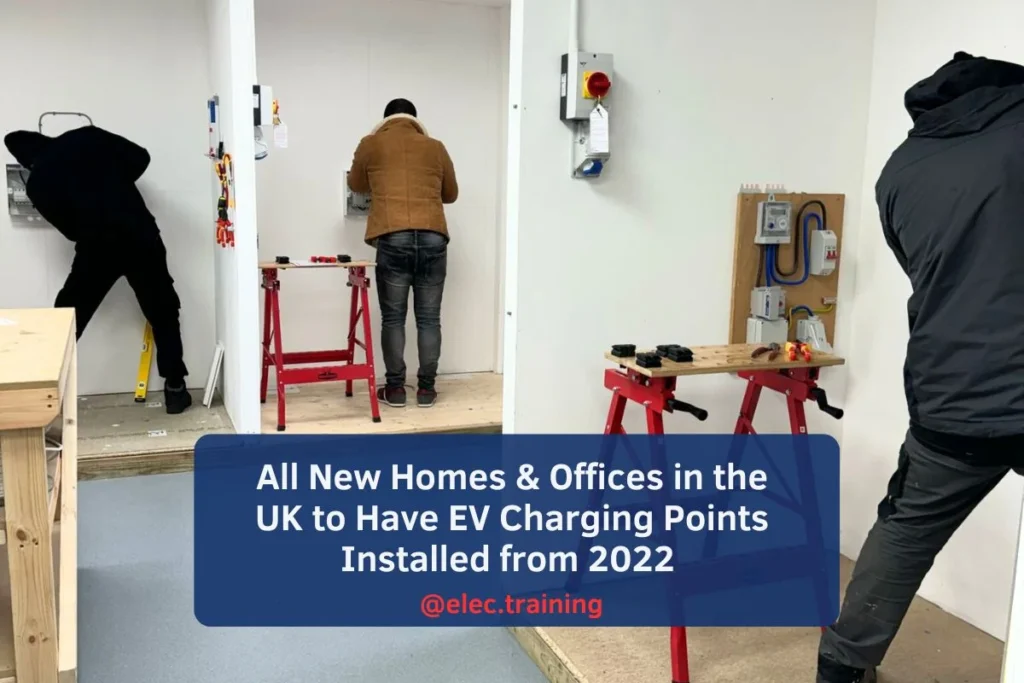
The UK has taken a bold step in its journey towards Net Zero. From 2022, it became mandatory for all new homes and offices to be built with electric vehicle (EV) charging points. This makes Britain the first country in the world to legislate for chargers in new buildings, setting the tone for the rapid expansion of EV infrastructure.
For homeowners, this ensures futureproofed properties. For businesses, it signals the shift to e lectrified fleets and workplace charging. For electricians, it represents one of the biggest growth markets of the decade.
At Elec Training, we’ve already seen demand for EV charging installation courses increase as contractors prepare to meet this challenge.
Why the Law Was Introduced
The UK government has committed to banning the sale of new petrol and diesel cars from 2030. To meet that target, the rollout of charging infrastructure needs to accelerate sharply.
By requiring chargers in every new home and office, the government removes one of the key barriers to EV adoption — access to reliable charging. Instead of retrofitting properties later, chargers are integrated during construction, saving time and cost.
This legislation is part of a broader package of measures aimed at:
- Supporting the transition to EVs.
- Reducing pressure on public charging infrastructure.
- Encouraging more drivers to switch sooner.
Smart Charging Technology
One of the most s ignificant elements of the new law is the requirement for “smart” charging technology.
Under the regulations, chargers must be able to:
- Automatically power down during peak times (8–11 am and 4–10 pm).
- Optimise charging when electricity demand is low, reducing strain on the grid.
- Integrate with smart meters and tariffs, helping households save money.
The only exemptions are public rapid chargers on motorways and A-roads.
This approach reflects government concern that, without smart charging, a surge in EV ownership could risk blackouts or grid instability. By managing demand, the grid can cope more effectively while more renewable energy comes online.
What This Means for Electricians
The introduction of mandatory chargers transforms EV installation from a niche service into a mainstream requirement. Every housing developer, landlord, and commercial property owner will need reliable, qualified electricians to deliver installations safely and compliantly.
Key implications include:
- Higher demand for installers: As new builds increase, so does the need for qualified electricians who can deliver EV-ready properties.
- More complex installations: Smart charging requires knowledge of control systems, load management, and integration with household electrics.
- Closer alignment with regulations: Installers must work to the latest Wiring Regulations, making refresher training essential. Completing an 18th edition course midlands is now more important than ever.
- Better earning potential: As with other specialist areas, EV installation commands strong rates and ongoing maintenance opportunities.
The Demand for Training
To meet this demand, structured training routes are essential. Electricians at different stages of their careers can access EV-related courses tailored to their needs.
- New entrants: Many begin with core diplomas before moving into EV specialisms.
- Career changers: Step into the industry via regional hubs such as Electrician Courses Chester or Electrician Courses Crewe.
- Experienced electricians: Can upskill quickly through dedicated EV charging installation courses, complementing their existing portfolio.
- Compliance-focused learners: Building expertise in inspection, testing, and regulation ensures high standards on every job.
This flexibility makes the EV sector accessible to a wide range of learners, from school leavers to seasoned electricians.
EV Charging and Industry Pay
Alongside new opportunities, wages in the industry continue to rise. According to the most recent agreement, jib rates will see steady increases between 2026 and 2028.
For electricians with EV expertise, the combination of rising base pay and specialist demand offers a strong outlook. Contractors able to deliver large-scale EV projects are already reporting full order books, with developers keen to get ahead of legislative deadlines.
Regional Opportunities
EV training and electrical courses are not confined to London or Birmingham. Learners across the Midlands and North West have access to high-quality centres. Options include:
- Electrician Courses Chester – supporting learners in Cheshire and North Wales.
- Electrician Courses Crewe – serving Staffordshire, Shropshire, and the North West.
This regional spread ensures learners don’t need to travel far to access n ationally recognised qualifications.
Why Train with Elec Training?
At Elec Training, we don’t just teach the basics. Our EV charging courses are designed to prepare learners for real-world installations, with an emphasis on compliance, safety, and smart technology.
We combine strong foundations in wiring regulations and inspection with practical training on modern charging systems. This ensures every graduate is confident, competent, and employable in one of the fastest-growing areas of the trade.
The UK’s decision to mandate EV chargers in new homes and offices is a turning point. For drivers, it means easier access to charging. For the industry, it signals years of sustained demand. And for electricians, it represents one of the clearest opportunities in a generation.
By training now, you can place yourself at the centre of this transition — ready to deliver the infrastructure that will power the UK’s Net Zero future.
Contact Elec Training today to explore your options and secure your place on an EV installation course.
FAQs on the UK Gas Boiler Ban and Opportunities for Electricians (September 2025)
Below is a comprehensive FAQ addressing your questions about the UK gas boiler ban, its implications for households, and opportunities for electricians, based on current policies and industry trends as of September 15, 2025. Information aligns with the government’s Net Zero strategy, Building Regulations, and training pathways.