

150,000 New Construction Jobs on the Horizon: Why Electrician Courses in Birmingham & Wolverhampton Matter More Than Ever

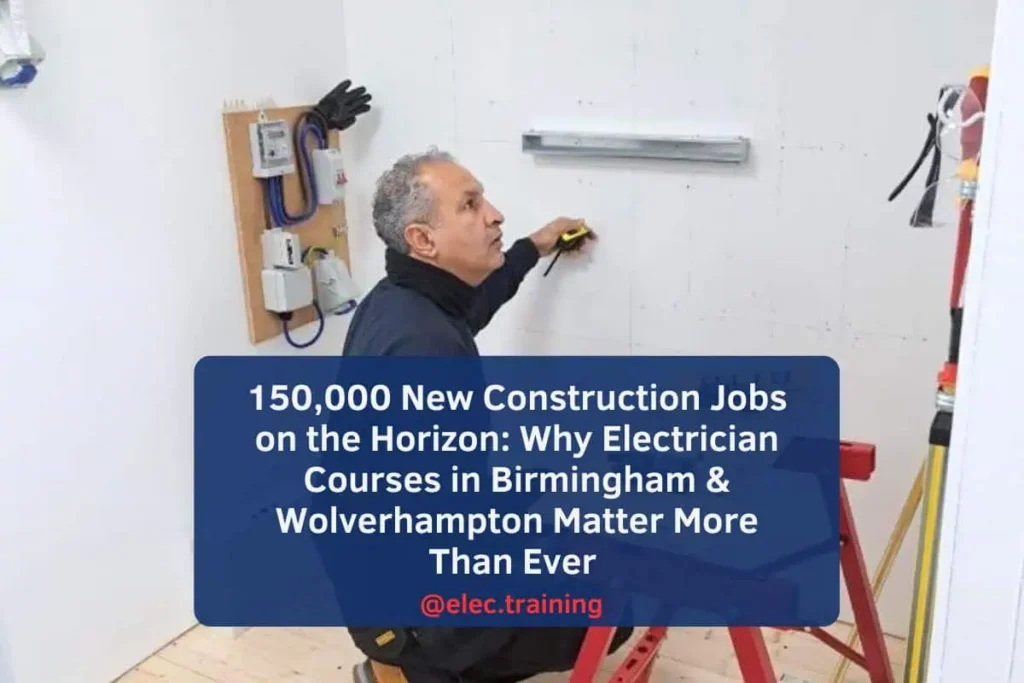
The UK construction industry is bracing for rapid expansion, with forecasts predicting 150,000 new jobs over the next five years. That growth is expected to drive massive demand for skilled trades, especially electricians. For anyone considering training, starting with an electrician course is a strong entry point. And for learners in the West Midlands, Electrician Courses Birmingham and Electrician Courses Wolverhampton provide the local access needed to seize these opportunities.
Elec Training is preparing learners for this demand with structured training routes that cover e verything from beginner to NVQ Level 3 and AM2. For full details, see www.elec.training.
A Growing Demand Despite Industry Uncertainty
Despite turbulence in recent years—such as the Carillion collapse and ongoing post-Brexit uncertainty—the Construction Industry Training Board (CITB) projects significant job creation. Their analysis suggests:
- 15,350 carpenters will be needed.
- 9,350 labourers will be required.
- Strong demand is expected across other trades, including electricians.
The Federation of Master Builders (FMB) has also reported severe recruitment difficulties:
- 48% of SMEs struggle to hire electricians and plumbers.
- 46% find it difficult to hire plasterers.
- Over two-thirds report shortages of bricklayers, up nearly 10% in just three months.
Brian Berry, FMB Chief Executive, described the situation starkly:
“Skills shortages are skyrocketing, and it begs the question, who will build the new homes and infrastructure projects the government is crying out for?”
With the government’s ambition to build 300,000 homes per year, the demand for electrical skills will continue to rise.
Electricians: At the Centre of Growth
Among all the trades, electricians hold a particularly strategic place. New housing, infrastructure, and the transition to green energy all require electrical expertise. This includes:
- Wiring for new builds: housing growth will need large numbers of electricians to install and certify safe systems.
- Infrastructure projects: rail, roads, and utilities all demand electrical specialists.
- Renewable installations: EV charging, solar PV, and battery systems require electricians with updated qualifications.
- Retrofitting older buildings: bringing existing housing stock up to modern safety and efficiency standards.
This isn’t just about numbers; it’s about up-to-date skills. The demand will increasingly be for electricians who understand both traditional installation and modern low-carbon technologies.
Wages and Career Prospects
The scarcity of skilled trades has led to sharp rises in wages across the sector. Electricians, already among the better-paid trades, are likely to see earnings rise further as demand outpaces supply.
ONS data shows that electricians consistently rank in the top quartile of skilled trades for pay, with averages above £35,000 per year, and higher earnings for contractors or those with specialisms like inspection & testing or renewables. Source: https://www.ons.gov.uk/
Combined with reports from trade bodies about rising day rates, the case for starting an electrician course now has never been stronger.
What an Electrician Course Covers
For those new to the trade, an electrician course typically includes:
- Basic theory: principles of electrical science, wiring systems, regulations.
- Practical training: wiring, terminations, testing, safe isolation.
- Health & safety: risk assessments, compliance with UK legislation.
- Progression pathways: moving from Level 2 through to Level 3, NVQ, and AM2.
This structured approach means you can start with no background knowledge and gradually build to becoming a fully q ualified electrician.
Local Access in Birmingham
With Electrician Courses Birmingham, learners gain access to training close to home. The advantages are clear:
- Proximity reduces travel costs and time, making it easier to attend all sessions.
- Tutor support: face-to-face help with both theory and practical elements.
- Regional relevance: understanding employer needs in the Birmingham market.
- Career networking: links with local employers for placements and opportunities.
In a city projected to see major housing and infrastructure expansion, Birmingham learners are well-placed to access future jobs.
Training in Wolverhampton
Electrician Courses Wolverhampton provide another key local option. Learners in Wolverhampton and surrounding areas gain:
- Hands-on workshops: practice wiring, testing, and installations under guidance.
- Smaller class sizes: more individual support.
- Placement opportunities: connections with contractors who need extra labour.
- Accessibility: local learning reduces barriers for adult learners or those changing careers.
Given Wolverhampton’s location within the West Midlands, learners are positioned close to both domestic and commercial projects across the region.
The Wider Economic Picture
Industry forecasts indicate:
- Output within the construction sector will rise by 1.3% annually, creating 158,000 jobs in the next five years.
- Infrastructure is expected to see 3.1% annual growth, with housing also increasing.
- Commercial building may stagnate due to investment uncertainty, but overall employment is projected to grow by 0.5% annually until 2022—reaching 2.77 million jobs.
CITB Policy Director Steve Radley commented:
“Though growth is slightly down on 2017, it’s looking more balanced with housing and infrastructure both expanding significantly. The range of job opportunities is growing.”
This creates both challenge and opportunity: while the demand is there, so is the need to r apidly train new entrants.
Challenges to Address
While opportunities are expanding, some hurdles remain:
- Training capacity: Providers need to scale up to meet learner demand.
- Apprenticeship frameworks: Government and industry must ensure T-Levels and apprenticeships are well-funded and structured.
- Retention: Attracting learners is only the first step; ensuring they stay on track is equally important.
- Updating skills: Rapid changes in technology (EVs, renewables, battery storage) mean electricians must continuously upskill.
Tips for New Learners
If you’re considering starting an electrician course now, here are some tips:
- Start with Level 2: Build your foundation before progressing to advanced units.
- Plan for NVQ early: Think ahead about how you’ll gather portfolio evidence.
- Keep updated with regs: Follow BS 7671 amendments closely.
- Develop soft skills: Communication and teamwork matter as much as technical ability.
- Use local providers: Access to tutors and reduced travel makes success more likely.
Why Now Is the Time
With 150,000 new jobs predicted, the industry faces a critical moment. For individuals, this is an opening to enter a secure, well-paid trade. For the UK, it’s about meeting housing targets, modernising infrastructure, and transitioning to greener energy.
Training through Elec Training—whether via Electrician Courses Birmingham or Electrician Courses Wolverhampton—offers the structured path needed.
If you’re ready to future-proof your career and tap into the growth, now is the time to start.
FAQs on the UK Electrician Skills Shortage and Training Opportunities (September 2025)