

University vs Electrical Training: Why the “Safe” Choice Might Be the Riskier One
For decades, this has been the default narrative pushed on school leavers. University equals success, security, and higher earnings. Electrical training equals manual labor, limited prospects, and being stuck. Here's what the 2025 data actually shows: Graduates entering the workforce carry average debts of £45,000-£50,000 and face 6-9 month job searches with median starting salaries of £28,500.

- Technical review: Thomas Jevons (Head of Training, 20+ years)
- Employability review: Joshua Jarvis (Placement Manager)
- Editorial review: Jessica Gilbert (Marketing Editorial Team)
- Last reviewed:
- Changes: Updated for HESA 2025 graduate outcomes, ONS ASHE 2025 electrician earnings, and Plan 5 student loan repayment terms
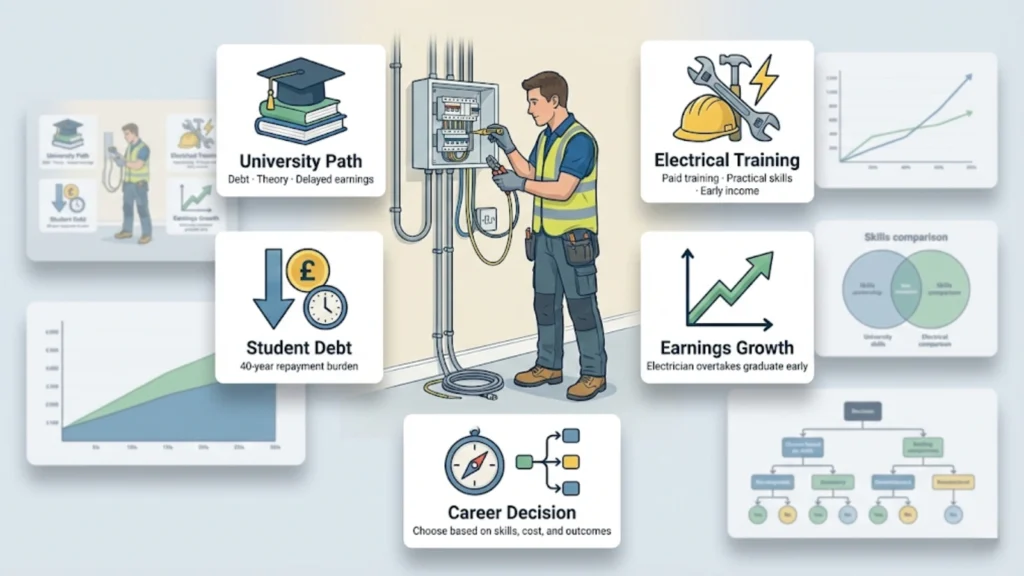
“University is the safe choice. Trades are for people who aren’t academic.”
For decades, this has been the default narrative pushed on school leavers. University equals success, security, and higher earnings. Electrical training equals manual labor, limited prospects, and being stuck.
Here’s what the 2025 data actually shows: Graduates entering the workforce carry average debts of £45,000-£50,000 and face 6-9 month job searches with median starting salaries of £28,500. Qualified electricians with ECS Gold Cards carry zero training debt, face active recruiter outreach due to severe skills shortages, and earn median salaries of £39,039 with multiple pathways to £50,000-£70,000 through self-employment or specialization.
93% of apprenticeship completers sustain employment compared to 59-61% of graduates in full-time work 15 months post-study. The UK faces a shortfall of 15,000 electricians by 2030 while graduate vacancies fell 13.8% annually. And perhaps most striking: 25% of male graduates and 15% of female graduates earn less over their lifetime than non-graduates, while vocational Level 3 qualifications deliver £15.53 return for every £1 invested.
The “safe” choice increasingly looks like the riskier one.
This isn’t an argument that university is universally wrong or that electrical training is universally superior. It’s recognition that the financial, employment, and lifestyle realities have shifted substantially, and the reflexive “university = success” assumption no longer holds for large segments of school leavers.
This article compares the actual pathways, costs, earnings trajectories, employment outcomes, and quality of life indicators between university degrees and electrical training to help people make informed decisions based on evidence rather than outdated assumptions.
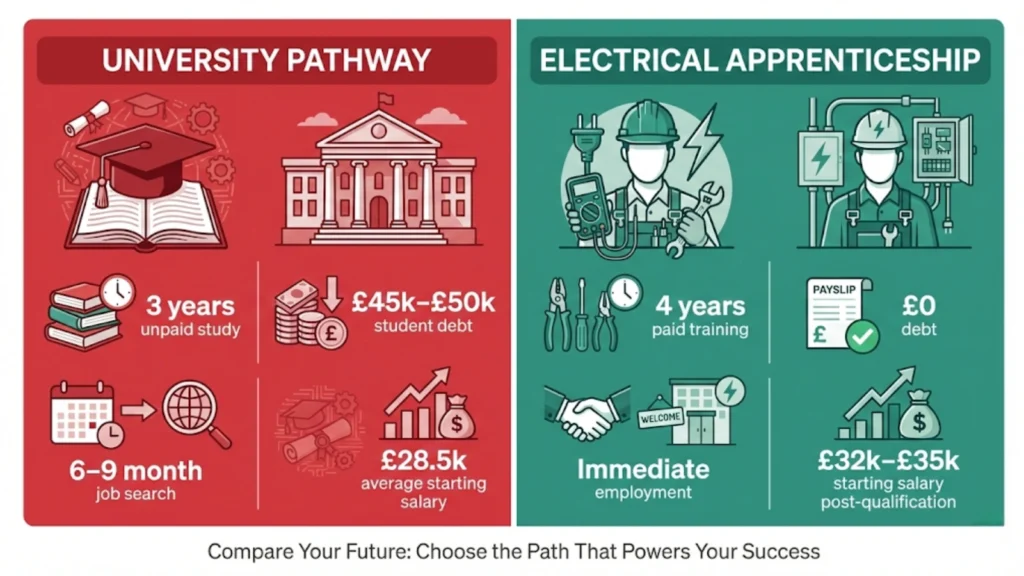
The Financial Reality: Debt vs Earnings
Let’s start with the numbers that matter most to 18-year-olds making this decision.
University pathway (3 years):
Tuition fees: £9,535/year maximum = £28,605 total for three years
Maintenance loan: Up to £13,762/year (London, living away from home) = approximately £40,000-£42,000 over three years
Additional living costs not covered by maintenance loan: £10,000-£15,000 estimated total over three years
Total debt upon graduation: £45,000-£53,000 average (HESA 2025 data)
Earnings during study: £0 from education (students may work part-time but this isn’t guaranteed or structured)
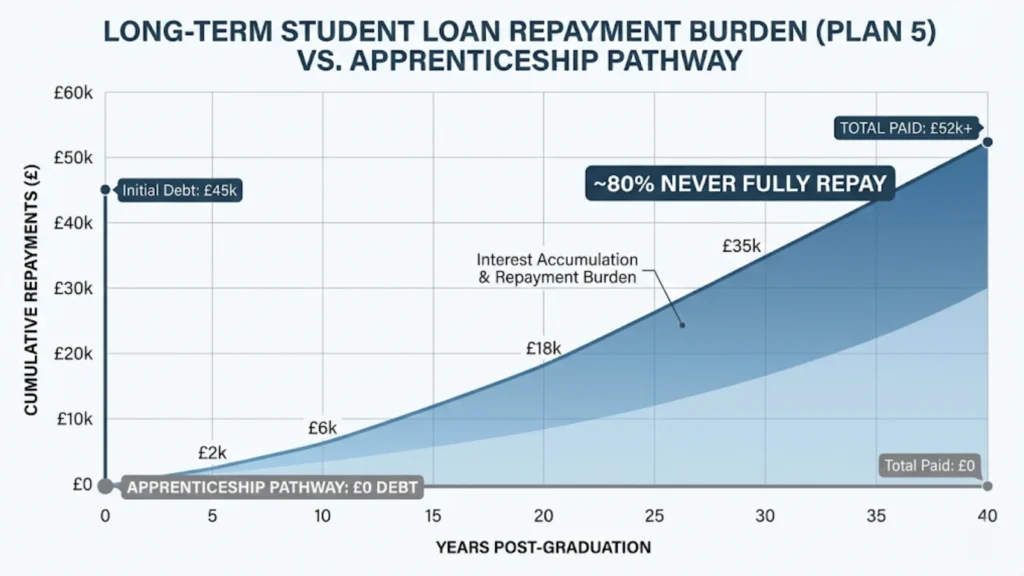
Repayment terms (Plan 5 for 2023/24 onwards): 9% of earnings above £27,295 threshold for 40 years. For a graduate earning £35,000, this equals approximately £700/year in repayments.
Electrical apprenticeship pathway (4 years):
Tuition fees: £0 (government-funded for under-25s)
Living costs: Covered by wages (you’re employed throughout)
Total debt upon qualification: £0
Tool costs: £500-£1,000 approximately (one-time investment)
Earnings during training (JIB rates 2026):
- Stage 1 (Year 1): £15,912 annually
- Stage 2 (Year 2): £21,236 annually
- Stage 3 (Year 3): £26,543 annually
- Stage 4 (Year 4): £30,831 annually
Cumulative earnings during 4-year training: Approximately £95,000
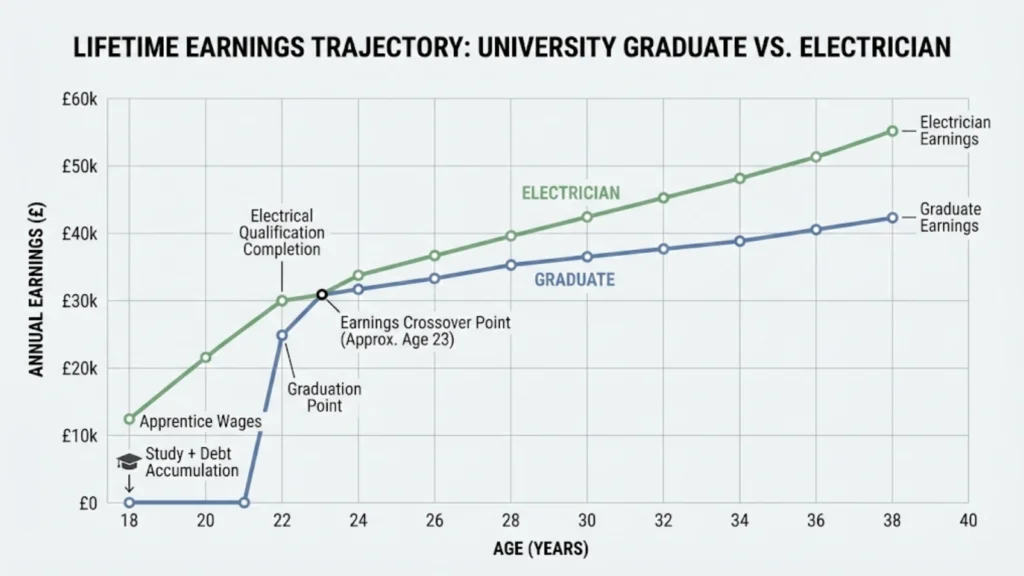
"From a pure financial perspective, apprentices earn approximately £95,000 cumulative during their four-year training while graduates accumulate £45,000-£50,000 debt. By age 25, an electrician who started apprenticeship at 18 has earned roughly £200,000+ total and is debt-free. A graduate who started university at 18 has earned maybe £80,000 post-degree and carries substantial debt. The financial gap is significant."
Thomas Jevons, Head of Training
The age 25 comparison:
University graduate who started at 18:
- Ages 18-21: Accumulated £45,000-£50,000 debt, earned £0 from degree
- Ages 21-25 (4 years working): Earned approximately £120,000 cumulative (£28,500 starting, progressing to £32,000-£35,000)
- Net position: £70,000-£75,000 earned, minus £45,000-£50,000 debt = £20,000-£30,000 net
Electrician who started apprenticeship at 18:
- Ages 18-22: Earned £95,000 cumulative during training, £0 debt
- Ages 22-25 (3 years qualified): Earned approximately £110,000-£120,000 cumulative (£35,000-£40,000 annually)
- Net position: £205,000-£215,000 total earned, £0 debt = £205,000-£215,000 net
The financial gap by age 25: Approximately £175,000-£185,000 in the electrician’s favor.
This doesn’t account for the 40-year debt repayment burden graduates carry or the compounding investment potential of having positive net worth earlier.
What Each Pathway Actually Delivers
Beyond the financial comparison, what do you actually get for your time and money?
University (3 years):
Qualification: Bachelor’s degree (BA/BSc) in chosen subject
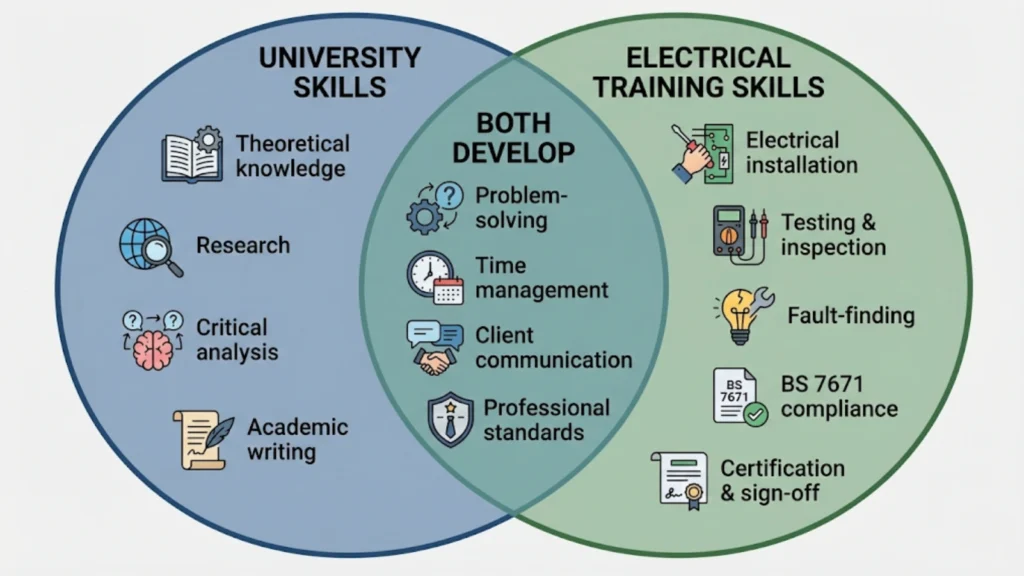
Skills developed: Theoretical knowledge in subject area, research skills, critical analysis, essay writing, time management, independent study
Assessment: Exams, coursework, dissertations, presentations
Practical experience: Varies dramatically by subject. STEM degrees include lab work. Most humanities/business degrees have minimal hands-on components. Work experience typically through voluntary internships (often unpaid or low-paid, not guaranteed).
Industry recognition: Degree certificates are widely recognized but increasingly employers filter by degree classification (2:1 minimum common requirement) and institution reputation. Non-STEM degrees face questions about practical applicability.
Employment guarantee: None. 82% employment rate 15 months post-graduation includes part-time work, further study, and roles unrelated to degree subject. 6-9 month average job search duration.
Electrical training (4 years via apprenticeship):
Qualifications: Level 3 Electrotechnical Qualification, NVQ Level 3 Diploma in Installing Electrotechnical Systems and Equipment, 18th Edition BS 7671 certification, AM2/AM2E End-Point Assessment pass, Functional Skills Level 2 (English/Maths if not already held)
Skills developed: Electrical installation, fault-finding, testing and inspection, safe isolation procedures, circuit design, compliance with BS 7671, consumer unit specification, cable sizing, certification procedures, site safety protocols, client communication
Assessment: Continuous practical assessment through NVQ portfolio (workplace evidence), AM2 independent practical examination (3 days of installation, fault-finding, inspection, testing under time pressure), knowledge tests throughout
Practical experience: 3,000-4,000 hours of supervised site work across domestic, commercial, or industrial settings. Real installations, real faults, real consequences for errors (under supervision).
Industry recognition: ECS Gold Card eligibility (required for unsupervised work on most commercial sites). Widely recognized and actively sought by employers. Approximately 85-90% of electrical job advertisements specify “ECS Gold Card essential.”
Employment guarantee: While not legally guaranteed, 93% of apprenticeship completers sustain employment. Many apprentices receive job offers from training employers before completion. High demand (70% of contractors report skills shortages, 15,000-person shortfall by 2030).
The competence distinction:
University proves you learned about a subject. You passed exams, wrote essays, demonstrated knowledge retention and analytical skills.
Electrical training proves you can do the job. The AM2 assessment independently verifies you can safely install circuits, fault-find, test, and certify work to BS 7671 standards. Employers know exactly what an AM2 pass means.
This distinction matters enormously in hiring. Degrees vary wildly in quality and practical applicability. NVQ Level 3 + AM2 + ECS Gold Card provides standardized competence verification employers trust.
However, short courses often fail completely to deliver employability because they provide theory without the supervised site experience and NVQ portfolio building that employers actually require.
Employment Outcomes and Job Market Reality
What happens when you finish your training and enter the job market?
Graduate employment (HESA 2025 data, 15 months post-graduation):
Employment rate: 82% (includes full-time, part-time, self-employed, and those in further study)
Full-time employment: 59-61% of graduates
Unemployed: 6% explicitly seeking work
Job search duration: 6-9 months average to secure first graduate role
Starting salary: Median £28,500, but varies dramatically by subject (STEM higher, humanities lower)
Degree relevance: Significant proportion work in roles unrelated to degree subject
Employer requirements: Typically 2:1 degree classification minimum, often filtering by institution reputation
Electrician employment (ONS, industry data 2025):
Employment rate post-qualification: 93% of apprenticeship completers sustain employment
Full-time employment: Overwhelming majority work full-time or self-employed
Job search duration: Days to weeks. Qualified electricians with ECS Gold Cards typically receive recruiter contact within days of indicating availability.
Starting salary (newly qualified): £32,000-£35,000 typical for Gold Card holders
Progression: Median qualified electrician earnings £39,039 (ONS ASHE 2025), with multiple pathways to £50,000-£70,000 through specialization or self-employment
Employer requirements: NVQ Level 3, 18th Edition, AM2 pass, ECS Gold Card (standardized, verifiable credentials)
Why the employment gap exists:
Supply and demand: The UK faces a 15,000-electrician shortfall by 2030. 70% of electrical contractors report skills shortages. Only 7,540 electrical apprentice starts annually versus 10,500 needed. Graduate vacancies fell 13.8% annually while electrical vacancies remain high.
Credential verification: ECS Gold Card provides instant competence verification. Employers know exactly what they’re getting. Degrees vary enormously in quality and practical applicability, requiring employers to assess candidates more extensively.
Immediate productivity: Electricians with NVQ Level 3 and AM2 can work productively from day one. Graduate hires require training, development, and often struggle to demonstrate immediate value.
Economic sensitivity: Graduate roles (management, administration, marketing) are more vulnerable to economic downturns. Electrical work (maintenance, installation, compliance) remains essential regardless of economic conditions.
The employment reality: If you complete electrical training and achieve Gold Card status, employment is virtually guaranteed. If you complete a degree, employment depends heavily on subject, institution, degree classification, and economic conditions.
Earnings Trajectories: Early Career Through Long-Term
How do earnings compare across career stages?
Early career (0-5 years post-qualification):
Graduates: £28,500 median start, progressing to £32,000-£35,000 by year 5 (highly variable by field)
Electricians: £32,000-£35,000 newly qualified, progressing to £38,000-£42,000 by year 5
Advantage: Electricians. Higher starting point, faster progression in early years.
Mid career (5-15 years):
Graduates: £35,000-£45,000 median, though significant variation (STEM and professional fields higher, humanities lower)
Electricians: £38,760 median (ONS ASHE 2025), with experienced commercial/industrial electricians reaching £45,000-£55,000. Self-employed domestic electricians often £40,000-£50,000.
Advantage: Roughly equivalent for median outcomes. Top performers in both categories exceed medians substantially.
Later career (15+ years):
Graduates: £40,000+ median, with senior management/specialist roles reaching £60,000-£100,000+ in high-performing sectors
Electricians: £50,000-£70,000 common for self-employed or specialist roles (data centers, high-voltage, industrial automation). Top 25% significantly exceed this.
Advantage: Variable. Depends heavily on specialization, self-employment success, and field for graduates.
The lifetime earnings caveat:
Research shows 25% of male graduates and 15% of female graduates earn less over their lifetime than non-graduates. This reflects degree quality variation, field selection, and employment outcomes.
Vocational Level 3 qualifications (including electrical NVQ) deliver £15.53 return for every £1 invested, substantially exceeding many degree ROI figures.
Self-employment opportunity:
Approximately 78% of tradespeople value autonomy and self-employment options. Electrical work enables relatively easy transition to self-employment (business registration, public liability insurance, vehicle, tools). Graduate roles typically require years of experience before self-employment becomes viable.
Self-employed electricians frequently report £50,000-£70,000+ annual earnings, though data quality is limited due to tax structuring.
Quality of Life and Job Satisfaction
Financial outcomes aren’t the only consideration. What about daily work experience and satisfaction?
Job satisfaction data:
Tradespeople (including electricians): 91% report job satisfaction, up from 83% in previous surveys. 63% report pride in their work and feeling of fulfillment.
Graduates in full-time roles: 80% report satisfaction, though this varies enormously by field and role. Common complaints include work not matching degree subject, feeling underutilized, and corporate bureaucracy.
Work-life balance:
Electricians: Variable. Self-employed electricians report high autonomy and flexibility. Employed electricians may work shifts or on-call but generally avoid extreme overtime culture. Physical work provides natural boundaries between work and personal time.
Graduates: Office-based roles increasingly report burnout, especially in high-pressure sectors (finance, consulting, law). Work-from-home creates boundary issues. “Always-on” culture via email/Slack common.
Autonomy and control:
Electricians: High rates of self-employment (30-40% within 10 years of qualification). Even employed electricians work relatively independently on sites. Direct client interaction common.
Graduates: Typically work within corporate hierarchies with limited autonomy in early career. Self-employment rare until establishing substantial experience and client base.
Tangible results:
Electricians: See immediate, visible results of work. You wire a building, it powers up, people use it. Problem-solving produces concrete solutions. Client satisfaction measurable.
Graduates: Work often involves processes, analysis, reporting. Results can feel abstract or delayed. Individual contribution to outcomes less visible in large organizations.
Physical vs mental demands:
Electricians: Physically demanding work (lifting, bending, working in confined spaces, standing for hours). Risk of injury exists. Physical fitness important. Mental demands include problem-solving, regulation compliance, client management.
Graduates: Mentally demanding (deadlines, decision-making, stress). Physically sedentary (health risks from prolonged sitting). Screen fatigue common.
Geographic flexibility:
Electricians: Work needed everywhere. Can relocate to any UK region and find employment. International opportunities (Australia, Canada, Middle East particularly receptive to UK-qualified electricians).
Graduates: Opportunities concentrate in major cities (London, Manchester, Birmingham). Regional variation in graduate employment significant. International opportunities vary by field.
The social perception issue:
Despite evidence, trades still face outdated “fallback” stigma in some circles. Graduates report social pressure to pursue university regardless of actual outcomes. This perception lag creates psychological challenges for those choosing trades despite strong evidence supporting the decision.
However, growing awareness of graduate debt and employment struggles is shifting perceptions, particularly among younger cohorts witnessing older siblings’ experiences.
Common Misconceptions and Reality Checks
Let’s address the myths that distort decision-making.
Myth: “A degree always leads to higher pay than a trade.” Reality: 25% of male graduates and 15% of female graduates earn less over their lifetimes than non-graduates. Vocational Level 3 qualifications deliver £15.53 return per £1 invested, exceeding many degree ROI outcomes. Self-employed electricians routinely earn £50,000-£70,000, exceeding median graduate earnings across most non-STEM fields.
Myth: “Trades are for people who aren’t academic.” Reality: Electrical training involves complex physics (voltage, current, resistance, power calculations), mathematics (cable sizing, voltage drop calculations, load calculations), regulation interpretation (BS 7671 is dense technical documentation), and problem-solving requiring critical thinking. The AM2 assessment is rigorous—approximately 60% pass rate. Academic ability is required; it’s applied differently.
Myth: “University opens more doors than trades.” Reality: This depends entirely on what doors you want opened. For installation electrical work, a degree is largely irrelevant—employers filter for NVQ Level 3 and ECS Gold Card. For academic research or specialized professional roles (law, medicine), degrees are mandatory. The “more doors” claim ignores that many graduate doors lead to roles unrelated to degree subjects with limited advancement.
Myth: “You can always go to university later; better to do it at 18.” Reality: Mature students face the same debt burden but with additional complications (dependents, mortgages, career disruption). Conversely, many electricians pursue further education (HNC/HND, degrees) part-time while employed, funding it from earnings rather than debt. You can absolutely pursue university later; starting with a trade provides financial foundation.
Myth: “Graduate salaries always catch up and exceed trade earnings long-term.” Reality: Median data shows convergence, not graduate superiority. Top-performing electricians (self-employed, specialists) exceed median graduate earnings across most fields. Only specialized graduate fields (medicine, law, senior engineering) reliably exceed top trade earnings, and these require additional qualifications beyond bachelor’s degrees.
Myth: “Trades destroy your body; you can’t work past 50.” Reality: While electrical work is physical, it’s not the same as heavy construction trades (bricklaying, groundwork). Many electricians work into their 60s, transitioning to inspection/testing, supervision, or consultancy roles. Self-employment allows workload control. Graduate sedentary work creates different health issues (cardiovascular disease, musculoskeletal problems from sitting).
Myth: “Electrical work is disappearing due to automation.” Reality: The opposite. Electrification (EVs, heat pumps, renewables) is driving demand. AI and robotics require electrical infrastructure. The 15,000-electrician shortfall by 2030 reflects sustained, growing demand. Automation affects routine tasks but increases complexity requiring skilled human intervention.
"We're seeing increasing numbers of graduates switching to electrical training—people with degrees in business, humanities, even some STEM fields who realized their degree wasn't opening doors. They're willing to start apprenticeships or fast-track routes at 25-30 because they see electricians their age earning £35,000-£40,000 doing practical work they enjoy."
Joshua Jarvis, Placement Manager
Why graduates switch:
Degree-job mismatch: Many discover their degree subject doesn’t lead to relevant employment. Business degrees produce generic graduates competing for limited roles. Humanities face similar challenges. They want work with clear connection to training.
Debt burden regret: Carrying £45,000-£50,000 debt for a job earning £26,000-£30,000 creates financial stress and resentment. Switching to electrical training offers debt-free skill acquisition and higher earning potential.
Desire for tangible work: Abstract office tasks (reporting, analysis, meetings) fail to provide satisfaction for many. Electrical work offers visible results and problem-solving with immediate feedback.
Employment security: Graduate job insecurity (contract work, redundancies, economic sensitivity) contrasts with electrical skills shortage creating guaranteed demand.
The switching pathway:
Wolverhampton programs cater to adults and other regional training centers in the West Midlands offer part-time and intensive electrical training options designed specifically for career changers who need to balance existing commitments while transitioning into the trade.
Options include fast-track theory courses (16 weeks) followed by employment-based NVQ building, or adult apprenticeships with employers understanding of mature learner circumstances.
Challenges: Income reduction during training (adult apprentice year-one wages still £15,000-£18,000). Time commitment (4 years for full apprenticeship, 18-24 months for fast-track plus NVQ). Starting over in a new field requires humility.
Success factors: Financial cushion to manage reduced income temporarily. Genuine interest in electrical work (not just escaping current job). Willingness to invest 2-4 years building credentials. Physical fitness for site work.
The age question:
While younger is generally easier, age 25-35 is viable for career switching. Employers value maturity, life experience, and commitment. The challenge is financial (managing reduced income), not capability.
Beyond age 40, the ROI calculation changes—4-year apprenticeship at reduced wages may not make financial sense for remaining career length. Fast-track routes or leveraging existing experience (if you have construction/engineering background) become more practical.
Regional Focus: West Midlands and Birmingham
Regional opportunities vary. The West Midlands shows particularly strong electrical demand.
Why the region matters:
Transport manufacturing: Jaguar Land Rover, automotive supply chains require industrial electricians for production maintenance and automation.
Battery manufacturing: Coventry/Wolverhampton corridor developing as battery production hub, requiring high-voltage DC expertise.
Infrastructure: HS2, Birmingham Big City Plan, tram network expansion create sustained commercial electrical demand.
Net-zero transition: Heat pump rollout, EV charging infrastructure, solar PV expansion driving residential and commercial work.
Wage comparison:
West Midlands median electrician salary: £39,921 (slightly above UK national median)
Graduate median (West Midlands): Lower than London/South East but varies by field
Cost of living: Significantly lower than London, improving real-term purchasing power
Training infrastructure:
Birmingham and West Midlands have strong apprenticeship provider coverage (JTL Birmingham, BMET College, Halesowen College, Sandwell College) with established employer networks.
Vacancy patterns: High volume of electrical vacancies (85-90% specify NVQ Level 3, ECS Gold Card, 18th Edition as essential requirements).
The regional advantage: Strong manufacturing base, lower cost of living than South East, excellent training infrastructure, and sustained demand create favorable conditions for electrical career development.
Government Policy and Financial Accessibility
Recent policy changes strengthen apprenticeship accessibility.
Youth Guarantee (£820m funding):
From April 2026, all 18-21 year-olds guaranteed a full apprenticeship or high-quality training place.
100% funding for apprenticeships for anyone under 25 (previously 16-18 only), eliminating the 5% co-investment requirement that deterred some employers from hiring 19-24 year-old apprentices.
The Youth Guarantee changed this significantly, making the apprenticeship pathway financially accessible for 18-24 year-olds without the co-investment requirements that previously created barriers.
Plan 5 student loan reality:
40-year repayment term for students starting 2023/24 onwards (effectively entire working career).
9% of earnings above £27,295 threshold (lower than previous plans, meaning repayments start sooner for lower earners).
Interest rates linked to RPI, meaning debt grows faster than many can repay.
80% of graduates never fully repay loans—they’re effectively a 9% graduate tax for 40 years.
The widening cost gap:
University costs have remained high while apprenticeship funding has improved. The financial barrier to university is increasing while barriers to apprenticeships are decreasing.
For families on lower incomes, apprenticeships now offer dramatically better financial outcomes than university for many career pathways.
Who Should Choose Which Pathway (Decision Framework)
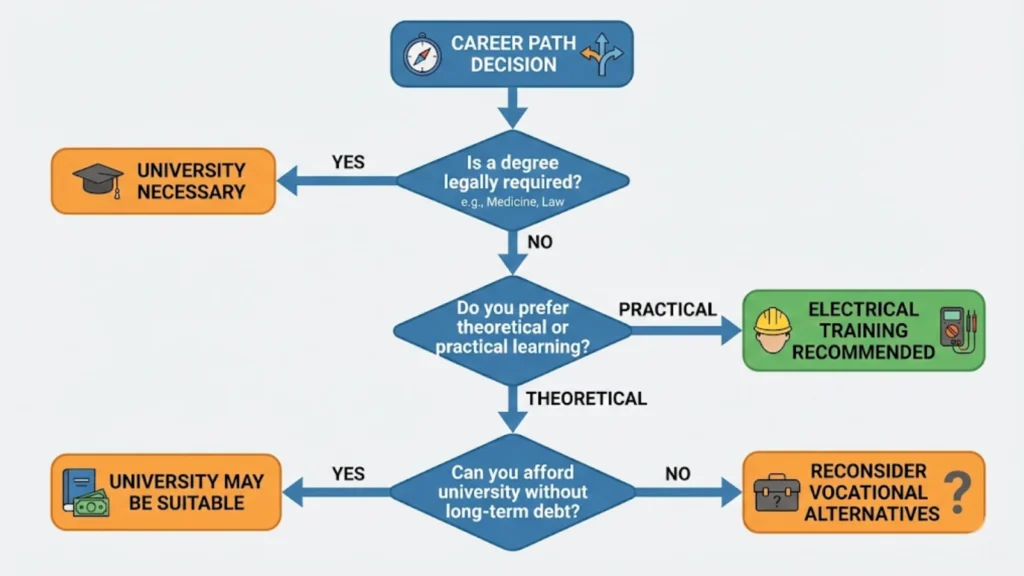
Neither option is universally superior. Individual circumstances matter.
Choose university if:
Career requires degree: Medicine, law (barrister/solicitor), academic research, clinical psychology, veterinary medicine, architecture require degrees by regulation. No alternative pathway exists.
You have specific academic passion: Genuine interest in theoretical study, research, and intellectual exploration for its own sake (not just for career outcomes).
You value university social experience: Campus life, societies, networking with future graduates may justify cost for some. This is a lifestyle choice, not a financial one.
Family can fund without debt: If parents/family can pay fees without loans, degree financial risk diminishes substantially (though opportunity cost of 3 years unpaid study remains).
You’re pursuing elite institution with strong graduate outcomes: Oxbridge, Russell Group universities in STEM fields show stronger graduate premium. Generic degrees from mid-tier institutions show weakest outcomes.
Choose electrical training if:
You prefer practical problem-solving: Hands-on work, tangible results, and applied learning over theoretical study.
You want to earn from day one: Cannot afford 3 years without income or want to avoid debt entirely.
You value employment security: Want guaranteed demand field with skills shortage creating employer competition for workers.
You want faster route to good earnings: Age 22-25 earning £35,000-£40,000 appeals more than age 25-30 catching up from debt.
You value autonomy: Self-employment opportunity and independence appeals more than corporate hierarchy.
You’re skeptical of non-STEM degrees: Recognize that many degrees don’t lead to relevant employment and want clear training-to-work pathway.
The hybrid approach:
You can do both, sequentially. Start with electrical training, establish career and income, then pursue part-time degree later (HNC/HND, Open University, employer-sponsored) if desired. This funds education through earnings rather than debt.
Conversely, graduates can pursue electrical training afterward (as many do), though this wastes the 3 years and debt from degree.
The hybrid disadvantage: Time. Doing both takes 7+ years total. Most people choose one path.
Ready to Make an Informed Decision?
Call us on 0330 822 5337 to discuss electrical training pathways, understand how they compare to university options financially and practically, and explore whether apprenticeships or alternative routes suit your circumstances.
What we’re not going to tell you:
- That university is always a mistake (it’s essential for specific careers)
- That everyone should become an electrician (some people genuinely suit academic paths)
- That debt doesn’t matter at all (it constrains life choices for decades)
- That there’s one “correct” choice for everyone
What we will tell you:
- Why £95,000 cumulative earnings during 4-year apprenticeship compares to £45,000-£50,000 debt during 3-year degree
- How the £175,000-£185,000 net worth gap by age 25 affects long-term financial security
- Why 93% apprenticeship employment rate exceeds 59-61% graduate full-time employment rate
- Why 70% of electrical contractors face skills shortages while graduate vacancies fell 13.8% annually
- How 25% of male graduates and 15% of female graduates earn less lifetime than non-graduates
- Why vocational Level 3 delivers £15.53 return per £1 invested vs variable degree ROI
- How 40-year student loan repayment (9% above £27,295) functions as effective graduate tax
- What adult career changers face financially (reduced income initially, but debt-free qualification)
No university bashing. No trade glorification. Just honest comparison of pathways based on 2025 financial data, employment outcomes, and earnings trajectories so you can decide what suits your circumstances, interests, and goals.
References
Primary Official Sources
- HESA Graduate Outcomes 2022/23 Statistics: https://www.hesa.ac.uk/news/17-07-2025/sb272-higher-education-graduate-outcomes-statistics/salary
- ONS Annual Survey of Hours and Earnings (ASHE) 2025: https://www.ons.gov.uk/employmentandlabourmarket/peopleinwork/earningsandworkinghours/bulletins/annualsurveyofhoursandearnings/2025
- UK Government Apprenticeship Statistics 2024/25: https://explore-education-statistics.service.gov.uk/find-statistics/apprenticeships/2024-25
- Student Loan Forecasts for England 2024/25: https://explore-education-statistics.service.gov.uk/find-statistics/student-loan-forecasts-for-england/2024-25
- Ofqual Register NVQ 2357 Electrotechnical: https://register.ofqual.gov.uk/
Industry Body Reports and Research
- ECA Skills Shortage Report 2025: https://www.eca.co.uk/taking-action/skills-for-the-future
- NICEIC Electrotechnical Skills Shortage: https://niceic.com/views/the-electrotechnical-skills-shortage
- National Careers Service Electrician Profile: https://nationalcareers.service.gov.uk/job-profiles/electrician
- Returns to Academic and Vocational Qualifications Research: https://www.researchgate.net/publication/4807512_The_Returns_to_Academic_and_Vocational_Qualifications_in_Britain
- City & Guilds 2357 Electrotechnical Qualification: https://www.cityandguilds.com/qualifications-and-apprenticeships/building-services-industry/electrical-installation/2357-electro-technical-technology
Labour Market and Careers Analysis
- Prospects University vs Apprenticeship Comparison: https://www.prospects.ac.uk/jobs-and-work-experience/apprenticeships/should-i-go-to-university-or-do-an-apprenticeship
- Indeed Electrician Jobs West Midlands: https://uk.indeed.com/q-electrician-l-west-midlands-region-jobs.html
- Elec Training Electrician Pay Guide 2026: https://dev.elec.training/news/how-much-can-you-make-as-an-electrician-a-2026-pay-guide/
- Electrician Courses 4U Salary Analysis: https://electriciancourses4u.co.uk/useful-resources/electrician-salary/
Note on Accuracy and Updates
Last reviewed: 02 February 2026. This page is maintained; we correct errors and refresh sources as graduate outcomes, apprenticeship statistics, and government loan terms evolve. HESA Graduate Outcomes 2022/23 data (82% employment, £28,500 median starting salary), ONS ASHE 2025 electrician earnings (£39,039 median), and Plan 5 student loan terms (9% above £27,295, 40-year repayment) reflect current published information. Youth Guarantee funding provisions (100% funding for under-25s from April 2026) and apprenticeship statistics (7,540 electrical starts vs 10,500 needed) are accurate to latest government data. Next review scheduled following any significant changes to student loan policy or graduate outcome methodology.