

EV Chargers in Every New Home: What the DfT’s Plans Mean for Electricians
- Technical review: Thomas Jevons (Head of Training, 20+ years)
- Employability review: Joshua Jarvis (Placement Manager)
- Editorial review: Jessica Gilbert (Marketing Editorial Team)
- Last reviewed:
- Complete rewrite reflecting Part S implementation since June 2022, updated training requirements, and 2026 market reality
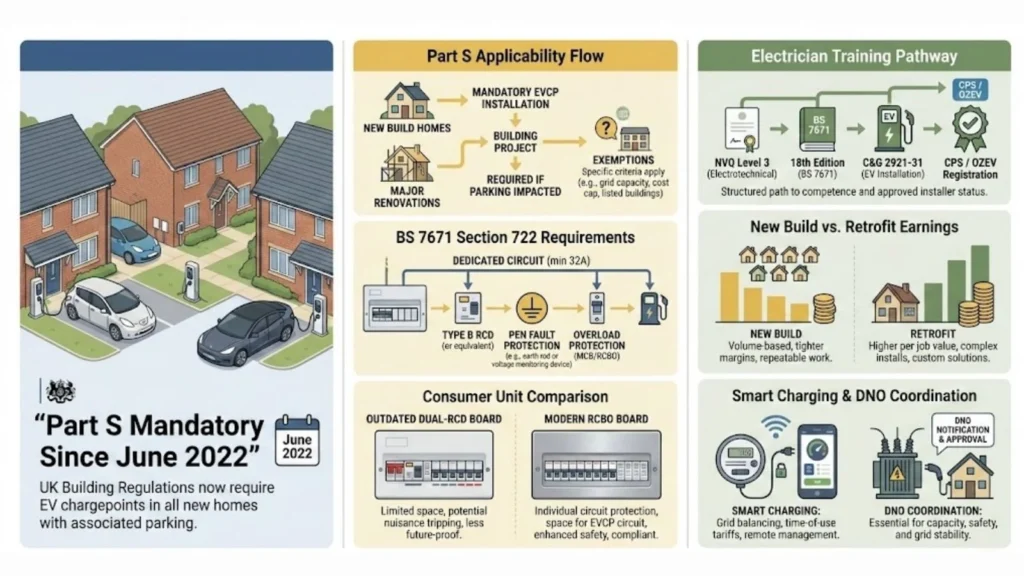
Since June 15, 2022, every new-build home in England with associated parking has been legally required to include an electric vehicle (EV) charging point. Not proposed. Not optional. Mandatory.
Part S of the Building Regulations made the UK one of the first countries to legislate EV infrastructure at the point of construction. Nearly four years in, the market has shifted from “Will this happen?” to “How do I make money from it?”
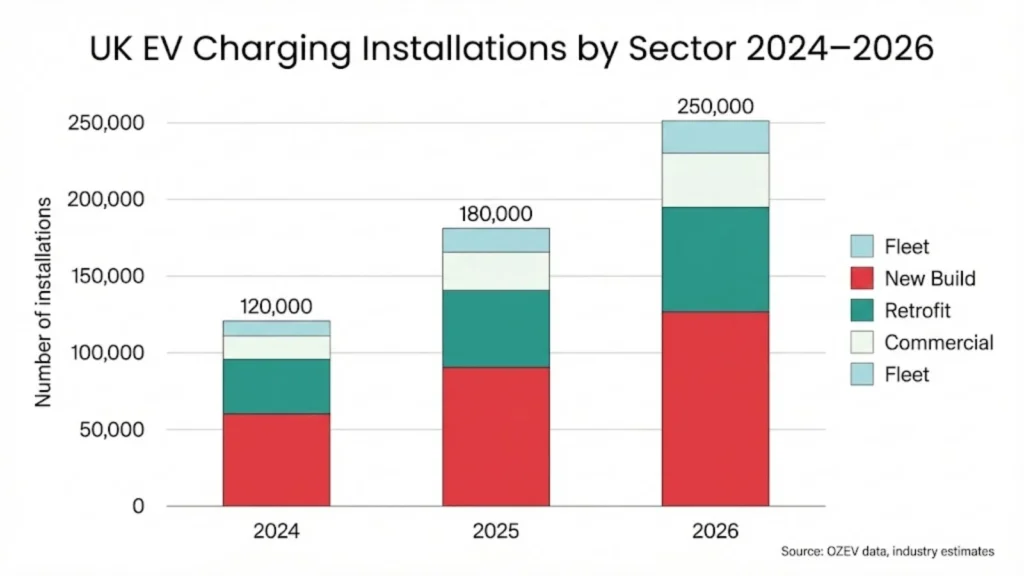
For electricians, the work is already here. Developers build 180,000+ homes annually in England. Most have parking. That’s 180,000 mandatory EV charging installations every year, plus commercial properties, major renovations, and retrofit demand from existing homeowners.
This isn’t a niche add-on anymore. It’s standard electrical work. And if you’re not qualified to install EV chargers in 2026, you’re leaving money on the table.
Here’s what’s actually changed since 2022, what electricians need to know about Part S compliance, and how the training pathway works in practice.
What Part S Actually Requires (The Legal Reality)
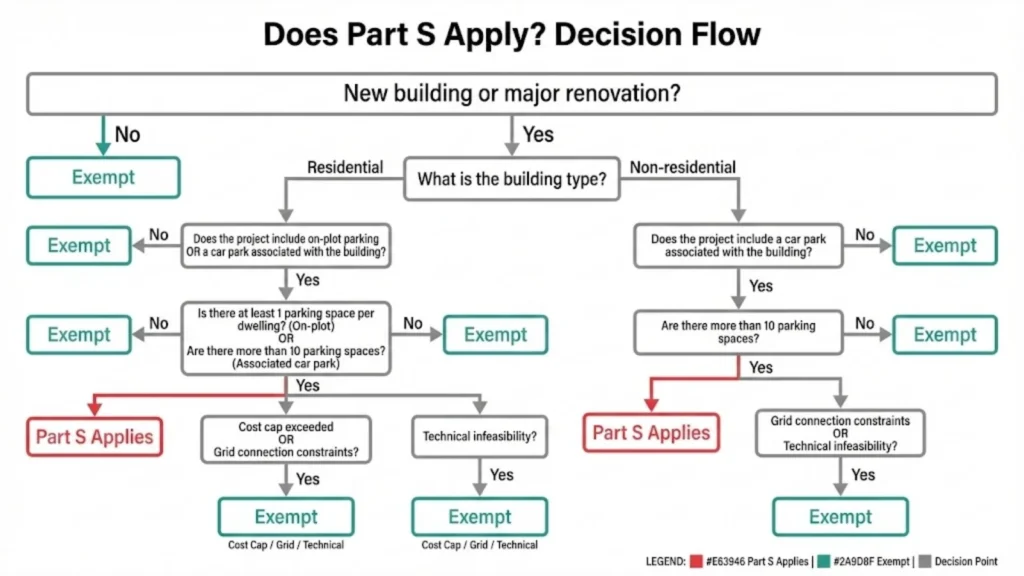
Part S of the Building Regulations 2010 sets out infrastructure requirements for EV charging in new developments. The rules vary depending on building type and parking provision.
For new residential buildings:
Every new home with associated parking requires at least one 7kW smart chargepoint
“Associated parking” means parking within the site boundary (driveways, designated bays)
Homes without parking (e.g., city centre flats relying on street parking) are exempt
Major renovations with more than 10 parking spaces trigger the same requirement
For non-residential buildings:
New commercial buildings with more than 10 spaces require one chargepoint and cable routes for 20% of spaces
Existing commercial buildings with more than 20 spaces must install one chargepoint by 2025
Exemptions:
If grid connection costs exceed £3,600 per chargepoint for new builds
If installation costs exceed 7% of total renovation costs
Historic or listed buildings may qualify for exemptions
The regulation only applies to new builds and major renovations from June 2022 onwards. There’s no retrofit mandate for existing housing stock, though the market is driving voluntary installations as EV adoption grows.
The 18th Edition Connection: Section 722 and Type B RCDs
BS 7671:2018 Amendment 2, published in March 2022, introduced Section 722 specifically covering EV charging installations. This wasn’t coincidence. The regulation and the technical standard arrived together to support Part S implementation.
Section 722 sets out mandatory requirements for EV charging circuits:
Dedicated circuits for each chargepoint
Type A or Type B RCD protection depending on the charger
PEN conductor monitoring (to detect lost neutral connections)
Overcurrent protection appropriate to the load
Cable sizing for sustained 7kW+ loads
The Type B RCD requirement catches people out. Standard Type A RCDs (the ones protecting most UK socket circuits) can’t handle DC fault currents from EV charging. DC current can saturate the RCD’s magnetic core, preventing it from tripping during a fault.
Type B RCDs detect both AC and DC faults. They cost £150-£200 versus £30-£40 for Type A, but they’re non-negotiable for EV installations unless the charger has built-in DC fault protection (many modern smart chargers do).
Without proper 18th Edition Wiring Regulations knowledge, particularly Amendment 2 changes, you can’t install EV chargers to code. It’s not about bolting a box to a wall. It’s about understanding protection devices, earthing systems, and how a 7kW continuous load integrates with existing circuits.
That’s why training providers emphasise 18th Edition as a prerequisite before EV-specific courses. You need the foundation before you specialise.
Why Consumer Units Often Need Upgrading
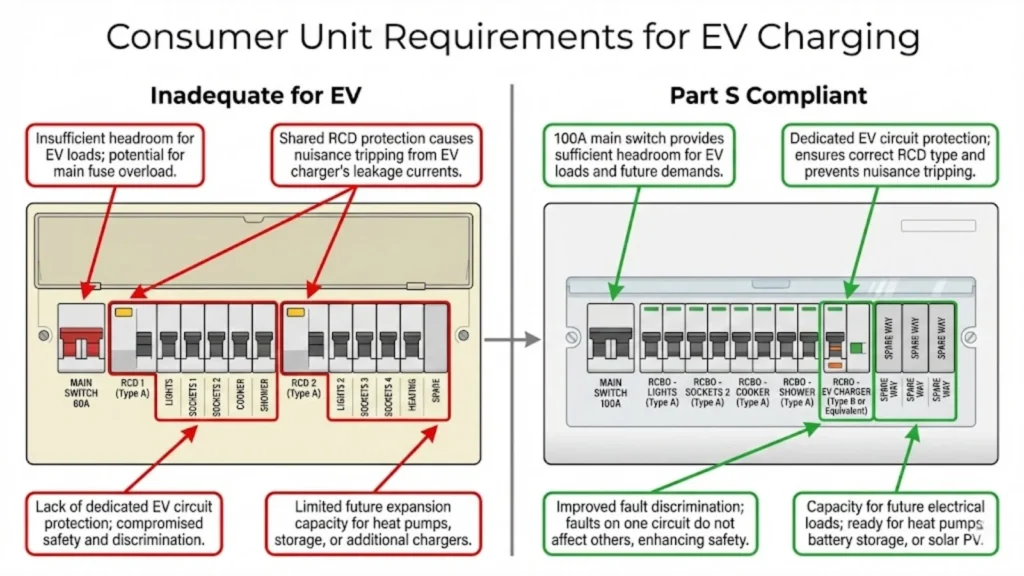
Most EV charger installations hit the same bottleneck: the existing consumer unit wasn’t designed for it.
A 7kW EV charger draws roughly 30 amps continuously for several hours. Compare that to a kettle (13A for 3 minutes) or an oven (16A intermittently). It’s sustained load, not peak demand, that stresses older consumer units.
Common issues:
- No spare ways: The board is full, no space for the dedicated EV circuit
- Inadequate main switch: 60A or 80A main switches can’t support EV charging alongside existing loads
- Old RCD protection: Dual-RCD boards with everything on two RCDs create nuisance tripping
- Poor condition: Boards from the 1980s-1990s often have brittle plastic, corroded busbars, or loose connections
Part S doesn’t explicitly mandate consumer unit upgrades, but Section 722 compliance often requires it. That’s where the conversation with homeowners or developers becomes critical.
For new builds, developers specify modern RCBO-protected consumer units from the start, making EV integration straightforward. For retrofits, you’re explaining to a homeowner why their £1,000 charger install requires a £600 consumer unit upgrade first.
Electricians who can explain this clearly, without over-complicating, win the work. Those who can’t lose customers to cheaper quotes that ignore compliance.
The Training Pathway: What You Actually Need
Being a “qualified electrician” isn’t enough. Part S compliance requires demonstrable competence in EV charging installation, which means specific qualifications and scheme membership.
Foundation qualifications:
You can’t install EV chargers without proper electrical qualifications. The baseline is NVQ Level 3 in Electrical Installation, 18th Edition Wiring Regulations, and AM2 assessment. These prove you’re a competent electrician.
EV charging courses don’t replace electrical training. They build on it.
Thomas Jevons, Head of Training (20+ years), Elec Training
"You need NVQ Level 3 and 18th Edition before you even think about EV charging courses. The C&G 2921 builds on that foundation - it's not a shortcut to becoming an electrician. Employers want the full package: competent electrician first, EV specialist second."
Thomas Jevons, Head of Training
EV-specific qualification:
City & Guilds 2921-31 (Level 3 Award in the Installation of Electric Vehicle Charging Equipment) is the industry standard. It covers:
Part S Building Regulations requirements
BS 7671 Section 722 compliance
Smart charging functionality and grid integration
Load management and diversity calculations
DNO notification procedures
Chargepoint commissioning and handover documentation
The course typically runs 2-3 days and includes practical assessment. You need existing electrical qualifications to enrol.
Competent Person Schemes (NICEIC, NAPIT, STROMA) require proof of EV competence before allowing members to self-certify installations. C&G 2921-31 provides that proof.
OZEV approval:
If you’re installing chargers for homeowners claiming grant funding, you need OZEV (Office for Zero Emission Vehicles) approval. This involves scheme membership (NICEIC/NAPIT/etc.) plus evidence of EV competence.
OZEV-approved installers access the Electric Vehicle Chargepoint Grant (formerly EVHS), worth £350 per domestic installation. Without approval, homeowners pay full price, and you lose competitive advantage.
What to avoid:
“EV installer in a day” courses targeting non-electricians. These promise quick qualifications but can’t deliver competence. You cannot legally sign off electrical work without proper qualifications, scheme membership, and insurance.
Short courses have value as CPD for qualified electricians, but they’re not entry routes to the trade.
New Build vs Retrofit Work: Where the Money Sits
The EV charging market splits into two distinct segments: new build developer contracts and domestic retrofits. Both offer opportunities, but the work, rates, and challenges differ significantly.
New build work:
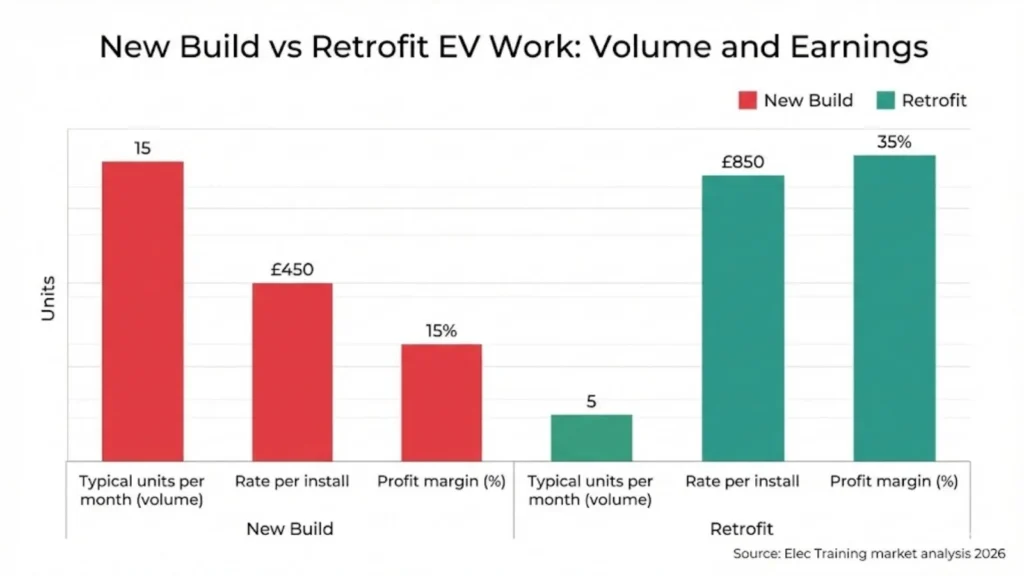
Volume contracts with housebuilders (10-100+ units per site)
Standardised installs using developer-specified chargers
Fixed-price contracts, typically £300-£500 per unit
Work scheduled during second-fix electrical stage
Requires coordination with site managers and DNO applications for multiple units
Steady workflow but competitive tendering
Retrofit work:
Individual homeowner installs
Customer chooses charger (often based on your recommendation)
Higher rates, £600-£1,200 per domestic install
Includes site survey, consumer unit assessment, installation, testing, and commissioning
Customer education needed (explaining costs, timescales, grant eligibility)
Less predictable workflow but better margins
Joshua Jarvis, Placement Manager, Elec Training
"New builds offer volume and consistency, but retrofit work pays better - £600-£1,200 per domestic install versus £300-£500 on developer contracts. The challenge is customer education: explaining why their 1980s consumer unit needs replacing before we fit the charger."
Joshua Jarvis, Placement Manager
Most electricians working in EV charging do both. New build contracts provide baseline income, while retrofit jobs boost overall earnings.
The key skill isn’t just installation – it’s customer communication. Homeowners don’t understand DNO notifications, load management, or why their existing board can’t support EV charging. Electricians who explain clearly without patronising win repeat business and referrals.
Smart Charging and DNO Coordination
Part S doesn’t just require chargers – it requires smart chargers. Every new installation must meet the Electric Vehicle (Smart Charge Points) Regulations 2021, which mandate:
Off-peak charging defaults (avoiding 8am-11am and 4pm-10pm peaks)
Randomised delay functions to prevent grid stress from simultaneous charging
Remote access capabilities for network operators during emergencies
Cybersecurity protections (unique credentials, tamper detection)
Users can override these defaults, but the charger must default to grid-friendly behaviour. This isn’t about controlling drivers – it’s about preventing local transformer overload when multiple homes on the same street charge simultaneously.
DNO notification:
Distribution Network Operators (DNOs) manage local electricity grids. They need to know about new EV charging installations to assess capacity and plan upgrades.
For single domestic installs, most DNOs accept post-installation notification via their online portals. For multiple units (e.g., new housing developments), you need prior approval before starting work.
The DNO application process can take 6-12 weeks for large sites. Developers who don’t factor this into construction timelines face delays at practical completion. Electricians coordinating DNO applications add value beyond basic installation.
In areas with constrained grid capacity (common in rural locations or older urban networks), the DNO may require load management systems that limit charging during peak times or when other high-load appliances are running. These systems add cost but ensure the installation doesn’t overload the local network.
Birmingham and West Midlands context:
National Grid Electricity Distribution covers the West Midlands. They’ve invested in EV-ready infrastructure, including 182+ EV charging bays at substations, but capacity varies by location.
New build sites in Birmingham’s city centre redevelopment zones (20,000+ homes targeted by 2040) generally have good grid capacity. Developments in Sutton Coldfield, Solihull, or rural Staffordshire may face longer DNO approval times and upgrade costs.
Electricians working across the region need to understand which postcodes have capacity constraints and build DNO coordination into their quotes and timelines.
Tools and Testing Equipment for EV Work
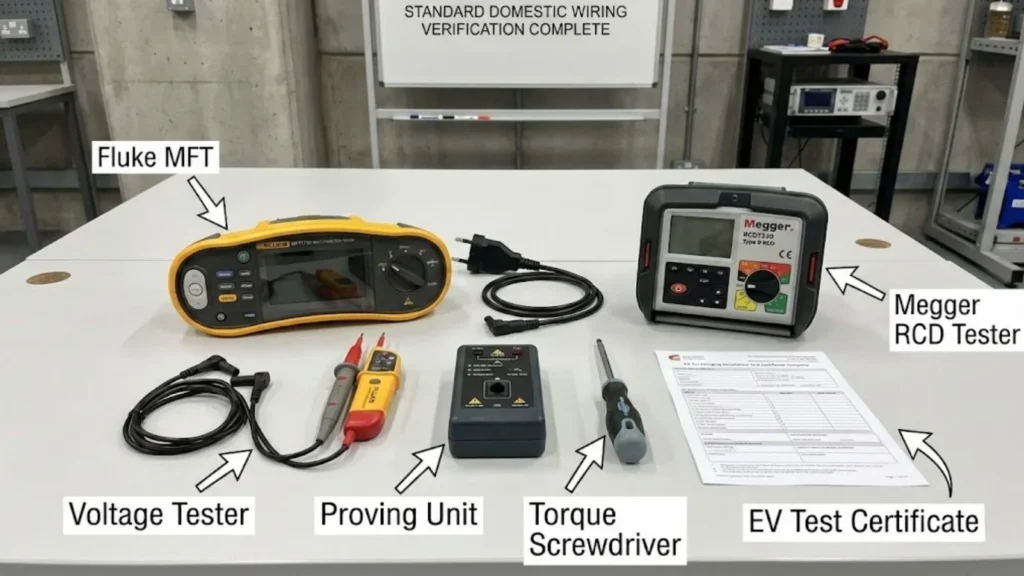
Standard electrical tools cover most EV installation work, but testing and commissioning require specific equipment.
Essential tools:
Multifunction tester (e.g., Fluke 1664 FC, Megger MFT1741+) for insulation resistance, earth loop impedance, and RCD testing
Type B RCD tester (essential for verifying DC fault detection)
Voltage tester and proving unit
Cable installation tools (SWA glands, conduit benders for surface runs)
Torque screwdrivers (for terminal tightness verification)
Documentation and software:
EV-specific test certificates (many competent person schemes provide templates)
Chargepoint commissioning software (often manufacturer-specific apps)
DNO notification portal access
Building Control notification systems
The testing regime for EV circuits is more rigorous than standard socket circuits due to the sustained high load and safety-critical nature of the installation. Section 722 requires specific tests beyond standard domestic wiring verification.
Market Reality: Demand, Earnings, and Challenges
EV charging work exists, but it’s not guaranteed riches. The market has matured since Part S came into effect, with both opportunities and constraints now visible.
Where demand actually sits:
New build residential (primary market, 180,000+ homes annually)
Domestic retrofits (market-driven, approximately 50,000-70,000 installs annually)
Commercial premises (workplace charging mandates driving steady demand)
Fleet charging (delivery companies, taxi firms, local authority vehicles)
Earnings potential:
PAYE electricians with EV competence: £2,000-£5,000 annual premium over standard electrical roles
Self-employed retrofit specialists: £600-£1,200 per domestic install, £300-£500 per new build unit
Commercial installers: day rates £250-£400 depending on project scale and complexity
These figures reflect reality, not recruitment hype. EV competence boosts earning potential, but it doesn’t replace core electrical skills or guarantee work.
Actual challenges:
DNO delays: Grid connection approvals can take 3-6 months for large sites
Grid capacity constraints: Some areas require expensive network upgrades before installations proceed
Consumer unit upgrades: Retrofit installs often cost more than quoted due to unforeseen electrical work
Smart charger complexity: Multiple manufacturer platforms, varying commissioning procedures
Cost sensitivity: Homeowners baulk at £1,500+ total costs when they expected £500
Electricians who can navigate these challenges – explaining costs clearly, managing DNO applications efficiently, recommending appropriate equipment – build sustainable EV businesses. Those who underbid to win work struggle when unforeseen issues arise.
Green Technology Integration: Solar, Storage, and V2G
EV charging doesn’t exist in isolation. It’s part of wider home energy systems increasingly including solar PV, battery storage, and smart controls.
Solar PV and EV charging:
Homeowners with solar panels can charge vehicles using generated electricity, reducing grid reliance and energy costs. This requires:
Excess solar generation during daylight hours (when vehicles are often away)
Smart charging systems that prioritise solar power when available
Battery storage to capture solar energy for evening/overnight charging
The business opportunity: offering combined solar PV and EV charger installations positions you ahead of electricians selling individual components. Customers buying EVs are already environmentally conscious, making them prime candidates for solar retrofits.
Battery storage:
Home battery systems (e.g., Tesla Powerwall, GivEnergy) store excess solar or off-peak grid electricity. EVs can then charge from stored energy, avoiding peak rates and maximising renewable usage.
Installing battery storage requires additional competence (G98/G99 grid connection approvals, DNO notifications, specific protection requirements), but it significantly increases project value.
Vehicle-to-Grid (V2G) and Vehicle-to-Home (V2H):
Emerging technology allows EVs to discharge stored energy back to the grid or power homes during outages. V2G-capable chargers cost more but future-proof installations as the technology matures.
Current V2G adoption is limited (only certain vehicle models support it), but electricians understanding the technology will lead the market as it grows.
The key insight: customers installing EV chargers today will likely add solar, storage, or smart home systems within 3-5 years. Electricians offering whole-system design and installation capture that future work rather than competing for individual retrofit jobs.
What This Means for Electricians in 2026
Part S has been law for nearly four years. The initial implementation phase is over. This is now standard electrical work, not emerging opportunity.
For qualified electricians:
Add C&G 2921-31 and join a competent person scheme if you haven’t already. The work exists, but it requires demonstrable competence.
For trainees and career changers:
Don’t skip the foundation. Complete NVQ Level 3, 18th Edition, and AM2 before specialising in EV work. The market wants competent electricians who can install chargers, not “EV specialists” who can’t wire a socket circuit properly.
For contractors:
Build relationships with DNOs and local housebuilders. EV work scales when you can handle 20-50 unit developments, not just individual installs.
For all electricians:
Understand consumer unit capacity, Section 722 requirements, and customer communication. These skills differentiate competent installers from those winging it.
The earning potential is real. The demand is real. But the hype around “easy money” from EV charging was always oversold. This is skilled electrical work requiring proper training, equipment, and customer management.
Get the qualifications. Understand the regulations. Explain things clearly to customers. That’s how you build a sustainable EV installation business.
EV chargers became mandatory in new-build homes with parking on June 15, 2022. Part S isn’t a proposal – it’s law, and it’s been driving electrical work for nearly four years.
For electricians, the pathway is clear:
Complete NVQ Level 3 and 18th Edition (foundation qualifications)
Add C&G 2921-31 EV charging competence
Join a competent person scheme (NICEIC, NAPIT, STROMA)
Apply for OZEV approval if targeting grant-funded residential work
Coordinate DNO applications and understand local grid capacity
Communicate consumer unit requirements clearly to customers
New builds provide volume. Retrofits provide margins. Commercial work provides scale. Most successful EV installers do all three.
The work exists. The demand is real. But success requires proper qualifications, competent installation, and clear customer communication – not shortcuts or hype.
Call us on 0330 822 5337 to discuss EV charging training pathways, NVQ Level 3 qualifications, and how our in-house recruitment team supports electricians into placements requiring green technology skills. We’ll explain exactly what you need, realistic timelines, and what employers actually want in 2026. No hype. No unrealistic promises. Just practical guidance from people training and placing electricians every day.
References
- The Building Regulations 2010, Part S (Infrastructure for charging electric vehicles) https://www.gov.uk/government/publications/infrastructure-for-charging-electric-vehicles-approved-document-s
- BS 7671:2018+A2:2022 (18th Edition Wiring Regulations), Section 722
- IET Code of Practice for Electric Vehicle Charging Equipment Installation, 5th Edition https://theiet.org/publishing/iet-standards/buildings-and-infrastructure-publications/
- Office for Zero Emission Vehicles (OZEV) grant scheme guidance https://www.gov.uk/government/collections/government-grants-for-electric-vehicle-chargepoints
- National Grid Electricity Distribution EV connection guidance https://www.nationalgrid.co.uk/connections/new-connections/electric-vehicle-charging-points
Note on Accuracy and Updates
Last reviewed: 20 January 2026. This page reflects Part S Building Regulations as implemented from June 15, 2022, plus subsequent updates to smart charging requirements and grant schemes. Technical requirements reference BS 7671:2018+A2:2022 Section 722. Costs and earnings estimates based on 2026 market rates and may vary by region, project scale, and installer experience.