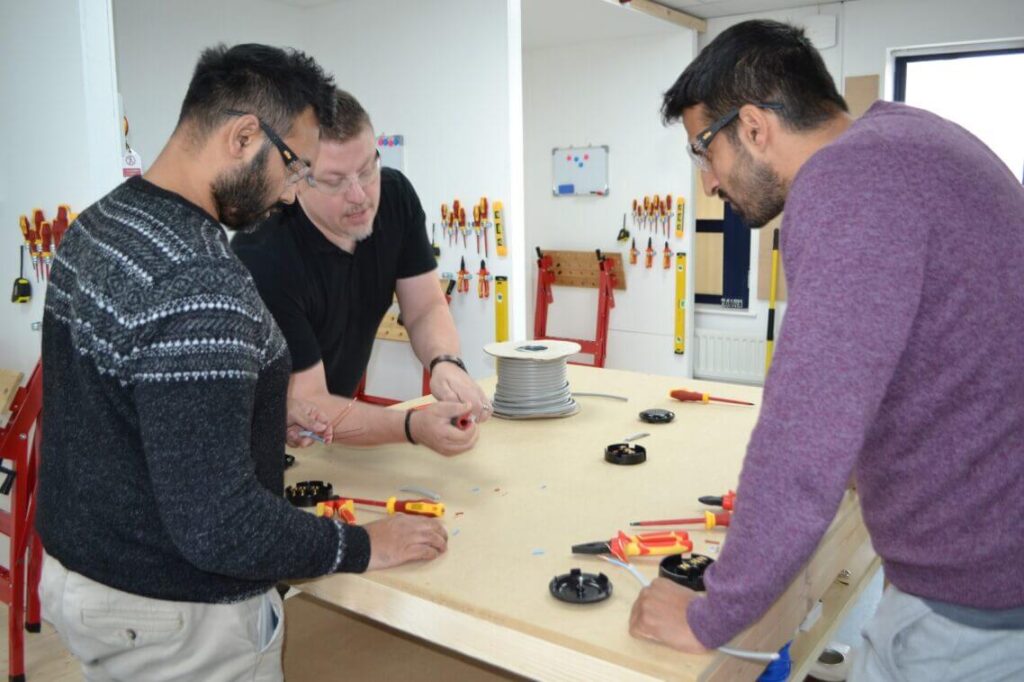

The Physical Demands of Being a Tradesperson: What Career Changers Need to Know Before Training
- Technical review: Thomas Jevons (Head of Training, 20+ years)
- Employability review: Joshua Jarvis (Placement Manager)
- Editorial review: Jessica Gilbert (Marketing Editorial Team)
- Last reviewed:
- Changes: Complete rewrite targeting career changers (30s-50s) considering trades careers. Added comprehensive HSE data (511,000 MSD cases 2024/25, 7.1 million lost working days), trade-specific physical demand profiles across seven trades (bricklaying, carpentry, plumbing, electrical, plastering, roofing, welding), age-specific considerations for late-entry training, realistic desk job comparisons, fitness preparation guidance, and long-term career sustainability strategies.
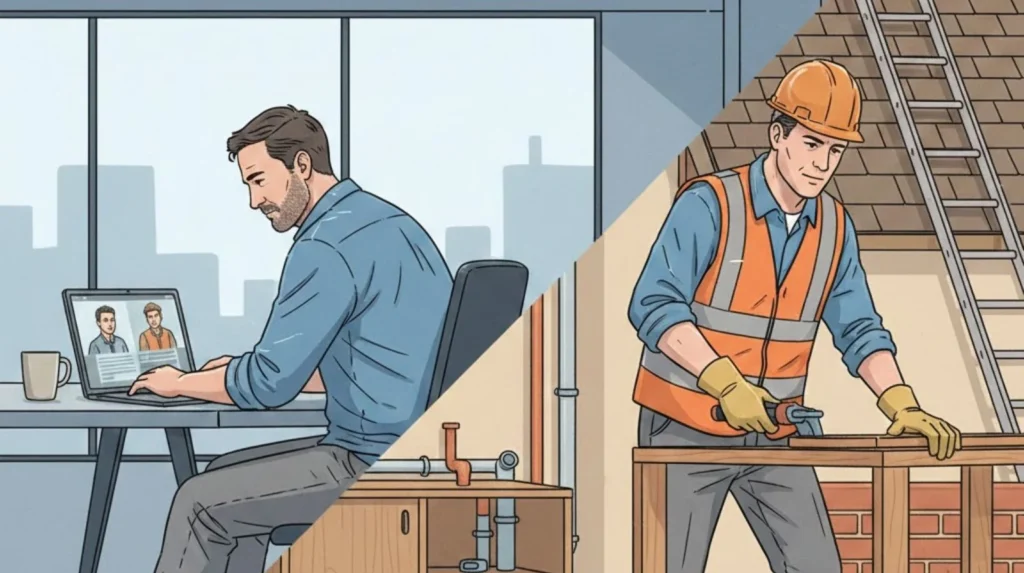
You’re 38, sat in another pointless Teams meeting, and you’ve just realised you’ve spent the last hour discussing a spreadsheet about a presentation about a strategy document. Again. The office heating’s too high, the coffee’s terrible, and you’re staring at the same four walls you’ve been staring at for a decade. You’re thinking, maybe, just maybe, a trade career makes sense. Work with your hands, see tangible results, earn decent money, avoid corporate nonsense.
Here’s what nobody tells you in the romantic version of that story: your body is about to have opinions. Strong opinions. Loud opinions. Especially if you’re coming from a desk job in your 30s, 40s, or 50s.
This isn’t a “trades are too hard, stay in your lane” article. UK trades are crying out for skilled people, career changers bring valuable life experience employers actually want, and thousands of people successfully transition from office work to manual trades every year. But if you’re going to make that jump, you need to understand what you’re signing up for physically, not just financially or professionally. Because the trades will test your body in ways your gym routine hasn’t prepared you for, and the physical demands don’t care about your desk job qualifications.
According to HSE data from 2024/25, approximately 511,000 UK workers suffered from work-related musculoskeletal disorders (MSDs), representing 27% of all work-related ill health. Construction and manual trades consistently show higher rates than the national average. These aren’t just statistics, they’re careers shortened, earnings lost, and bodies that aged faster than they should have. But they’re also largely preventable if you go in with realistic expectations, proper preparation, and smart long-term thinking.
If you’re considering a trade career as someone who’s spent years behind a desk, this is the honest conversation about what your body will actually experience across different trades, what you can do to prepare, and why age isn’t necessarily the barrier you think it is (though it does require more strategic planning than it would for an 18-year-old).
The Desk Job to Trades Transition: What Actually Changes
The Environmental Reality
Office work has conditioned you for climate control, ergonomic chairs, toilets 20 metres away, and lunch breaks at tables. Trade sites operate differently:
Temperature extremes: No heating in winter (working in 2°C lofts pulling cable), no air conditioning in summer (40°C roof spaces in July)
Facilities: Portaloos 100 metres from your work area, no sink to wash your hands before eating lunch standing up
Comfort: You’re kneeling on concrete, crouching in cupboards, lying in crawl spaces, reaching overhead for hours, not sitting in a £400 Herman Miller chair
Weather exposure: Rain, wind, cold penetrating through multiple layers because you’re static doing detailed work, not moving
The physical work is one thing. The environmental conditions amplify it. Your body burns more energy just maintaining core temperature. Muscles fatigue faster in cold conditions. Dehydration happens quicker in heat when you’re wearing full PPE. It’s cumulative strain you haven’t experienced since (if ever) manual labour in your teens or twenties.
The Movement Pattern Shift
Desk jobs involve:
Sitting 6-8 hours daily
Minimal lifting (laptop, coffee cup, occasionally moving chairs)
Repetitive fine motor (typing, mouse clicking)
Static postures with occasional standing
Trade work involves:
Standing, kneeling, crouching, crawling 8-10 hours daily
Frequent lifting (10-30kg loads, some heavier with team lifts)
Repetitive gross motor and fine motor (drilling, screwing, sawing, cable termination)
Constantly changing postures, often awkward or constrained
Your cardiovascular system, joints, muscles, tendons, and connective tissue need to adapt to completely different demands. A 38-year-old body can absolutely do this, but it won’t happen in the first week. It takes months of progressive adaptation, and most career changers don’t give themselves that runway because they’re financially pressured to be productive immediately.
The Cumulative Load Reality
The HSE reports that work-related MSDs led to 7.1 million lost working days in 2024/25, with an average of 19.1 days lost per case. For the self-employed (which many tradespeople become), that’s not sick pay, that’s zero income for three weeks.
The injuries that end careers aren’t typically acute (dropping something on your foot, falling off a ladder). They’re cumulative strain that builds over months and years:
Lower back pain from repeated lifting with slight twisting
Knee cartilage degradation from hours of kneeling daily
Shoulder tendinopathy from repetitive overhead work
Wrist and hand issues from vibration exposure and forceful gripping
Neck strain from sustained awkward postures
Career changers entering at 35-40 are starting this accumulation later than 18-year-old apprentices, but they’re also entering with bodies that may already have some wear from desk work posture issues, lack of conditioning, or previous injuries. The advantage is life experience and body awareness. The disadvantage is less physiological adaptability than younger bodies and more financial pressure to push through pain.
Trade-Specific Physical Demands: What Each Trade Actually Requires
Thomas Jevons, Head of Training at Elec Training with over 20 years in the industry, explains the reality career changers face:
"Each trade has a different physical profile. Electricians need shoulder mobility and grip strength for overhead conduit work and cable termination. Plumbers face more confined space work and heavy lifting with boilers and cylinders. Bricklayers are pure repetitive strain, thousands of lifts per day with poor ergonomics. Plasterers work overhead constantly with materials that never get lighter. Career changers need to understand what their chosen trade actually demands before committing to training, not just the romanticised version."
Thomas Jevons, Head of Training
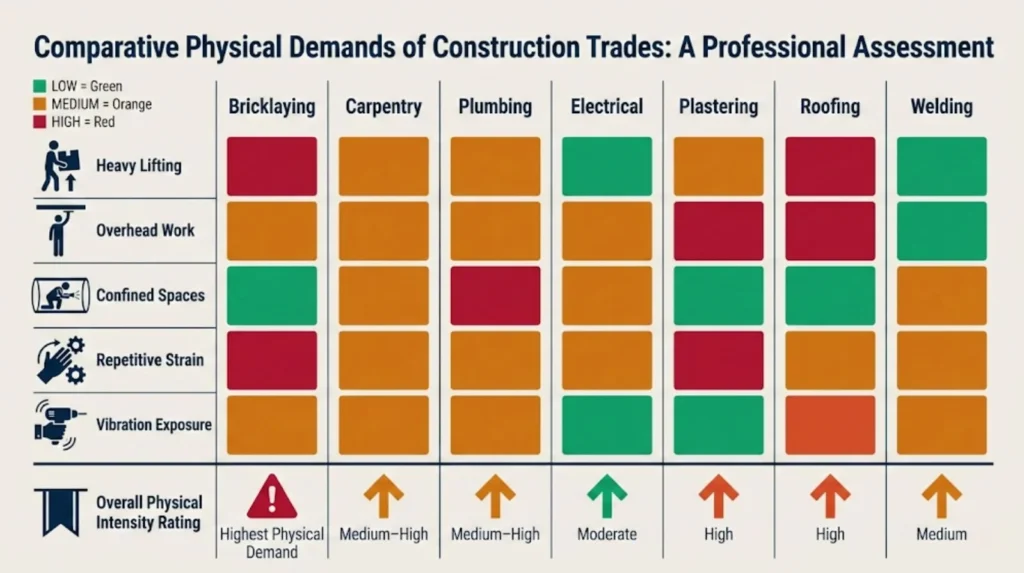
Here’s the breakdown across seven major UK trades:
1. Electrical Installation
Primary Physical Demands:
Overhead work: Installing lighting, trunking, conduit systems requires sustained reaching above shoulder height
Fine motor repetition: Cable stripping, terminal connections, testing procedures involve thousands of repetitive hand and wrist movements
Awkward postures: First-fix in lofts, under floors, in cupboards often in restricted spaces
Ladder work: Frequent climbing carrying tools and materials
Grip strength: Tightening connections, pulling cable through containment systems
Key Risk Areas:
Shoulder strain and rotator cuff issues from overhead work
Wrist tendinopathy and carpal tunnel from repetitive fine motor tasks
Knee pain from extended periods working at low levels (socket installations, skirting circuits)
Lower back strain from working in confined spaces and carrying cable reels
Age Considerations: Electrical work is less heavy-lifting intensive than some trades, but the fine motor precision and sustained awkward postures make it challenging for bodies not conditioned for it. A 42-year-old career changer with decent fitness can absolutely succeed, but shoulder mobility and hand strength need attention. Electricians with 20+ year careers typically move toward testing, inspection, or design work as they age to reduce the overhead installation burden.
2. Plumbing and Domestic Heating
Primary Physical Demands:
Confined space work: Under sinks, in airing cupboards, crawl spaces, loft tanks
Heavy lifting: Boilers (50-100kg team lifts), cylinders (30-50kg), copper pipe bundles
Sustained kneeling: Pipework under baths, kitchen units, floor-level installations
Torso twisting: Working in tight spaces requires rotation while applying force
Wet and dirty conditions: Water exposure, drainage work, potentially unsanitary environments
Key Risk Areas:
Knee cartilage damage from prolonged kneeling on hard surfaces
Lower back strain from twisting while lifting or working in constrained positions
Shoulder issues from overhead pipework in tight ceiling voids
Respiratory exposure to mould, stagnant water, occasionally asbestos in older properties
Age Considerations: Plumbing is physically demanding with significant lifting and confined space challenges. Career changers in their 30s-40s need strong core stability and joint mobility. The work is harder on knees than most trades. Many plumbers transition to maintenance contracts or specialise in areas like renewables (heat pumps, solar thermal) as they age to reduce the heavy installation workload.
3. Carpentry and Joinery
Primary Physical Demands:
Heavy lifting: Timber sheets, joists, door frames, staircases
Vibration exposure: Circular saws, sanders, nail guns, routers produce hand-arm vibration
Sustained standing: Long periods cutting, measuring, assembling on-site
Precision physical work: Fine adjustments requiring steady hands and spatial control
Varied environments: First-fix framing to second-fix finishing across different site conditions
Key Risk Areas:
Hand-Arm Vibration Syndrome (HAVS) from power tool use leading to permanent nerve and circulation damage
Lower back strain from lifting and manoeuvring heavy timber
Knee issues from kneeling during floor and skirting installation
Dust exposure affecting respiratory health long-term
Hearing damage from sustained power tool noise
Age Considerations: Carpentry combines heavy physical work with fine precision skills. Career changers need good overall fitness and must manage vibration exposure carefully from the start. Many carpenters specialise (kitchen fitting, bespoke joinery, restoration) to focus on areas matching their physical capabilities. Bench joinery offers less physically demanding work than site carpentry but typically lower income.
4. Bricklaying and Trowel Trades
Primary Physical Demands:
Extreme repetitive strain: Laying 300-500 bricks daily, each requiring lift, position, tap, and mortar application
Heavy sustained work: Constant lifting of bricks (3-4kg each), blocks (heavier), mortar loads
Bent posture: Working at low levels (foundations, DPC) then progressively higher
Weather exposure: Outdoor work in all conditions, can’t brick in frost or heavy rain but exposed while prepping
Material handling: Moving pallets of bricks, bags of cement, constant resupply
Key Risk Areas:
Lower back disorders from repeated bending and lifting with poor ergonomics
Shoulder and arm strain from sustained repetitive motion
Knee problems from kneeling and working at various heights
“Bricklayer’s elbow” (lateral epicondylitis) from repetitive trowel work
Cement dermatitis and respiratory issues from mortar dust
Age Considerations: Bricklaying is arguably the most physically demanding trade in terms of sustained repetitive load. Career changers entering in their 30s-40s face significant challenges. The work is relentless, and productivity expectations don’t adjust for age. Many older bricklayers move to supervisory roles, estimating, or site management because the physical toll becomes unsustainable.
5. Plastering, Painting and Decorating
Primary Physical Demands:
Overhead work: Ceiling plastering and painting requires sustained reaching with loaded tools
Repetitive arm motion: Applying plaster, sanding, painting involves thousands of strokes
Material weight: Hawk and trowel loaded with plaster held at chest height for extended periods
Ladder and scaffold work: Constant position changes, working at height
Fine motor control: Finish work requires precision despite fatigue
Key Risk Areas:
Shoulder and upper back strain from overhead work and holding loaded hawks
Repetitive strain injuries in wrists and elbows from trowelling and sanding
Lower back issues from bending, reaching, and material handling
Respiratory problems from plaster dust, paint fumes, sanding particulates
Knee pain from kneeling during skirting and low-level detail work
Age Considerations: Plastering is brutally hard on shoulders and upper body. The materials don’t get lighter as you age. Many plasterers focus on smaller domestic work or decorating only (less overhead strain) as they get older. Painting and decorating is less physically demanding than plastering but still requires significant ladder work and overhead reaching. Career changers in 40s-50s often find decorating more sustainable than plastering.
6. Roofing, Fenestration and Insulation
Primary Physical Demands:
Sustained height work: Full days on roofs, scaffolding, or working from elevated platforms
Weather exposure: Wind, rain, sun, temperature extremes with limited shelter
Heavy lifting: Roof tiles, battens, insulation rolls, window frames at height
Balance and coordination: Working on pitched roofs requires constant proprioceptive control
Crawl space work: Loft insulation involves confined, dusty, often overheated environments
Key Risk Areas:
Fall risks from height (acute hazard, not cumulative)
Lower back strain from lifting at awkward angles on slopes
Knee damage from working on pitched surfaces and crawling
Heat stress in summer when working in roof voids
Respiratory issues from insulation fibres and dust
Shoulder strain from overhead work installing soffits, fascias, and guttering
Age Considerations: Working at height requires confidence, balance, and physical capability that may decline with age. Career changers in 40s-50s face higher insurance costs and employer hesitation around height work. Fenestration (window and door installation) offers similar work with less sustained height exposure. Many roofers transition to estimating, project management, or ground-level trades as they age.
7. Welding and Fabrication
Primary Physical Demands:
Sustained awkward postures: Welding in position requires holding body still while manipulating equipment
Heavy lifting: Steel sections, fabricated components, raw materials
Fine motor control: Precise torch and rod control despite physical fatigue
Heat exposure: Working near molten metal, often in protective gear that limits cooling
Vision strain: Detailed work through welding masks
Key Risk Areas:
Lower back strain from sustained static postures and lifting steel
Shoulder and neck issues from holding awkward positions during welding
Hand-arm vibration from grinders and cutting equipment
Respiratory exposure to welding fumes (long-term risk)
Eye strain and potential damage despite PPE if procedures not followed
Burns and heat stress
Age Considerations: Welding combines precision skill with physical demands. Career changers with good vision, steady hands, and reasonable fitness can succeed. The work is less about cardiovascular fitness and more about strength, stability, and tolerance for uncomfortable positions. Many welders specialise (TIG, MIG, specific materials) and move toward inspection, NDT (non-destructive testing), or workshop roles rather than site fabrication as they age.
The Age Factor: What Changes When You Start at 35, 42, or 51
Physiological Realities
Your body at 38 is not your body at 18. That’s not inherently bad, but it requires acknowledgment:
Recovery takes longer: Muscle soreness from new physical demands persists longer, requiring more attention to sleep, nutrition, and active recovery
Injury risk changes: Younger workers face more acute injuries from poor technique; older workers face more cumulative strain from existing wear and previous injuries
Adaptation is slower: Building cardiovascular capacity, strength, and movement patterns takes more time and consistency
Pre-existing issues matter: That dodgy knee from football 15 years ago, the lower back that occasionally flares up, the shoulder that clicks, these will all be tested
The Advantages Career Changers Bring
It’s not all downside. Career changers in their 30s-50s have significant advantages:
Body awareness: You understand pain signals better and (hopefully) seek help earlier rather than pushing through
Financial resources: You can invest in quality tools, proper PPE, ergonomic equipment, and private physiotherapy if needed
Life skills: You communicate better with clients, manage time more effectively, and handle business admin that younger apprentices struggle with
Motivation: You’ve chosen this deliberately, not defaulted into it, which drives better long-term commitment
What the Data Shows
The HSE statistics don’t separate career changers from lifelong tradespeople, but they do show that construction accounts for around 79,000 cases of work-related ill health annually (averaged over 2022-2024), with MSDs making up over half. Peer-reviewed studies on construction ergonomics suggest that workers entering trades later face:
Higher initial injury rates (first 6-12 months) as bodies adapt
Lower long-term injury rates if they survive the adaptation phase (better self-management)
Different injury profiles (more overuse, less acute trauma)
Earlier career transitions to less physical roles (by choice, not injury-forced)
The key insight: entering trades later doesn’t mean you’ll fail physically, it means you need a more strategic approach than “just get on with it.”
Physical Preparation: What You Should Do Before Starting Training
Joshua Jarvis, Placement Manager at Elec Training, explains what actually works:
"Most career changers don't prepare physically before starting trades training. They assume the work will get them fit, which is like assuming running a marathon will train you for running a marathon. The first weeks on site are when injuries happen because bodies aren't conditioned for the demands. We recommend three months of functional fitness preparation before starting, focusing on movement patterns, grip strength, and cardiovascular base. The people who do this have dramatically lower injury rates and higher completion rates."
Joshua Jarvis, Placement Manager
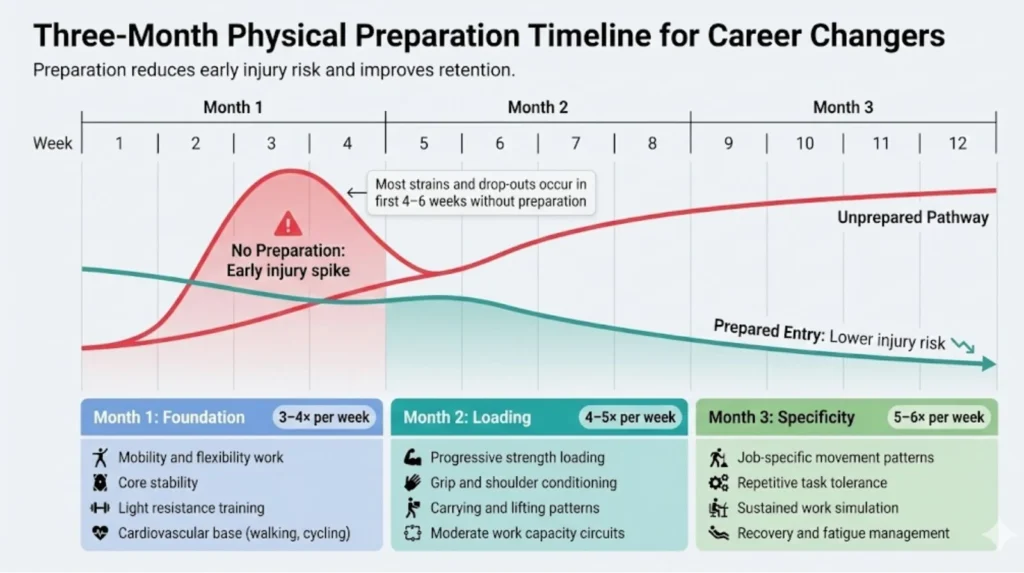
The Three-Month Preparation Protocol
If you’re serious about a trades career, invest three months preparing your body before you start training. This isn’t about looking gym-fit, it’s about functional capability.
Month 1: Foundation Movement Patterns
Squat mobility: Practice bodyweight squats with good form, work toward holding a deep squat for 2-3 minutes (critical for electricians and plumbers)
Hip hinge: Deadlift pattern with light weight, focuses on lower back protection during lifting
Core stability: Planks, side planks, bird dogs focusing on maintaining neutral spine under load
Shoulder mobility: Arm circles, band pull-aparts, doorway stretches to prepare for overhead work
Grip strength: Farmer’s carries, dead hangs from pull-up bar, gripper tools
Frequency: 3-4 sessions weekly, 30-45 minutes
Goal: Establish movement patterns without injury, build baseline work capacity
Month 2: Loading and Conditioning
Progressive overload: Gradually add weight to squats, deadlifts, and overhead pressing
Loaded carries: Carrying awkward objects (sandbags, water jugs) simulating material handling
Cardiovascular base: Walking, cycling, or rowing for 30-45 minutes building work-day stamina
Kneeling tolerance: Practice kneeling positions with knee pads, progressively increasing duration
Grip endurance: Sustained gripping exercises simulating tool use
Frequency: 4-5 sessions weekly
Goal: Build strength and endurance relevant to trade demands
Month 3: Specificity and Testing
Trade-specific simulation: If going into electrical, practice overhead reaching with light loads; plumbing, work in confined positions; carpentry, repeated lifting and carrying
Work day simulation: 6-8 hour day of varied physical activity matching trade patterns
Recovery testing: Assess how your body responds to sustained effort, identify problem areas
Professional assessment: Consider sports physiotherapist or occupational health screening to identify injury risks
Frequency: 5-6 days weekly with active recovery
Goal: Confirm physical readiness and address gaps before starting paid work
What This Actually Costs
Gym membership or basic equipment: £30-£100 monthly
Sports physio screening: £60-£100 one-time
Knee pads, grip trainers, basic equipment: £50-£80
Total investment: £200-£400 over three months
Compare this to the cost of a back injury three weeks into your first placement: lost income, potential training termination, medical expenses, and long-term pain. The preparation is cheap insurance.
Long-Term Career Sustainability: Planning Your Physical Future
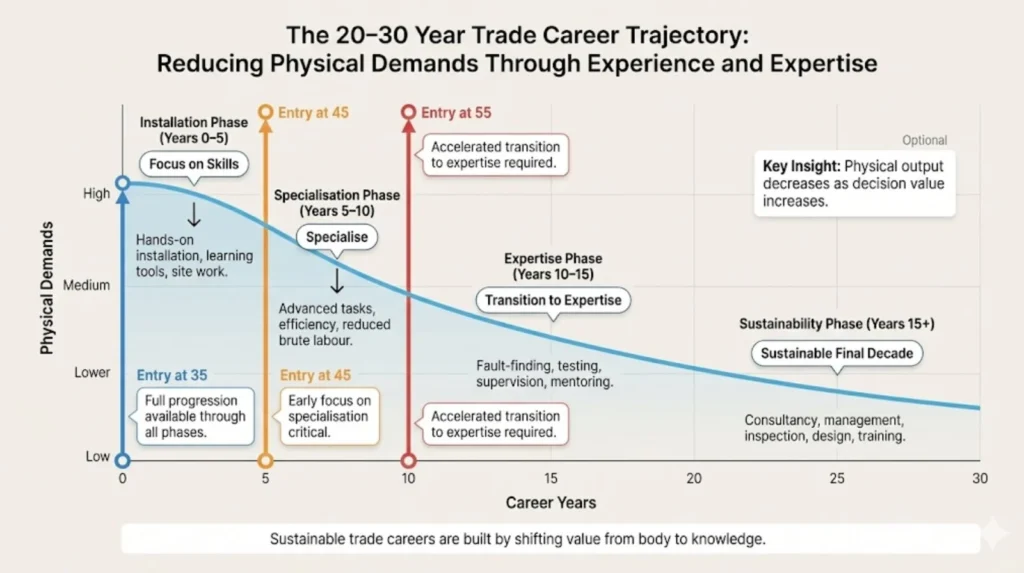
The 20-Year Trajectory
If you enter a trade at 35, you’re planning for 30 years until state pension age (currently 67, likely higher by the time you get there). If you enter at 45, you’re planning for 20+ years. That’s a long time to do physically demanding work.
Successful career changers think strategically about progression:
Years 1-5: Build Skills and Durability
Focus on learning proper technique to minimise physical strain
Invest in quality tools and PPE (good knee pads, ergonomic tools, proper boots)
Build habits around stretching, warm-up, and recovery
Don’t chase maximum productivity at the expense of body mechanics
Years 5-10: Specialise Strategically
Identify less physically demanding specialisations within your trade
For electricians: testing and inspection, EV charging, smart home systems
For plumbers: heat pump installation, maintenance contracts, design
For carpenters: bespoke joinery, restoration, CAD and estimating
Build reputation for quality and reliability, not just speed
Years 10-15: Transition Toward Expertise Roles
Reduce percentage of time doing heavy physical work
Increase supervision, mentoring, training, and consultancy
Consider additional qualifications (NVQ assessor, health and safety, project management)
Use accumulated knowledge to command higher rates for less physical labour
Years 15+: Position for Sustainable Final Decade
Focus on roles leveraging experience rather than physical capability
Estimating, project management, business ownership employing others
Training and assessment work
Specialist consultancy in your niche
This trajectory isn’t about “giving up” on hands-on work, it’s about acknowledging physical reality and planning accordingly. Some people remain physically capable of full-time installation work into their 60s. Most don’t. Planning for the most likely scenario protects your income and quality of life.
The Financial Reality
Career longevity directly affects earnings. According to industry data, fully qualified tradespeople can earn £30,000-£45,000 annually as employees, with experienced specialists and the self-employed potentially earning £45,000-£70,000+. Understanding what electricians actually earn across different experience levels and roles helps with long-term career planning.
But those figures assume you remain physically capable of working. A back injury at 48 that reduces your capacity to work doesn’t just cost you weeks of income, it potentially costs you £100,000-£300,000 in lifetime earnings if it forces early retirement.
Investing in your physical sustainability (proper equipment, conditioning, smart work practices) isn’t optional, it’s the most important business decision you’ll make.
Practical Advice: Day-to-Day Physical Management
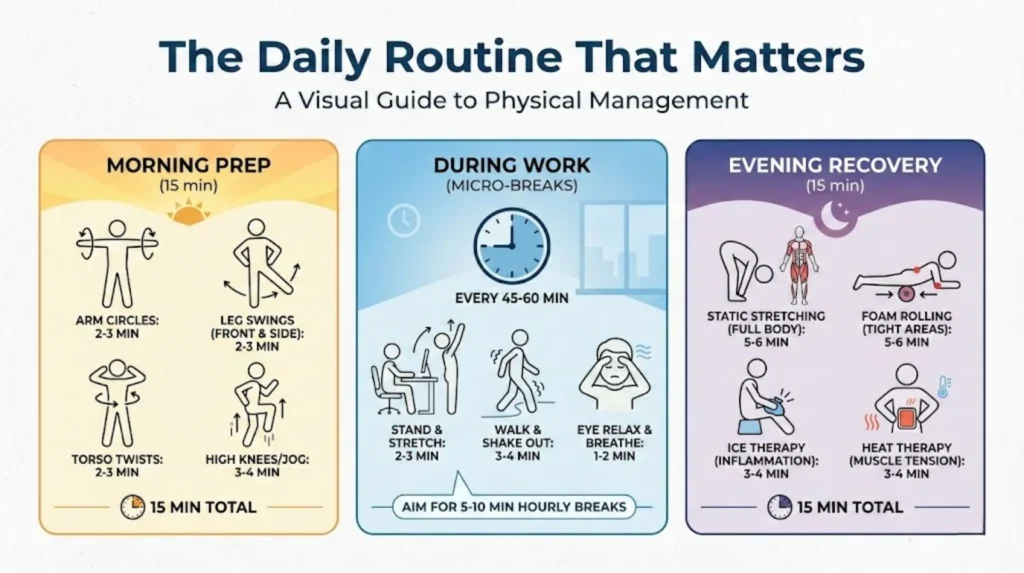
The Daily Routine That Matters
Successful tradespeople treat their bodies like professional athletes treat theirs:
Morning (15 minutes before work):
Dynamic stretching: leg swings, arm circles, torso rotations
Activation exercises: glute bridges, band pull-aparts, wrist circles
Brief cardiovascular warm-up: walk, light jog, cycling to site if possible
During Work:
Micro-breaks every 45-60 minutes: stand up, stretch, shake out hands and shoulders
Proper lifting technique always, even for “light” loads (cumulative strain adds up)
Use mechanical aids wherever possible (trolleys, hoists, team lifts for anything heavy)
Rotate tasks if possible (don’t spend all day in the same position)
Evening (15 minutes post-work):
Static stretching: hold stretches for 30-60 seconds for major muscle groups
Self-massage or foam rolling for particularly tight areas
Ice for any acute pain (20 minutes), heat for chronic stiffness (15-20 minutes)
Weekly:
One dedicated recovery/mobility session (yoga, swimming, gentle stretching)
One strength maintenance session (gym, bodyweight exercises, relevant to your trade demands)
Monitor cumulative strain: track any persistent pain or dysfunction, seek help early
The Equipment That Actually Helps
Not all PPE and tools are created equal. Career changers with financial resources should invest in:
For all trades:
Premium work boots with proper arch support and cushioning (£80-£150, replace annually)
High-quality knee pads designed for your trade, not cheapest option (£40-£100)
Tool belt or vest that distributes weight properly (£60-£120)
Anti-vibration gloves for power tool work (£15-£30, replace every 3-6 months)
Trade-specific:
Electricians: Telescopic tools to reduce overhead reaching, ergonomic strippers and cutters
Plumbers: Adjustable kneeling pads, pipe lifters, trolleys for boiler movements
Carpenters: Anti-vibration handles for power tools, dust extraction equipment
All trades: Site-appropriate seating for breaks (don’t eat lunch standing)
When to Seek Professional Help
Don’t wait for injuries to become chronic. See a professional if:
Pain persists beyond 48 hours of rest
Pain affects sleep or daily activities
You’re changing movement patterns to compensate for pain
You experience numbness, tingling, or weakness
Existing conditions (back, knees, shoulders) flare up repeatedly
Sports physiotherapists, osteopaths, and occupational health specialists understand trade-related injuries. Private appointments cost £50-£80 but can save months of worsening conditions.
The Honest Reality: Should You Do This?
You’re a Good Candidate If:
You understand this will be physically harder than your current work
You’re willing to invest three months preparing your body before starting
You have realistic expectations about income during training and early career
You’re prepared to work on long-term physical sustainability, not just short-term toughness
You’re entering a trade with a strategic plan for 20+ year career progression
You have financial buffer to handle the transition period and potential setbacks
You Should Reconsider If:
You have significant pre-existing physical limitations (chronic back pain, severe arthritis, major joint instability)
You’re entering solely for financial reasons without genuine interest in the work
You expect trades to be “easier” than office work (they’re not, they’re just different)
You’re unwilling to invest in physical preparation and quality equipment
You have no plan for long-term career sustainability beyond “I’ll worry about that later”
Your financial situation can’t handle 6-12 months of reduced income while establishing yourself
The Middle Ground
Most people considering trades as career changers aren’t at either extreme. You’re reasonably fit, willing to work hard, aware it won’t be easy, but uncertain about physical capability. That’s normal.
The answer is almost always: start preparing now, get professional assessment, try the work before committing fully. Many training providers offer short taster courses or weekend workshops. Try the physical work for two days and see how your body responds. If you’re wrecked after eight hours of light physical activity, you need more preparation. If you’re sore but functional, you’re probably ready to start training with proper progression.
For those considering becoming an electrician in the UK, understanding the qualification pathways and training options helps align physical preparation with realistic timelines. Elec Training provides structured electrical training programmes designed for adult learners, including those transitioning from desk-based careers who need support understanding both the technical and physical requirements of the profession.
The physical demands of trades work are real, significant, and career-defining. But they’re not insurmountable for career changers entering in their 30s, 40s, or even 50s. The difference between people who succeed long-term and people who burn out in 18 months comes down to:
Preparation: Conditioning your body before you start, not assuming the work will condition you Investment: Quality equipment and professional support aren’t luxuries, they’re essentials Strategy: Planning 20+ year trajectories that account for physical decline, not just chasing immediate income Realism: Understanding what each trade actually demands before committing to training
The UK needs skilled tradespeople desperately. The industry is losing approximately 210,000 workers to retirement annually while recruiting only 200,000. Career changers represent a critical part of filling that gap. You bring maturity, business sense, client communication skills, and motivation that younger apprentices often lack.
But you also bring bodies that need more careful management than 18-year-olds. That’s not weakness, it’s reality. The tradespeople who build sustainable 20-30 year careers are the ones who respect physical demands, prepare properly, invest in durability, and plan strategically.
If you’re sat in that office right now, still thinking about whether a trade career makes sense, here’s the actual question to ask yourself: Am I willing to invest three months and a few hundred pounds preparing my body before I commit to training? If yes, you’re probably ready to seriously explore trades. If no, you might be chasing an idea rather than committing to a career.
The work is out there. The income is there. The career satisfaction of seeing tangible results and avoiding corporate nonsense is absolutely there. The question is whether you’re willing to do the physical preparation and long-term planning that separates successful career changers from cautionary tales.
Your body will have opinions about this decision. Make sure you’re listening to them before you commit, not after you’re already injured and regretting choices.
References
Tier 1 (Official Legislation, Standards, and Government Data)
HSE Work-related Musculoskeletal Disorders (MSDs) Statistics 2024/25: https://www.hse.gov.uk/statistics/causdis/msd.pdf
HSE Construction Statistics in Great Britain: https://www.hse.gov.uk/statistics/industry/construction.pdf
Manual Handling Operations Regulations 1992: https://www.hse.gov.uk/pubns/books/l23.htm
Work at Height Regulations 2005: https://www.hse.gov.uk/work-at-height/
Construction Skills Network Reports: https://www.citb.co.uk/about-citb/construction-industry-research-reports/
Tier 2 (Industry Reports, Professional Bodies, Academic Research)
CITB Workforce Health and Retention Studies: https://www.citb.co.uk/
British Occupational Hygiene Society (BOHS) Breathe Freely Campaign: https://www.bohs.org/breathe-freely/
Peer-reviewed occupational health literature on MSD risks in construction: https://pmc.ncbi.nlm.nih.gov/articles/PMC11345736/
CDC/NIOSH Construction Industry Ergonomics Resources: https://stacks.cdc.gov/view/cdc/203630/
ECA (Electrical Contractors’ Association) Safety Guidance: https://www.eca.co.uk/
Tier 3 (Forum Patterns, Practitioner Sentiment – Qualitative Signals)
Reddit r/ukelectricians (Physical Demands Discussions): https://www.reddit.com/r/ukelectricians/
Reddit r/UKDIY (Trade Comparison and Physical Reality): https://www.reddit.com/r/UKDIY/
X/Twitter Practitioner Signals (Trade-specific physical complaints and career experiences)
Note on Accuracy and Updates
Last reviewed: 12 January 2026. This guide reflects current HSE statistics for 2024/25 work-related ill health and MSDs in UK construction (511,000 MSD cases, 7.1 million lost working days), current Manual Handling Operations Regulations 1992 and Work at Height Regulations 2005 requirements, and typical physical demands across seven major UK trades as of January 2026. Physical demand profiles are generalised across trades; individual roles within each trade vary significantly (e.g., industrial electrician vs domestic electrician, new-build plumber vs maintenance plumber). Career changer success rates and injury statistics are not tracked centrally by HSE, limiting specific data on age-of-entry physical outcomes. Fitness preparation protocols represent general occupational health guidance, not medical advice; individuals with pre-existing conditions should seek professional assessment. State pension age currently 66-67 depending on birth date, likely to increase by 2040s-2050s.