
How Volunteering Shapes Engineering Soft Skills (And What It Absolutely Doesn’t)
- Technical review: Thomas Jevons (Head of Training, 20+ years)
- Employability review: Joshua Jarvis (Placement Manager)
- Editorial review: Jessica Gilbert (Marketing Editorial Team)
- Last reviewed:
- Changes: Updated for 2026 Skills Builder Framework alignment and EngineeringUK skills gap data
Here’s a question that comes up regularly: does volunteering actually help you become an electrician?
The short answer is no. Volunteering at a food bank won’t teach you how to wire a consumer unit or interpret Zs readings. It won’t get you a JIB Gold Card. It won’t replace your NVQ Level 3 or your 18th Edition certificate.
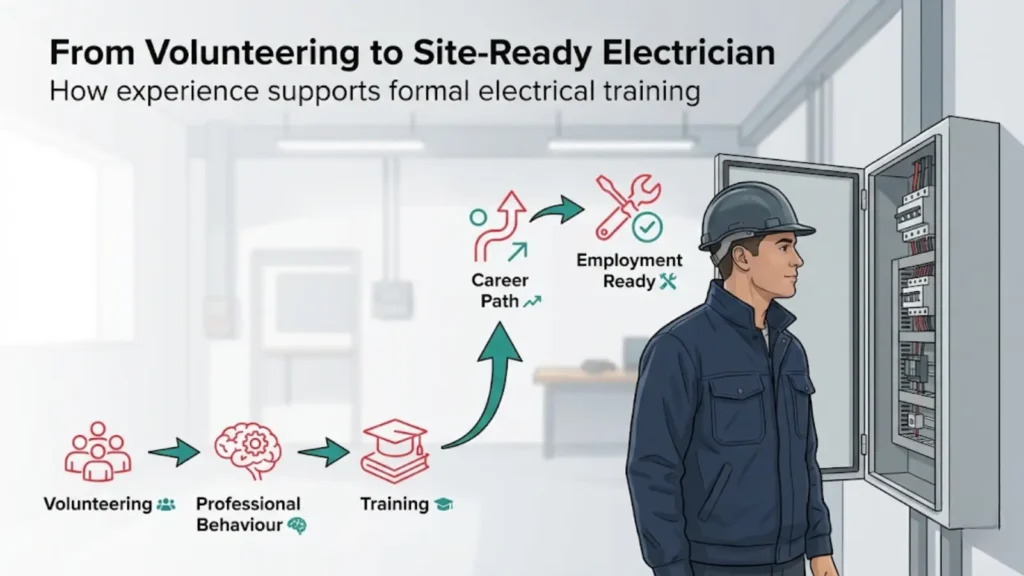
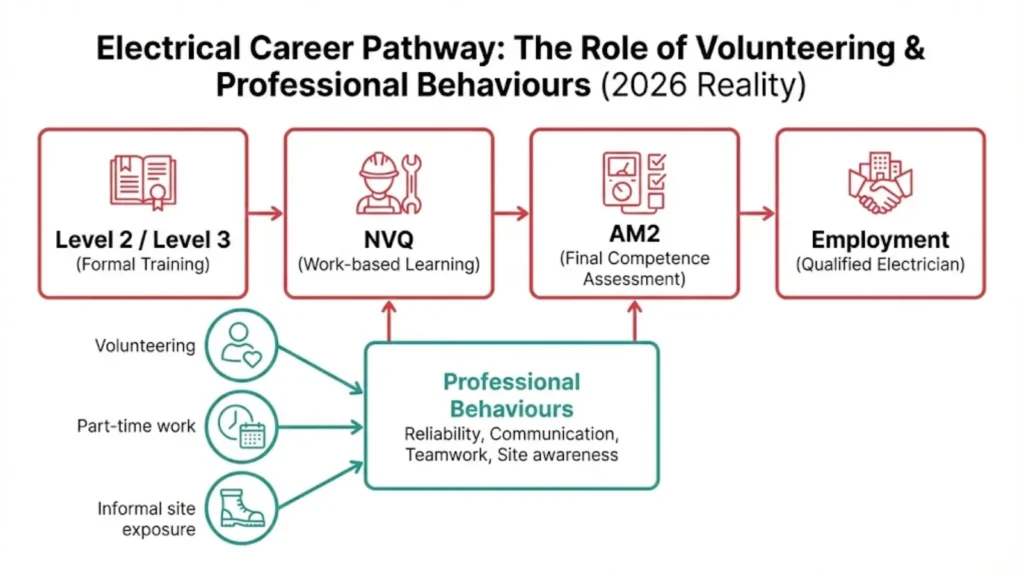
But here’s the longer answer: the skills gap that blocks most people from employability in electrical work isn’t usually technical knowledge. It’s the professional behaviours that technical training doesn’t teach. Reliability. Communication with non-technical people. Understanding site hierarchy. Managing pressure when things go wrong.
Volunteering develops those behaviours. Not always. Not automatically. But when it’s done in the right environments, it builds exactly the operational skills that separate technically qualified learners from genuinely site-ready electricians.
This isn’t about Jaya’s inspirational journey or feel-good volunteering stories. It’s an honest breakdown of what volunteering actually develops, what it absolutely doesn’t replace, and when it makes sense as part of your pathway into electrical work.
Stop Calling Them "Soft Skills" (They're Operational Behaviours)
The term “soft skills” makes them sound optional. Like a nice-to-have. Like personality traits rather than competences.
On a construction site, a communication failure isn’t social awkwardness. It’s a safety incident or a £10,000 mistake. The ability to brief a site manager clearly isn’t “being friendly.” It’s operational competence.
So let’s reframe what we’re actually talking about:
Briefing and debriefing: Can you explain what you did and what remains to be done without the supervisor having to drag information out of you?
Conflict de-escalation: Can you handle a frustrated homeowner or a stressed site manager without making the situation worse?
Resourcefulness under constraints: Can you solve a problem when the “correct” tool isn’t available or the spec doesn’t match site reality?
Accountability without supervision: Can you be trusted to complete a task properly when no one’s checking every termination?
These aren’t corporate presentation skills or networking abilities. They’re the operational behaviours that determine whether you hold employment after the first week, regardless of how well you passed your Level 3 exams.
What Volunteering Actually Develops (The Evidence-Based List)
Let’s be specific about what changes when you volunteer in the right environments.
Communication in Unfamiliar Environments
Volunteering forces you to explain complex tasks to people who don’t have your background or technical knowledge. Community energy projects. Youth mentoring. Coordinating charity builds.
The site parallel? Explaining to a homeowner why their 1960s wiring needs upgrading without causing panic. Coordinating with plasterers who don’t understand electrical first-fix timing. Translating technical issues into language a site manager can use for scheduling decisions.
The Skills Builder Framework identifies “Speaking Level 6+” as the ability to tailor communication to different audiences. Volunteering in public-facing roles builds exactly that competence.
Teamwork Across Mixed Skill Levels
Volunteer projects rarely involve people with identical backgrounds or capabilities. You’re working alongside teenagers, retirees, professionals on their day off, and people with varying physical abilities.
The site parallel? A trainee electrician working alongside a master tradesperson, a site manager, an architect, and labourers from different trades. Understanding how to contribute without either dominating or disappearing. Knowing when to ask questions and when to observe.
The IET Skills Survey consistently identifies “teamworking” as one of the primary gaps in junior recruits. Not because they can’t work with others, but because they struggle with hierarchy and mixed-competence teams.
Accountability and Reliability
This is the big one. Committing to a schedule where others depend on you, without the incentive of a paycheck, builds the “turn-up-and-work” reliability that employers value above almost everything else.
Site parallel? Punctuality for toolbox talks. Being where you’re supposed to be when the delivery arrives. Completing tasks when you said you’d complete them, even when supervision is light.
CIPD research on volunteering consistently shows that the single strongest employability outcome is demonstrated reliability. Not skills. Not knowledge. Proof that you show up.
Problem-Solving with Limited Resources
Community projects operate on tight budgets with donated materials and limited tools. You learn to improvise. To make do. To find workarounds when the “correct” solution isn’t available.
Site parallel? The spark who can solve a problem when the wholesaler’s closed, the spec doesn’t match what’s actually behind the wall, or the budget’s been cut and you need to find a compliant alternative.
This isn’t about cutting corners. It’s about resourcefulness within constraints while maintaining safety and compliance standards.
What Volunteering Absolutely Doesn't Replace
Let’s be brutally honest about limitations, because managing expectations matters. Understanding the full financial investment in electrical work, including tools, equipment, and transport, helps frame volunteering as one component of professional development rather than a substitute for proper qualification pathways.
It doesn’t build technical competence. You cannot volunteer your way to understanding circuit theory, BS 7671 compliance, or safe isolation procedures. You need formal Level 2/3 Diplomas, NVQ assessment, and supervised site experience.
It doesn’t count as site experience. Volunteering at a community centre isn’t the same as working on a live construction site with 110V tools, RAMS documentation, and real consequences for mistakes. The environments aren’t comparable.
It doesn’t grant certifications. No amount of volunteering replaces a CSCS card, an ECS Gold Card, or 18th Edition certification. Employers need proof of competence, not character references.
It doesn’t teach site-specific safety. PPE requirements. Permit-to-work systems. Lockout/tagout procedures. Understanding how main contractors manage multi-trade coordination. These come from actual construction environments, not community projects.
It doesn’t prove you can handle physical demands. Electrical work involves crawling through lofts, working in confined spaces, handling heavy equipment, and operating in all weather conditions. Volunteering rarely tests those physical capabilities.
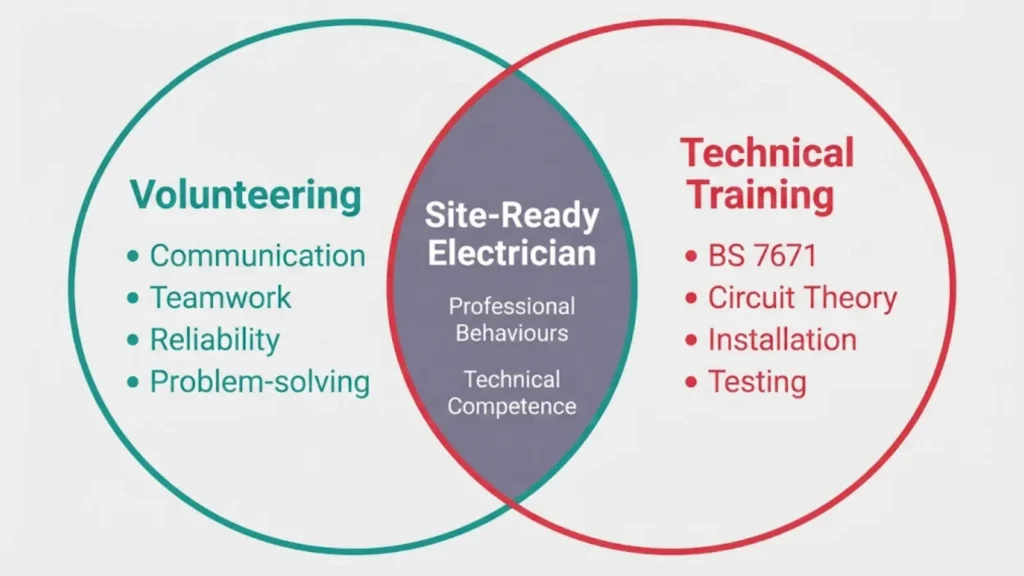
The pattern? Volunteering develops the human behaviours that make you employable. It doesn’t develop the technical competences that make you qualified.
Jaya's Journey (The Illustrative Case, Not the Blueprint)
Jaya’s story gets referenced frequently in volunteering discussions. She volunteered for a community energy project while studying for her electrical qualifications, and it helped her land her first placement.
Here’s what actually happened versus what people assume happened.
What volunteering gave Jaya:
Observing project lifecycles from planning through completion. Understanding that delays, resource constraints, and changing requirements are normal, not failures.
Developing resilience when things went wrong. Community projects involve frustrated stakeholders, tight budgets, and volunteer coordination challenges. Learning to handle those pressures built tolerance for site stress.
Refining her communication pitch. She learned how to explain technical concepts to non-technical audiences, which translated directly to client interactions during domestic installations.
Building a professional network. One of the community energy project contacts became a reference who vouched for her reliability and communication skills.
What volunteering didn’t give Jaya:
Technical competence in electrical installation. She still needed her Level 3 Diploma, her NVQ portfolio, and supervised site experience to become qualified.
Proof of site safety awareness. The community project didn’t involve RAMS, permit-to-work systems, or construction site hazards.
Automatic employment. She got the placement because she combined volunteering evidence with proper qualifications and could articulate how the behaviours she’d developed applied to electrical work.
The takeaway? Jaya didn’t get hired because she volunteered. She got hired because she used volunteering to demonstrate professional maturity alongside her technical qualifications.
"When I'm assessing NVQ portfolios, I can tell which learners have worked with the public or in team environments before. They photograph evidence properly, they communicate issues clearly, and they understand that professionalism isn't optional. Those behaviours often come from volunteering or retail work, not technical training."
Thomas Jevons, Head of Training
When Volunteering Actually Makes Sense
Not everyone benefits equally. Here’s when it genuinely adds value.
Career changers proving recent UK track record: If you’re moving from retail, hospitality, or office work into electrical training, volunteering provides recent evidence of teamwork and reliability in UK contexts. It bridges the gap between your previous industry and your new technical pathway.
Young learners building initial work history: If you’ve never had a paid job, volunteering creates something to discuss in interviews. It proves you can handle workplace expectations, follow instructions, and work alongside others.
As you progress through JIB gradings from trainee through to approved electrician, the professional behaviours developed through diverse experiences become increasingly important for demonstrating the maturity expected at higher pay grades
Confidence building before site exposure: For people who find construction site environments intimidating, volunteering in community building projects or youth mentoring provides a lower-pressure environment to develop professional behaviours.
International learners adapting to UK workplace culture: If you’re trained overseas or new to UK work environments, volunteering helps you understand British workplace norms, communication styles, and professional expectations.
Network development in niche areas: Community energy projects, sustainability initiatives, and local building schemes sometimes lead to contractor connections that wouldn’t happen through standard job applications.
The common thread? Volunteering works best as a supplement to technical training, not a substitute for it.
How Employers Actually View Volunteering on CVs
Let’s cut through the theory and talk about what recruiters and contractors actually think.
When volunteering strengthens a CV:
When you link it to specific operational behaviours. “Coordinated team of 8 volunteers for community build project, developing task delegation and deadline management skills applicable to site coordination.”
When it demonstrates initiative beyond minimum qualification requirements. It shows you’re proactive about professional development, not just completing mandatory coursework.
When it provides evidence for competency-based interview questions. “Tell me about a time you solved a problem under pressure” is easier to answer with real examples than theoretical scenarios.
When volunteering is neutral:
When it’s just a list without reflection on skills developed. “Volunteered at charity shop 2022-2023” tells a recruiter nothing about capabilities.
When it’s unrelated to any transferable behaviours. Some volunteering is genuinely just altruistic time donation with no professional development component. That’s fine, but it doesn’t belong on a technical CV.
When volunteering is irrelevant or negative:
When you prioritise it over technical qualifications. If your CV emphasises volunteering more than your Level 3 Diploma or NVQ progress, it suggests misaligned priorities.
When it’s recent but technical training isn’t. If you’ve been volunteering for three years but haven’t progressed your electrical qualifications, contractors question your commitment to the technical pathway.
The signal recruiters look for? Evidence of proactive character combined with technical competence. Volunteering provides the former. It never provides the latter.
"Volunteering gives you stories to tell in interviews. 'Tell me about a time you solved a problem under pressure' is easier to answer if you've coordinated a charity event than if your only experience is classroom theory. Employers aren't looking for perfection; they're looking for evidence you can handle real-world situations."
Joshua Jarvis, Placement Manager
Common Myths About Volunteering (And What's Actually True)
Let’s address the misconceptions that persist on forums and in careers advice.
Myth: “Volunteering proves you’re job-ready.” Reality: It proves you’re interview-ready and socially ready. It doesn’t prove technical competence or site safety awareness. You still need qualifications, NVQ assessment, and supervised experience for actual job readiness.
Myth: “Soft skills matter more than technical ability.” Reality: Both are required. Technical competence gets you the interview. Professional behaviours keep you employed. Neither alone is sufficient for long-term career success in electrical work.
Myth: “Employers prefer volunteers over paid experience.” Reality: Relevant paid experience is always the gold standard because it proves you’ve already handled workplace expectations. Volunteering beats an empty CV, but it doesn’t beat actual employment history.
Myth: “All volunteering develops engineering-relevant skills.” Reality: It depends entirely on the environment and role. Coordinating a community build develops different skills than sorting donations in a charity shop. Generic volunteering provides generic skills.
Myth: “Volunteering guarantees you’ll get an electrical apprenticeship.” Reality: It strengthens your application by demonstrating proactive character, but apprenticeships are competitive and prioritise technical aptitude, academic performance, and interview performance alongside soft skills evidence.
The pattern? Most myths stem from conflating employability (likelihood of getting hired) with competence (ability to perform the work). Volunteering builds the former. Technical training builds the latter.
The 2026 Reality: Where Volunteering Fits in Modern Pathways
Here’s how volunteering fits into electrical career development in 2026.
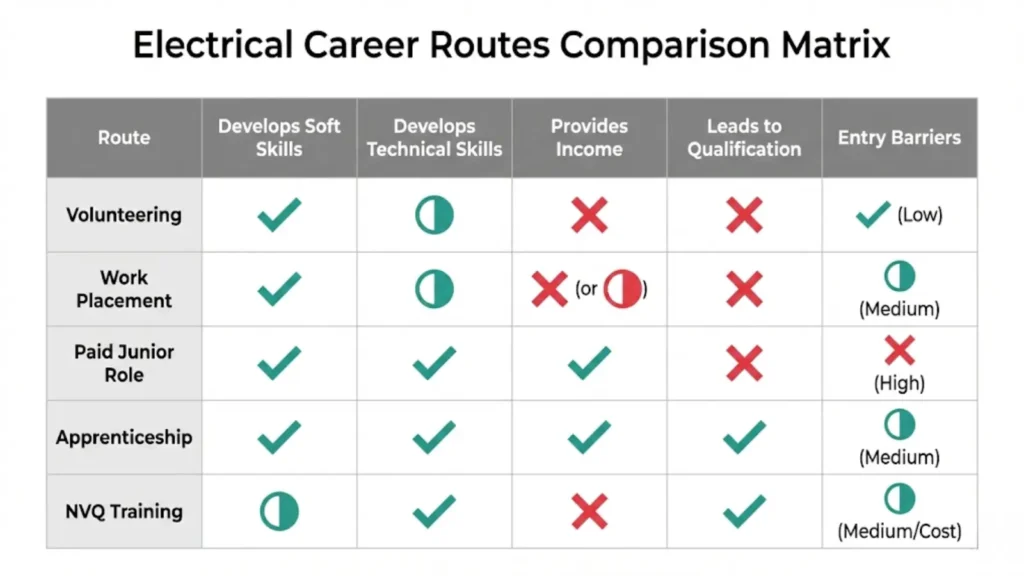
It’s a complement, not a pathway. The primary route into electrical work remains NVQ Level 3 qualifications, supervised site experience, and AM2 assessment. Volunteering enhances that journey by developing professional behaviours, but it’s never the main route.
It’s more valuable for career changers than school leavers. Young people moving through standard education pathways already build workplace behaviours through college projects and work experience modules. Career changers need to prove they can transition from their previous industry to construction site expectations.
It works best when targeted. Random volunteering provides random benefits. Volunteering in environments that mirror site conditions (community builds, energy efficiency projects, youth mentoring requiring coordination) develops specific transferable behaviours.
It’s one signal among many. Contractors evaluate candidates on qualifications, references, interview performance, technical knowledge, and evidence of professional maturity. Volunteering contributes to that last category, but it doesn’t override weaknesses in the others.
It’s becoming less unique. As more learners add volunteering to CVs following careers advice, it’s shifting from a differentiator to a baseline expectation. The quality and relevance of volunteering matters more than its mere presence. The NVQ Level 3 pathway provides the structured competence assessment that volunteering cannot replace, combining classroom knowledge with supervised site experience and formal verification of technical capabilities.
What This Means for Your Career Development
If you’re considering electrical training, here’s how to think about volunteering practically.
Don’t volunteer instead of pursuing qualifications. If you’re choosing between volunteering and starting your Level 3 Diploma, start the diploma. Technical competence is the foundation; professional behaviours build on top of it.
Do volunteer alongside technical training. If you’re already enrolled in electrical qualifications and have time capacity, relevant volunteering strengthens your employability without delaying your technical progression.
Choose volunteering that mirrors site environments. Community building projects, energy efficiency schemes, and youth mentoring develop more relevant behaviours than purely administrative or isolated volunteering.
Document and reflect on what you’ve learned. Keep a log of situations you’ve handled, problems you’ve solved, and skills you’ve developed. Interview preparation becomes easier when you have specific examples ready.
Balance time investment realistically. Six months of consistent monthly volunteering provides more interview material than sporadic one-off events. But if it’s interfering with study time or delaying qualification completion, the trade-off isn’t worth it.
The electricians building successful careers in 2026 are the ones who understand that employability requires both technical competence and professional behaviours. Volunteering develops the latter. Formal training develops the former. Both matter.
Ready to Build Both Technical Competence and Professional Behaviours?
Call us on 0330 822 5337 to discuss how our NVQ pathway combines formal qualifications with placement support that values the professional behaviours developed through volunteering, part-time work, or previous career experience. We’ll explain exactly how technical competence and professional maturity work together to create genuine site readiness.
What we’re not going to tell you:
That volunteering alone will get you a job
That soft skills matter more than qualifications
That you should delay technical training to build volunteer experience
What we will tell you:
How to combine formal qualifications with professional behaviour development
When volunteering strengthens your employability and when it doesn’t
What contractors actually look for when evaluating candidates beyond certificates
How our placement team assesses both technical competence and site readiness
No hype about transformational volunteering journeys. Just practical guidance on building the complete package of technical capability and professional maturity that electrical employers actually hire.

References
Primary Skills and Employment Frameworks
- Skills Builder Universal Framework (UK Essential Skills Standard): https://www.skillsbuilder.org/universal-framework
- National Careers Service (Transferable Skills Guidance): https://nationalcareers.service.gov.uk/careers-advice/transferable-skills
- UK Government Skills and Training Guidance: https://www.gov.uk/career-skills-and-training
- Department for Education (Essential Skills in UK Economy): https://www.gov.uk/government/publications/essential-skills-in-the-uk-economy
Engineering Industry Research
- IET Engineering and Technology Skills Survey 2025: https://www.theiet.org/impact-society/fact-files/engineering-skills-survey/
- ECITB Skills and Needs Survey (Construction Focus): https://www.ecitb.org.uk/research/skills-and-needs-survey
- EngineeringUK Skills Needs Discussion Paper: https://www.engineeringuk.com/media/uqqdal5b/engineering-skills-needs-discussion-paper-engineeringuk-may-23.pdf
Professional Development and Employability
- The Prince’s Trust Research and Policy Reports: https://www.princes-trust.org.uk/about-the-trust/research-policies-reports
- Skills Development Scotland (Apprenticeship Standards): https://www.skillsdevelopmentscotland.co.uk/
Industry Bodies and Practitioner Resources
- JIB (Joint Industry Board) Grading and Standards: https://www.jib.org.uk/
Note on Accuracy and Updates
Last reviewed: 28 January 2026. This page is maintained; we correct errors and refresh sources as skills frameworks and employability research evolves. Skills Builder Universal Framework and EngineeringUK skills gap data reflect current 2025-2026 industry standards. Next review scheduled following any significant updates to apprenticeship frameworks or employability guidance.