

How to Get an Electrical Apprenticeship in the UK: A Complete Step-by-Step Guide
- Technical review: Thomas Jevons (Head of Training, 20+ years)
- Employability review: Joshua Jarvis (Placement Manager)
- Editorial review: Jessica Gilbert (Marketing Editorial Team)
- Last reviewed:
- Changes: Comprehensive apprenticeship guide updated with 2025 entry requirements, JIB wage rates, realistic age-related barriers, employer preferences, and alternative route comparisons
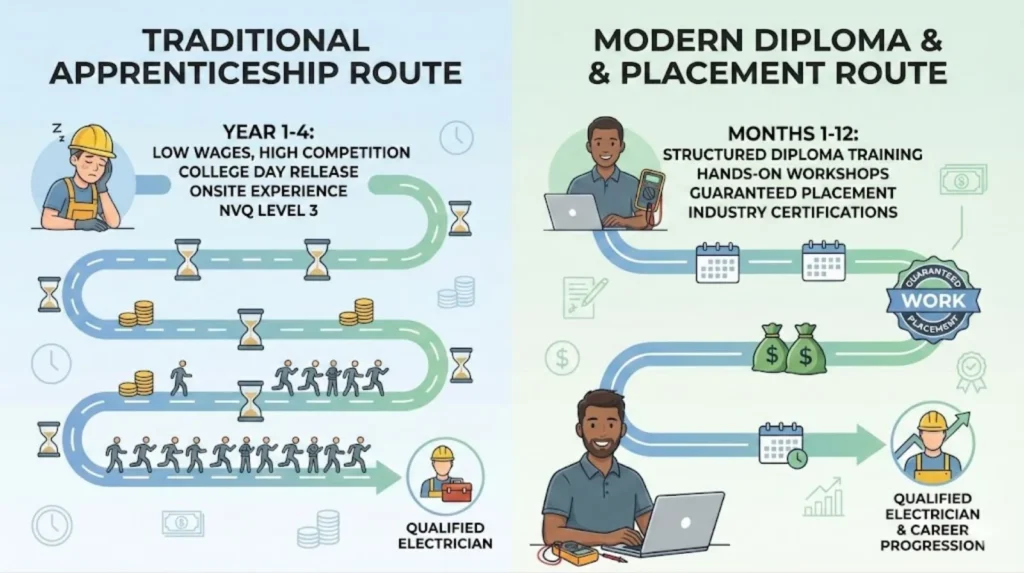
An electrical apprenticeship is the traditional, highly respected route into the UK electrical trade, combining paid employment with structured training to achieve Level 3 Electrotechnical Qualification, NVQ Level 3, AM2 assessment, and eligibility for the ECS Gold Card. It typically takes 3-4 years, with apprentices spending approximately 80% of time on site with an employer and 20% in college-based training.
However, electrical apprenticeships are intensely competitive. Application-to-vacancy ratios in major cities regularly exceed 40-50 applicants per position, with employers showing strong preference for 16-18 year olds due to full government funding and lower wage costs. The apprentice minimum wage starts at £6.40 per hour, rising to £8.60-£9.18 in subsequent years depending on age, making apprenticeships financially challenging for adults with rent, mortgages, or family responsibilities.
Entry requirements include GCSE Maths and English at Grade 4 (C) or Functional Skills Level 2, plus aptitude tests covering numeracy, comprehension, and mechanical reasoning. Employers assess attitude, reliability, and safety awareness during interviews and assessment days. The largest providers include SECTT (Scotland), major national contractors (utilities, rail, facilities management), public sector bodies (NHS, councils, MOD), and thousands of small-to-medium electrical contractors who recruit through direct approach rather than advertised vacancies.
This guide provides evidence-based strategies for school leavers, young adults, and adult career changers seeking electrical apprenticeships. It explains where apprenticeships come from, who employers actually want, how to find unadvertised opportunities, what aptitude tests assess, how to present yourself in interviews, and critically, whether an apprenticeship is the right route for your circumstances or whether alternative pathways (Level 2 and Level 3 diplomas with guaranteed work placements) provide faster, more realistic progression.
Success hinges on targeted applications, demonstrable technical interest, persistent networking with local contractors, and honest assessment of whether you match employer preferences or need to pursue alternative qualification routes that don’t depend on securing competitive apprenticeship positions.
Is an Electrical Apprenticeship the Right Route for You?
Before investing time applying for apprenticeships, you need to understand whether this route actually suits your circumstances. Apprenticeships work exceptionally well for some people and are completely impractical for others.
An apprenticeship is the right route if:
You’re 16-24 years old with time on your side. Employers invest 3-4 years developing apprentices. They want that investment to pay off over decades of employment. Younger candidates offer better return on investment.
You can survive on £6.40-£9.18 per hour for 3-4 years. Apprentice wages are significantly lower than qualified electrician rates. If you live at home with family support, this is manageable. If you have rent, car payments, or dependents, it’s extremely difficult.
You have solid Maths and English foundations. GCSE Grade 4 (C) or Functional Skills Level 2 are non-negotiable. If you struggled with these subjects at school and haven’t retaken them, you won’t be accepted onto college programmes regardless of enthusiasm.
You thrive with structured, external accountability. Apprenticeships provide clear progression through NVQ units, college assessments, and workplace mentoring. If you need milestones, deadlines, and regular feedback to stay motivated, this structure is valuable.
You’re geographically flexible. Apprenticeship vacancies cluster in major cities and construction hubs. If you live in rural areas or cannot relocate, opportunities are severely limited.
You can commit to one employer for 3-4 years. Apprenticeships aren’t job-hopping arrangements. Employers expect loyalty in exchange for their training investment. If you have difficulty maintaining workplace relationships or get bored quickly, apprenticeships are high-risk.
Thomas Jevons, Head of Training at Elec Training, explains the employer perspective:
"An apprenticeship works best when you're entering the trade with time on your side, typically 16 to 24 years old. The employer invests three to four years developing you, knowing they'll benefit from that investment for potentially decades. If you're 30 or older, the maths changes for them. It's not impossible, but you need to prove you're worth that long-term commitment when there are younger candidates who'll statistically stay in the trade longer."
Thomas Jevons, Head of Training
An apprenticeship is NOT the right route if:
You’re 25+ with financial responsibilities. Adult apprentice wages (£6.40-£9.18/hour) don’t cover living costs for most adults. Employers strongly prefer younger candidates due to funding structures and wage expectations.
You need to start earning qualified rates quickly. Apprenticeships take 3-4 years to reach qualified electrician status. Alternative routes (Level 2 + Level 3 diplomas with NVQ placement support) can achieve the same outcome in 18 months to 3 years while maintaining current employment during classroom training.
You have childcare or caring responsibilities. Apprenticeships require Monday-Friday availability (often 7:30am starts) plus college attendance (day release or block release). Flexibility is extremely limited.
You have poor work history or attendance issues. Employers check references rigorously. Patterns of short-term employment, lateness, or unexplained gaps raise serious concerns because they’re investing years of training in you.
You’re in a different region from apprenticeship hubs. If vacancies don’t exist in your area and you cannot relocate, pursuing apprenticeships is futile. Alternative routes don’t depend on finding that single perfect employer willing to take you on.
Joshua Jarvis, Placement Manager at Elec Training, addresses the financial reality:
"The apprentice wage, £6.40 to £9.00 per hour in the first year, is a genuine barrier for adults. If you've got rent, car payments, family responsibilities, that wage doesn't cover living costs in most of the UK. School leavers living at home can manage it. Adults often can't. That's why many adult career changers choose the Level 2 and Level 3 diploma route with guaranteed placement support instead, they can keep their current job while training."
Joshua Jarvis, Placement Manager
Alternative Routes That May Suit You Better
If you’ve read the above and apprenticeships don’t align with your circumstances, that doesn’t mean you can’t become a qualified electrician. Multiple pathways exist:
Level 2 + Level 3 Diploma Route with Guaranteed Work Placements:
Complete Level 2 (8 weeks) and Level 3 (8 weeks) technical certificates at college
Maintain current employment during classroom training (evening or weekend courses available)
Secure electrician’s mate or improver position through training provider’s placement support
Complete NVQ Level 3 portfolio over 12-18 months in real work environment
Pass AM2 assessment
Obtain ECS Gold Card and qualified electrician status
Timeline: 18 months to 3 years total, depending on work placement speed and NVQ portfolio progress.
Financial advantage: Keep current income during classroom training (16 weeks total). Only transition to electrician’s mate wages (£18,000-£26,000) once diplomas are complete and site work begins.
Who this suits: Adults 25+ with financial responsibilities, people who need geographic or time flexibility, career changers who can’t afford 3-4 years at apprentice wages.
For a complete comparison of all routes to becoming a qualified electrician in the UK, including detailed pros/cons of apprenticeships vs adult training pathways, read our comprehensive guide: How to Become an Electrician in the UK
That guide explains the four main qualification routes, realistic timelines, total costs, employment barriers, and which pathway suits your specific circumstances. If you’re uncertain whether an apprenticeship is right for you, read that guide first before investing time in applications.
The rest of this article assumes you’ve determined an apprenticeship IS the right route for you and provides detailed, actionable strategies for securing one successfully.
What an Electrical Apprenticeship Actually Is
An electrical apprenticeship in the UK is a genuine employment contract combining paid site work with formal off-the-job training, leading to nationally recognized qualifications and industry credentials that permit unsupervised electrical work.
The Legal and Funding Structure
Definition: An apprenticeship is a structured training programme governed by government funding rules (Education and Skills Funding Agency in England, devolved equivalents in Scotland, Wales, Northern Ireland) that combines:
Paid employment: You are an employee of the company, not a student. You have an employment contract, employment rights (holiday pay, sick pay after qualifying period), and earn wages throughout.
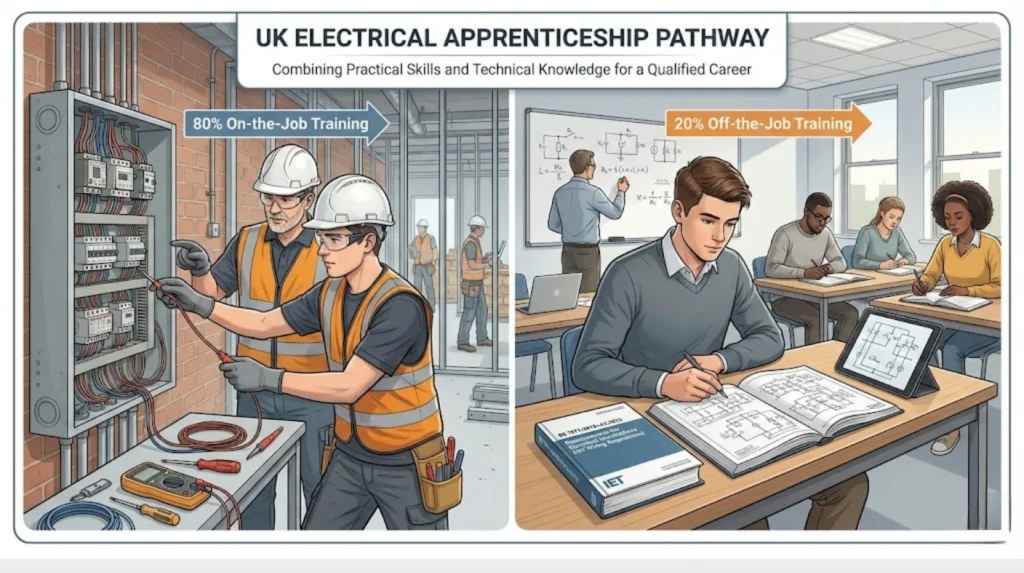
Off-the-job training: Minimum 20% of your working hours must be dedicated to formal learning. This typically occurs through day release (one day per week at college) or block release (1-2 weeks at college, then several weeks on site, repeated throughout the year).
On-the-job learning: The remaining 80% is spent working on real electrical installations under supervision of qualified electricians, gathering evidence for your NVQ portfolio.
Duration: Standard electrical apprenticeships take 3-4 years from start to AM2 completion. Some learners finish in 36 months if portfolio work progresses quickly. Others take the full 48 months if evidence gathering is slow or employer provides limited work variety.
What You Actually Qualify With
Level 3 Installation and Maintenance Electrician Standard (England):
The current apprenticeship standard (ST0152) replaced older frameworks in 2016-2017. It incorporates:
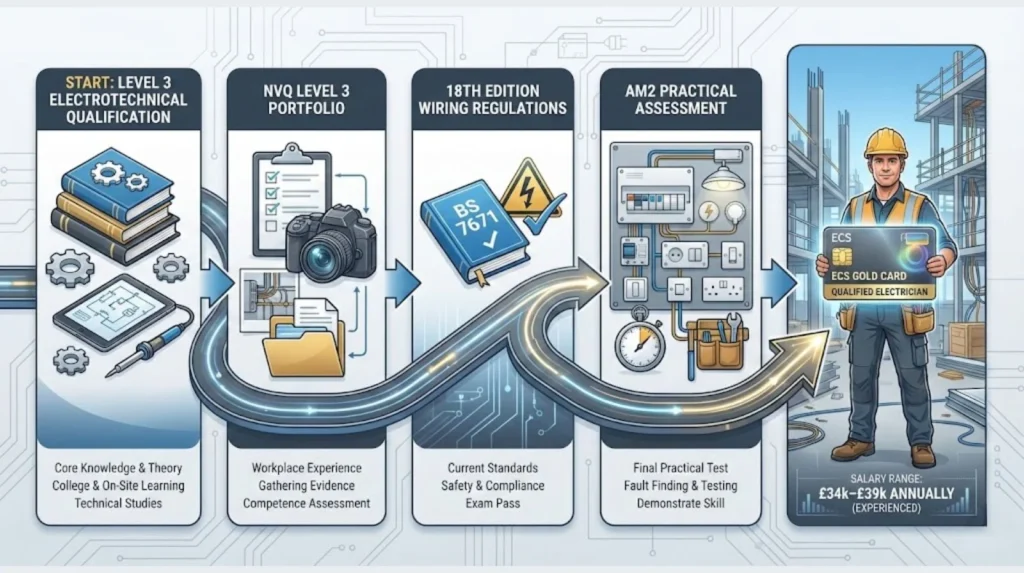
City & Guilds Level 3 Electrotechnical Qualification (2365 Level 3): Theory, circuit design, BS 7671 regulations, calculations.
NVQ Level 3 Diploma in Installing Electrotechnical Systems and Equipment (2357): Work-based competence portfolio proving you can install, test, and certify electrical systems in real environments.
18th Edition Wiring Regulations (2382): Current knowledge of BS 7671:2018+A2:2022.
AM2S (Achievement Measurement 2 for Apprenticeship Standard): Three-day practical assessment testing installation, inspection/testing, fault-finding, and certification skills under exam conditions.
Upon completion, you’re eligible to apply for:
ECS Gold Card (Installation Electrician): Industry-recognized proof of competence, required by most major construction sites and contractors for unsupervised work.
JIB Grading (Electrician or Approved Electrician): Determines pay rates on JIB-compliant contracts. Electrician grade starts at £18.38/hour (£34,000-£36,000 annually). Approved Electrician (requires additional C&G 2391 Inspection & Testing qualification) earns £20.08/hour (£37,000-£39,000 annually).
Competent Person Scheme Eligibility: With additional C&G 2391 and experience, you can join NICEIC, NAPIT, or ELECSA to self-certify domestic electrical work under Part P Building Regulations, essential for self-employment.
Devolved Nations Variations
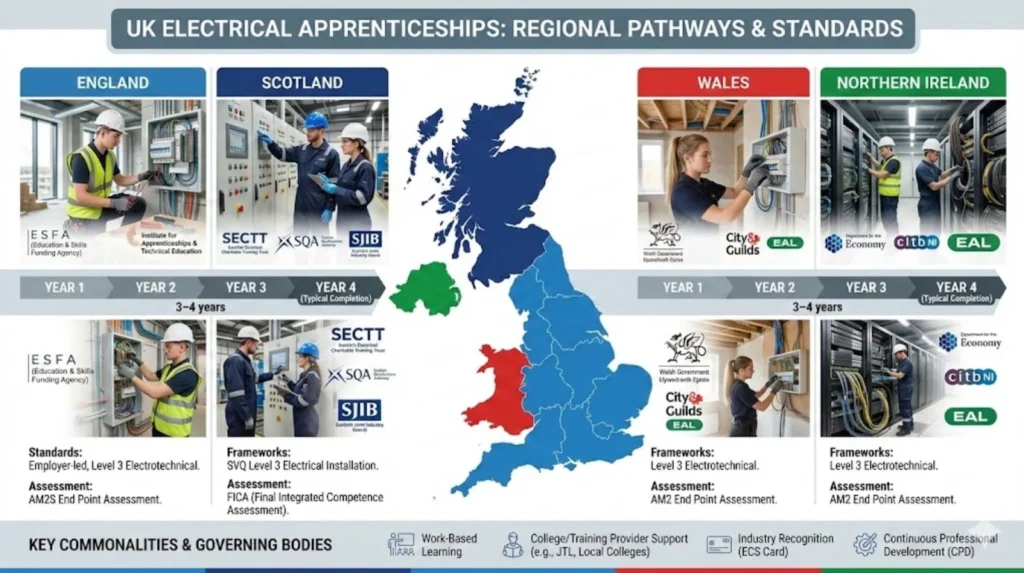
Scotland (SECTT Framework):
Scotland uses the Scottish Electrical Charitable Training Trust (SECTT) to coordinate apprenticeships. The structure is similar (3-4 years, Level 3 equivalent, AM2E assessment) but follows Scottish Qualifications Authority (SQA) frameworks. Wages follow SJIB rates (Scottish Joint Industry Board), which are slightly higher than JIB England/Wales rates. SJIB Electrician earns £18.54/hour base (2025).
Wales:
Aligned with England’s ESFA funding and apprenticeship standards. Welsh language support available.
Northern Ireland:
Uses nidirect frameworks with similar GCSE requirements (Maths and English Grade C minimum). Funding administered through Department for the Economy. Fewer provider options than mainland UK, with most apprenticeships organized through local colleges or direct employer schemes.
Why Employers Offer Apprenticeships
Government Incentives:
Large employers (payroll over £3 million annually) pay the Apprenticeship Levy (0.5% of payroll) which can only be spent on apprenticeship training. This creates strong financial incentive to recruit apprentices.
Small employers (non-levy) receive 95% government funding for apprentice training costs (100% for 16-18 year olds), meaning they only pay 5% of training fees plus apprentice wages.
Long-Term Workforce Development:
Employers invest 3-4 years developing apprentices because they gain:
Employees trained exactly to their standards and methods
Lower staff turnover (apprentices who complete stay with employers longer)
Younger workforce replacing retiring electricians
Access to government contracts requiring apprentice employment
Industry Requirements:
Many public sector contracts and large construction projects require contractors to employ minimum percentages of apprentices. Employers who don’t recruit apprentices lose access to lucrative contracts.
Where Electrical Apprenticeships Come From: The Reality of Vacancy Sources
Understanding where apprenticeships actually originate is critical because most vacancies never appear on job boards. The application strategy that works for large national employers fails completely for small regional contractors who recruit through word-of-mouth and direct enquiries.
Employer Types and Their Recruitment Methods
Small-to-Medium Regional Contractors (SMEs) – Largest Source of Apprenticeships
Scope: 1-20 employees. Work primarily on domestic installations (rewires, consumer unit changes, additions), small commercial projects (shop fit-outs, office rewiring), light industrial maintenance. Typically operate within 30-50 mile radius of base location.
How they recruit: These contractors rarely advertise apprenticeships online. They receive unsolicited enquiries from young people via:
Speculative CVs hand-delivered or emailed directly
Phone calls from parents or candidates
Recommendations from current employees (“my nephew just finished college”)
Local college tutors who know the contractor and match learners
Why they don’t advertise: Small contractors receive dozens of applications whenever they post online vacancies. Sorting through unsuitable candidates is time-consuming. They prefer hiring through trusted recommendations or taking time to assess candidates who show initiative by approaching directly.
How to access these opportunities: Direct approach is essential. Research electrical contractors in your area (Google search, Yell.com, Rated People, Checkatrade), prepare professional CV and cover letter, and contact every one. Visit trade counters (CEF, Edmundson, Rexel) where electricians collect materials and ask staff if they know contractors looking for apprentices.
Large National Employers – Visible But Highly Competitive
Scope: Major contractors (Balfour Beatty, Clarkson Evans, NG Bailey), utilities (National Grid, UK Power Networks, SSE, Scottish Power), facilities management (CBRE, Mitie, Sodexo), transport infrastructure (Transport for London, Network Rail, airports), manufacturing and industrial sites (automotive, food processing, pharmaceutical).
How they recruit: Dedicated apprenticeship recruitment campaigns with formal application processes:
Posted on gov.uk Find an Apprenticeship portal
Company careers websites with online application forms
National job boards (Indeed, Reed, Totaljobs)
Recruitment agencies specializing in apprenticeships
Entry requirements: Typically more rigorous than SMEs. Expect aptitude tests, assessment centres, multiple interview stages, and DBS checks. Competition is extreme (100+ applicants per position common).
Why they’re visible: Large employers have HR departments managing recruitment compliance. They’re legally required to post levy-funded apprenticeships on government portals and follow structured processes.
Who succeeds: Candidates with strong academic records (GCSE Grade 5+), relevant work experience (construction site labouring, engineering), excellent aptitude test performance, and polished interview skills. School leavers from technical colleges often have advantage due to existing relationships between colleges and large employers.
Public Sector Bodies – Stable But Limited Vacancies
Scope: Local councils (electrical maintenance for council buildings, housing stock, street lighting), NHS Trusts (hospital electrical maintenance), Ministry of Defence (MOD bases, military installations), housing associations (social housing maintenance), airports (electrical systems maintenance), universities and colleges (estates departments).
How they recruit: Formal processes via:
Organization websites (check “Careers” or “Jobs” sections)
gov.uk Find an Apprenticeship
Local press (council magazines, community newsletters)
Requirements: Often require enhanced DBS checks due to working in schools, hospitals, or secure sites. Some roles (MOD, airports) require security clearance which can take months to process and may exclude candidates with certain backgrounds or foreign connections.
Competition: Moderate to high. Public sector roles attract applicants seeking job security, pension benefits, and stable working hours. However, vacancy numbers are much lower than private sector.
Who succeeds: Candidates with clean background checks, strong references, mature attitude, and demonstrable reliability. Public sector employers value stability over flashiness.
Training Provider (SECTT) – Industry Body Recruitment
What they do: Training providers recruit apprentices on behalf of multiple employers who can’t manage recruitment themselves. The provider finds the candidate, matches them with an appropriate employer, manages college enrollment, coordinates assessments, and provides ongoing support.
SECTT (Scotland): Manages electrical apprenticeships across Scotland using similar recruitment model. Applications open January-March for August starts.
Why this matters: SECTT is single application route that can lead to multiple employer opportunities.
Colleges Acting as Intermediaries
How it works: Local FE colleges running Level 3 Electrotechnical programmes maintain waiting lists of learners seeking apprenticeships. When local contractors contact the college looking for apprentices, tutors recommend candidates from their list.
How to access: Enroll on Level 2 Electrical Installation at local college even if you ultimately want apprenticeship. This puts you in contact with tutors who have employer connections and can recommend you when opportunities arise. Many apprenticeships are filled this way without ever being advertised.

Where Vacancies Are Actually Posted (And Where They're Not)
Primary Portal: gov.uk Find an Apprenticeship
Mandatory posting location for all levy-funded apprenticeships in England. Search by keyword (“electrical apprenticeship”, “electrician”, “electrotechnical”) and location. Set up email alerts for new postings.
Website: https://www.gov.uk/apply-apprenticeship
Limitations: Only shows vacancies that employers choose to post publicly. Many SME opportunities never appear here because they’re filled through direct approach or internal recruitment.
National Job Boards
Indeed.co.uk
Reed.co.uk
Totaljobs.com
Apprenticeships.gov.uk (redirects to main gov.uk portal)
What appears: Primarily large employer vacancies and recruitment agency postings. SME vacancies rare.
Provider-Specific Websites
SECTT: https://www.sectt.org.uk (applications open January-March)
Large employer careers pages (search “National Grid careers apprenticeship”, “Mitie apprenticeships”, etc.)
Local College Websites
Check “Courses” or “Apprenticeships” sections of FE colleges in your area. Many colleges advertise available apprenticeships with partner employers.
Where Vacancies DON’T Appear
Social media (mostly): Apprenticeships rarely advertised on Facebook, Twitter, Instagram, LinkedIn. Exception: some large employers post on LinkedIn, but these are already listed on gov.uk portal.
Gumtree/Craigslist: Occasionally apprenticeships appear but high scam risk. Legitimate apprenticeships are always advertised through more official channels.
The 70/30 Rule: Approximately 70% of electrical apprenticeships with SMEs are filled through direct approach, word-of-mouth, or college recommendations. Only 30% appear on job boards or official portals. This means if you only apply to advertised vacancies, you’re competing for 30% of total opportunities and missing 70% of the market.
Entry Requirements: What You MUST Have Before Applying
Apprenticeship entry requirements are set by combination of government funding rules (ensuring public money is spent on candidates capable of completing), college acceptance criteria (ensuring learners can handle Level 3 curriculum), and employer preferences (ensuring apprentices can perform the job safely and effectively).
Academic Requirements (Non-Negotiable)
GCSE Maths at Grade 4 (C) or above
Why this matters: Electrical work requires constant calculations (voltage drop, cable sizing, circuit protection, earth loop impedance, power factor correction). Level 3 college curriculum includes algebra, trigonometry, and complex circuit calculations. Without solid maths foundation, you will fail college assessments.
What’s tested in apprenticeship aptitude tests:
Fractions, decimals, percentages
Ratios and proportions
Basic algebra (solving for unknowns)
Ohm’s Law (V = IR)
Power calculations (P = IV, P = I²R, P = V²/R)
Area and volume calculations (cable containment sizing)
If you don’t have GCSE Maths Grade 4: You must achieve Functional Skills Level 2 Maths before or during the first few months of apprenticeship. Colleges will not allow progression to Level 3 assessments without this.
GCSE English Language at Grade 4 (C) or above
Why this matters: BS 7671 Wiring Regulations are complex technical documents requiring high-level reading comprehension. Electrical Installation Certificates must be completed accurately with correct terminology. Safety procedures must be understood from written method statements and risk assessments.
What’s tested in apprenticeship aptitude tests:
Reading comprehension (understanding technical documents)
Written communication (completing forms, writing accident reports)
Grammar and spelling
Following multi-step written instructions
If you don’t have GCSE English Grade 4: You must achieve Functional Skills Level 2 English before college will accept you onto Level 3 programme.
Functional Skills as Alternative
Functional Skills Level 2 in Maths and English are accepted by almost all apprenticeship providers as equivalent to GCSE Grade 4 (C). These qualifications can be completed at FE colleges or online learning providers in 8-16 weeks.
When to pursue Functional Skills:
You don’t have GCSE Maths/English
You have GCSE Grade 3 or below
You completed GCSEs years ago under old grading system (pre-2017) and can’t prove equivalence
Preferred Additional Subjects
Science (Physics, Combined Science): GCSE Grade 4+ in science demonstrates understanding of electrical principles (circuits, resistance, energy, power) covered in Level 3 curriculum. Employers and colleges prefer but don’t always require this.
Design & Technology: Practical subject demonstrating manual skills, technical drawing, and problem-solving. Useful but not essential.
Why employers care about grades: They don’t particularly care whether you got Grade 5 or Grade 7. What matters is proving you achieved minimum Grade 4 threshold in Maths and English. Higher grades make you more competitive for large employer positions but have minimal impact on SME recruitment decisions where attitude and work ethic matter more.
Age Requirements and Funding Reality
Legal Requirements:
Minimum age: 16 (must have completed compulsory education)
No upper age limit: Legally, anyone over 16 can apply for apprenticeships. Government funding is available for apprentices of all ages.
Must not be in full-time education: Cannot be enrolled in sixth form, college, or university while starting apprenticeship.
Practical Reality: Age Discrimination Exists
Employers strongly prefer 16-18 year olds for several reasons:
Funding incentives:
16-18 year olds: 100% government funding for training costs, no employer contribution
19-24 year olds: 95% government funding, 5% employer contribution
25+ year olds: 95% government funding, 5% employer contribution (some funding models require apprentice to take loan for their 5% share)
Wage costs:
Apprentice minimum wage (first year, all ages): £6.40/hour (2025)
Apprentice minimum wage (year 2+, under 19): £6.40/hour
Apprentice minimum wage (year 2+, aged 19+): £8.60/hour
National Minimum Wage (aged 21+): £11.44/hour
Employers can legally pay all apprentices £6.40/hour in first year. Many pay more (JIB Stage 1 rate is £9.14/hour for under-18s), but the key point is younger apprentices cost less in subsequent years because they can stay on lower apprentice minimum wage.
Longevity concerns:
Employers investing 3-4 years training an apprentice want that investment to pay off over decades. Statistics show:
18-year-old apprentice: Potentially 45+ years in the trade before retirement
30-year-old apprentice: Potentially 35 years in the trade
45-year-old apprentice: Potentially 20 years in the trade
While these are generalizations, employers worry older apprentices may retire sooner, switch careers again, or have health issues that limit physical work capacity.
Financial stability concerns:
Employers assume (often correctly) that older applicants have mortgages, families, car payments, and other financial responsibilities that make apprentice wages unsustainable. They worry about:
Higher turnover (leaving for better-paying jobs)
Financial stress affecting work performance
Resentment about low wages causing workplace friction
Age Groups and Realistic Success Rates:
Age Group | Employer Preference | Competition Level | Success Strategies 16-18 (School Leavers) | Highest preference (full funding, lowest wages) | Very high (most competitive age group) | Focus on grades, aptitude test prep, work experience, early applications 19-24 (Young Adults) | Good preference (still young, partially funded) | High (competing with 16-18s) | Emphasize maturity, previous work experience, strong references, consider Level 2 Diploma first 25-34 (Early Career Changers) | Moderate preference (concerns about commitment) | Very high (must overcome age bias) | Exceptional commitment proof (complete Level 2 first), lower wage expectations, highlight transferable skills 35+ (Mature Career Changers) | Low preference (funding same as 25+ but longevity concerns) | Extremely high (most barriers) | Alternative routes often more realistic (Level 2+3 diplomas with guaranteed placement), if pursuing apprenticeship: demonstrate exceptional value, accept realistic limitations
Other Essential Requirements
Colour Vision (Colour Blindness Testing)
Why it matters: Electrical cables in UK are colour-coded (brown = live, blue = neutral, green/yellow = earth for single-phase; brown/black/grey = phases, blue = neutral, green/yellow = earth for three-phase). Inability to distinguish colours creates serious safety risks (connecting live to earth can kill).
Who tests: Some employers test all applicants using Ishihara colour plates (spotting numbers in coloured dot patterns). Others only test for specific roles (utilities, rail, industrial maintenance where colour identification is critical).
Types of colour blindness and impact:
Red-green colour blindness: Most common type, affects 8% of males and 0.5% of females. Can make distinguishing brown (live) from green (earth) extremely difficult.
Blue-yellow colour blindness: Rare, affects ability to distinguish blue (neutral) from other colours.
What happens if you fail: Some employers reject applicants who fail colour vision tests. Others accept with accommodations (cable labeling, multimeter voltage confirmation rather than colour-only identification). Large utilities and rail companies are strictest due to safety regulations.
DBS (Disclosure and Barring Service) Checks
What it is: Criminal background check required for working in certain environments.
When required:
Schools, colleges, nurseries (working in educational settings with children)
Hospitals, care homes, NHS facilities (working with vulnerable adults)
MOD sites (security clearance for military installations)
Airports (security clearance for landside/airside access)
Some public sector roles
What they check: Spent and unspent convictions, cautions, reprimands, warnings, plus barred list status (prevented from working with children or vulnerable adults).
What disqualifies: Serious violent offences, sexual offences, drugs offences may disqualify from roles requiring DBS. Each employer assesses individually. Minor offences (drunk and disorderly, theft as teenager) may not disqualify, especially if disclosed honestly upfront.
Physical Fitness Requirements
Electrical work is physically demanding:
Working at height: Ladders, scaffolding, scissor lifts, cherry pickers. Must be comfortable with heights and able to work safely on elevated platforms.
Confined spaces: Plant rooms, roof voids, floor voids, ducts. Must manage claustrophobia and be able to work in tight spaces.
Lifting and carrying: Reels of cable (25kg+), containment materials, distribution boards, lighting fixtures. Must be capable of manual handling.
Repetitive tasks: Pulling cables, drilling, conduit bending, terminations. Must have hand/wrist strength and stamina.
Kneeling/crouching: First-fix and second-fix work often requires extended periods kneeling or in awkward positions.
Who this excludes: Serious back problems, severe joint issues, mobility restrictions, medical conditions causing dizziness or blackouts, severe obesity limiting movement in confined spaces. Employers assess on case-by-case basis but must ensure candidates can perform the work safely.
Right to Work in UK
Must be British citizen, have settled status (indefinite leave to remain), or hold visa permitting employment. Most apprenticeships are not eligible for visa sponsorship, so non-UK nationals typically need existing right to work before applying.
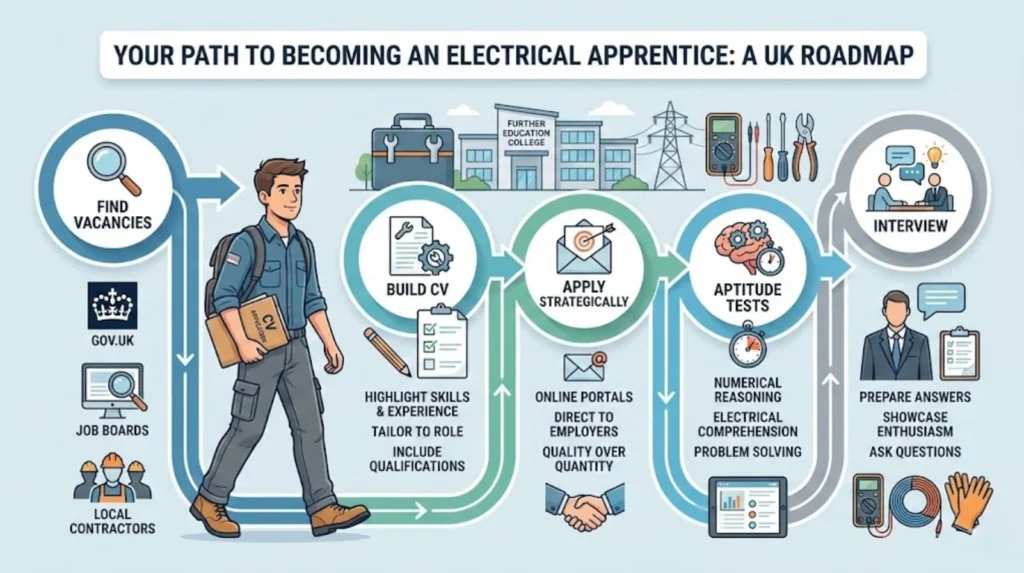
The Apprenticeship Application Process: Complete Step-by-Step Guide
Securing an electrical apprenticeship requires systematic, targeted effort across multiple channels. One-size-fits-all approaches fail. Success comes from adapting your strategy to employer type and vacancy source.
Step 1: Finding Vacancies (Where to Look and How Often)
Daily Routine (15-30 minutes per day):
Gov.uk Find an Apprenticeship portal:
Visit https://www.gov.uk/apply-apprenticeship
Search keywords: “electrical apprenticeship”, “electrician”, “electrotechnical”, “installation electrician”
Set location radius (start with 10 miles, expand to 25 miles if limited results)
Create account and set up email alerts (receive notifications when new vacancies posted)
Check portal daily because popular vacancies fill within 48-72 hours
Indeed, Reed, Totaljobs:
Create alerts using same keywords
Filter by “Apprenticeship” job type
Set distance radius from your postcode
Check alerts daily
Weekly Tasks (1-2 hours per week):
SECTT websites:
Check recruitment pages weekly
Applications typically open January-March (SECTT)
When open, priority is completing application immediately (first-come advantage for assessment centre slots)
Large employer careers pages:
Identify 10-15 large employers in your region (utilities, contractors, FM companies, rail, NHS, councils)
Visit careers/apprenticeships pages weekly
Applications often open in waves (September-October for next year’s intake, January-February for summer/autumn starts)
Local college websites:
Check “Apprenticeships” or “Vacancies” sections
Colleges sometimes advertise apprenticeships on behalf of partner employers
Speak directly to Level 3 Electrotechnical course tutors, express interest in apprenticeship, ask to be added to their recommendation list
Ongoing Direct Approach Campaign:
This is the most important strategy for accessing the 70% of apprenticeships that never appear online.
Build a target list:
Google search: “electrician [your town/city]”
Use Yell.com, Checkatrade, Rated People, Trustpilot to find local electrical contractors
Drive around your area noting electrical company vans (company name, phone number, website)
Visit trade counters (CEF, Edmundson, Rexel) and ask staff which contractors they supply frequently
Ask family, friends, neighbors if they know any electricians or electrical companies
Target: 50-100 local electrical contractors
For each contractor:
Research their website (what type of work do they do? Domestic, commercial, industrial?)
Prepare tailored CV and cover letter referencing their specific work
Contact via email or phone
If no response after 1 week, follow up with phone call
If no response after 2 weeks, deliver printed CV in person to their office/trade counter where they collect materials
Example email structure:
Subject: Apprentice Electrician Application – [Your Name]
Dear [Owner/Manager Name],
I am seeking an electrical apprenticeship and am particularly interested in [Company Name] due to your focus on [specific type of work they do, e.g., “commercial installations” or “domestic rewiring”].
I have recently achieved: – GCSE Maths Grade [X] – GCSE English Grade [X] – [Any relevant work experience or Level 2 Diploma]
I am reliable, safety-conscious, and eager to learn the electrical trade properly under experienced supervision. I understand apprenticeships are long-term commitments and I am prepared to work hard and prove my value to your team.
I have attached my CV and would appreciate the opportunity to discuss apprenticeship opportunities with you. I am available for interview at your convenience.
Yours sincerely, [Your Name] [Phone Number] [Email Address]
Why this works: Small contractors receive hundreds of speculative applications over the years. Most are poorly written, generic, or clearly mass-sent. A professional, tailored approach stands out. Contractors remember candidates who show initiative, research their company, and follow up professionally.
Open Days and Networking Events:
College open evenings:
Attend open evenings at colleges offering Level 3 Electrotechnical programmes
Employers often attend to meet prospective apprentices
Opportunity to demonstrate enthusiasm and make personal connections before formal applications open
Trade shows and industry events:
Electrical industry exhibitions (Electrical Installation Awards, skills competitions)
Some employers recruit at these events
Networking opportunity with electricians and contractors
Construction careers fairs:
Schools, colleges, and local councils sometimes host careers fairs featuring construction employers
Bring printed CVs, dress professionally, prepare 30-second introduction explaining who you are and why you want electrical apprenticeship
Step 2: Building a Strong CV and Application
CV Structure for Apprenticeships (Keep to 2 pages maximum):
Section 1: Personal Details
Full name
Address (including postcode)
Phone number (mobile preferred, ensure professional voicemail)
Email address (professional: firstname.lastname@email.com, NOT partygirl99@ or similar)
Date of birth (employers need to verify age for funding purposes)
Section 2: Personal Statement (3-4 sentences maximum)
Example: “I am a motivated school leaver / young adult / career changer seeking an electrical apprenticeship to develop long-term career in the electrotechnical trade. I have achieved GCSE Maths Grade [X] and English Grade [X], demonstrating the academic foundation required for Level 3 training. I am safety-conscious, reliable, and eager to learn under experienced electricians. I am committed to completing a full apprenticeship and building a career with the right employer.”
Section 3: Education
List most recent first:
Example: [School Name], [Town] GCSEs (2024): – Mathematics: Grade 6 – English Language: Grade 5 – Science (Combined): Grade 5-5 – Design & Technology: Grade 6 – [Other subjects]: Grade [X]
Critical: NEVER leave out your Maths and English grades. Omission signals poor grades. If you genuinely don’t have GCSEs, state “Currently enrolled on Functional Skills Level 2 Maths and English at [College Name], expected completion [Month Year].”
Section 4: Work Experience (if any)
Even non-electrical work experience demonstrates reliability:
Example: Warehouse Operative, [Company Name] (June 2024 – Present) – Manual handling, stock control, forklift operation – Demonstrates punctuality (no sick days in 6 months), teamwork, physical fitness
Construction Labourer, [Company Name] (Summer 2024) – Assisted tradespeople on site, material handling, site cleanup – Demonstrates understanding of construction environment, health and safety awareness, ability to follow instructions
If you have no paid work experience: Include volunteering, school work experience placements, helping family member with DIY projects (if genuinely substantial, not just “helped my dad wire a socket once”).
Section 5: Skills and Interests
Include:
Practical hobbies (model building, car maintenance, woodworking, electronics projects)
Basic technical knowledge (mention if you’ve researched voltage/current/resistance, BS 7671, safe isolation)
Soft skills (punctuality, teamwork, communication, problem-solving)
Example: “I have researched basic electrical principles including Ohm’s Law, safe isolation procedures, and the purpose of BS 7671 Wiring Regulations. In my spare time I enjoy [practical hobby], which has developed my manual dexterity and problem-solving skills. I am a reliable team player with strong punctuality record demonstrated through [work/school attendance].”
Section 6: References
Provide 2 references:
Teacher/tutor (confirms grades, attitude, attendance)
Employer or previous manager (confirms work ethic, reliability)
If no employment history: Use second teacher, sports coach, volunteer coordinator, anyone who can vouch for your character and reliability.
CV Mistakes That Guarantee Rejection:
❌ Spelling and grammar errors (suggests poor attention to detail, lack of care)
❌ Unprofessional email addresses (partyboy123@, weedmaster420@)
❌ No mention of Maths/English grades (suggests failure or hiding poor results)
❌ Generic personal statement (copy-pasted from internet, no personalization)
❌ Listing irrelevant hobbies (gaming, social media, watching TV)
❌ No explanation of employment gaps (if you’ve been unemployed 12+ months, explain why and what you’ve done to stay productive)
❌ Lies or exaggerations about qualifications or experience (employers check references and qualifications rigorously)
Cover Letter Structure:
Cover letters should be tailored to each employer. Generic cover letters are obvious and worthless.
Paragraph 1: State which apprenticeship you’re applying for and where you saw it advertised (or that you’re making speculative enquiry).
Paragraph 2: Explain why you want to become an electrician (keep brief, genuine reasons only, avoid “good money” as primary motivator).
Paragraph 3: Highlight your qualifications (Maths/English grades, any relevant courses or experience).
Paragraph 4: Explain why you’re interested in THIS specific company (reference their type of work, reputation, anything specific you’ve learned about them).
Paragraph 5: State your availability for interview and include phone number.
Length: 250-400 words maximum. One page. Shorter is better than longer.
Step 3: Aptitude Tests and Entry Assessments
Most large employers and providers (SECTT, utilities, major contractors) use pre-screening aptitude tests to filter applicants before interview stage. These tests assess whether candidates have the cognitive abilities and technical aptitude required for Level 3 curriculum.
Numeracy/Maths Section:
What’s tested:
Fractions, decimals, percentages, ratios
Basic algebra (solving for x)
Ohm’s Law problems (V=IR, given two variables, solve for third)
Power calculations (P=IV)
Area and perimeter (rectangular containment sizing)
Volume (cable containment capacity)
Unit conversions (mm to cm, watts to kilowatts)
Example questions:
“A circuit has voltage of 230V and current of 13A. Calculate power using P=IV.” Answer: P = 230 × 13 = 2,990W or 2.99kW
“Cable tray is 2.5m long and 300mm wide. What is the area in square metres?” Answer: 2.5 × 0.3 = 0.75m²
“If 40% of a batch of 250 cable joints fail inspection, how many joints failed?” Answer: 250 × 0.4 = 100 joints
How to prepare:
Practice basic maths regularly (Khan Academy, BBC Bitesize)
Practice electrical calculations (Ohm’s Law, power formulas)
Timed practice is essential (tests are usually time-limited, 30-40 questions in 30-45 minutes)
English Comprehension Section:
What’s tested:
Reading technical passages and answering comprehension questions
Grammar and spelling
Following written instructions
Identifying safety information in written procedures
Example question format:
[Passage describing safe isolation procedure]
“According to the procedure, what should you do immediately after switching off the circuit breaker?” A) Test the circuit is dead B) Lock off the circuit breaker C) Inform other workers D) Complete isolation form
Correct answer: B (Lock off before testing, according to standard procedures)
How to prepare:
Read BS 7671 guidance summaries online
Practice reading technical documents (manuals, safety procedures)
Take practice comprehension tests online (search “mechanical comprehension tests”)
Mechanical/Diagrammatic Reasoning Section:
What’s tested:
Spatial awareness (visualizing 3D objects from 2D drawings)
Following sequences (identifying patterns in diagrams)
Mechanical principles (gears, pulleys, levers)
Circuit diagrams (identifying components, following circuit paths)
Example question format:
[Diagram showing gear system with input gear rotating clockwise]
“If Gear A rotates clockwise, which direction does Gear C rotate?”
How to prepare:
Practice mechanical reasoning tests online (search “Bennett Mechanical Comprehension Test practice”)
Study basic circuit diagram symbols (resistors, switches, lamps, batteries)
Practice spatial reasoning puzzles
Test-Taking Strategies:
✅ Answer every question even if guessing (no negative marking, blank answers definitely wrong)
✅ Manage time (if stuck on question, skip it and return if time remains)
✅ Read questions carefully (many wrong answers are designed to catch people who skim-read)
✅ Show working in maths sections (partial marks often given for correct method even if final answer wrong)
✅ Practice beforehand (familiarity with question types significantly improves performance)
What Happens If You Fail:
Most providers allow one resit after waiting period (typically 3-6 months). Use waiting period to improve weak areas:
Retake GCSE Maths if that’s the barrier
Complete online maths courses (Khan Academy, Coursera)
Practice aptitude tests repeatedly until comfortable
Some candidates realize they genuinely struggle with maths/English and pursue alternative routes (Level 2 Diploma provides more time to develop academic skills before progressing to Level 3).
Step 4: Interviews and Assessment Days
Large employers often use assessment centres bringing multiple candidates together for group activities and individual interviews. Small contractors typically conduct one-on-one interviews at their office or via phone/video call.
Common Interview Questions
“Why do you want to become an electrician?”
Good answers:
Long-term career interest (always been interested in how things work)
Job security and career progression opportunities
Interest in technical problem-solving
Enjoy practical hands-on work
Want skilled trade qualification that’s respected and portable
Bad answers:
“Good money” (suggests you’ll leave for higher wages)
“My dad/uncle is an electrician” (suggests lack of personal motivation)
“Couldn’t get into university” (suggests apprenticeship is second choice)
“Seems easy” (demonstrates ignorance about demands of the trade)
“What do you know about our company/the electrical trade?”
Good answers:
Reference company’s specific work (researched their website, seen their vans, know what sectors they work in)
Mention types of electrical work (domestic, commercial, industrial)
Demonstrate knowledge of qualifications (Level 3, NVQ, AM2, Gold Card)
Show understanding that apprenticeships take 3-4 years
Bad answers:
“Not much, that’s why I’m here” (laziness, lack of preparation)
Generic statements that could apply to any company
Confused understanding of what electricians actually do
“Give an example of when you worked in a team.”
Use STAR method:
Situation: Describe context
Task: Explain what needed to be done
Action: Detail your specific contribution
Result: State the outcome
Example: “During work experience at [Company], we had to complete a stocktake by end of day (Situation). I was assigned to count warehouse items while others checked computer records (Task). I worked methodically, double-checking counts, and communicated clearly with the team lead when I found discrepancies (Action). We completed the stocktake ahead of schedule with 100% accuracy (Result).”
“What are the main health and safety risks electricians face?”
Demonstrates safety awareness:
Electric shock from live conductors
Burns from arc flash or short circuits
Falls from height (ladders, scaffolding, working on roofs)
Manual handling injuries (lifting cables, equipment)
Working in confined spaces (risks of asphyxiation, entrapment)
Mention PPE and safe isolation procedures: “I understand electricians must use PPE including hard hats, safety boots, gloves, and eye protection. They also follow safe isolation procedures, proving circuits are dead before working on them using voltage testers, to prevent electric shock.”
“Where do you see yourself in 5 years?”
Good answers:
Qualified electrician with Gold Card
Gaining experience across different sectors (domestic, commercial, industrial)
Possibly working towards Approved Electrician with inspection and testing qualification
Potentially progressing to supervisory role or specialist area (solar, EV charging)
Bad answers:
Self-employed (suggests you’ll use their training then leave)
Working for competitor (suggests lack of loyalty)
Different career entirely (suggests you’re not committed to electrical trade)
“Why should we choose you over other candidates?”
Good answers:
Reliability (reference attendance record, punctuality in previous work/school)
Genuine interest (specific examples of what you’ve done to research the trade)
Long-term commitment (understanding apprenticeship is 3-4 years and you’re prepared for that)
Good attitude (willingness to learn, take instruction, start at bottom and work up)
Group Assessment Activities:
Large employers use these to assess teamwork, communication, and problem-solving:
Typical activities:
Build a structure from limited materials (tests cooperation, planning, time management)
Plan a project together (tests contribution to discussion, leadership, listening skills)
Solve a problem as a group (tests logical thinking, creativity)
What assessors look for:
Contributing constructively (ideas, suggestions, helping others)
Listening to others (not dominating, acknowledging other people’s input)
Staying on task (not getting distracted or going off-topic)
Professional behavior (no swearing, inappropriate jokes, aggressive behavior)
Interview Behaviors That Impress:
✅ Arrive 10-15 minutes early (demonstrates punctuality and respect for interviewer’s time)
✅ Dress professionally (smart casual minimum: clean trousers, collared shirt, closed-toe shoes)
✅ Firm handshake and eye contact (confidence without arrogance)
✅ Bring printed copies of CV and certificates (shows preparation and organization)
✅ Ask questions at end (shows genuine interest: “What type of work would I be doing in first year?” / “What is the typical day like for apprentices?”)
✅ Thank interviewer for their time
✅ Send follow-up email thanking them for opportunity and restating your interest
Interview Behaviors That Guarantee Rejection:
❌ Late arrival without valid reason
❌ Scruffy appearance (dirty clothes, strong body odor, inappropriate clothing)
❌ Weak handshake, no eye contact (suggests lack of confidence or disinterest)
❌ Chewing gum during interview
❌ Phone ringing or checking phone during interview
❌ Badmouthing previous employers or teachers
❌ Arrogance or overconfidence (“I already know everything about electrical work”)
❌ No questions for interviewer (suggests lack of interest or preparation)
Challenges and Barriers (Especially for Adults 25+)
Securing electrical apprenticeships is challenging for all age groups due to high competition, but adults face specific additional barriers that must be acknowledged and strategically addressed.
The Employer Preference Reality
Statistical truth: Employers prefer 16-18 year olds for apprenticeships. This isn’t speculation or perception. It’s documented in employer surveys, funding structures, and anecdotal evidence from forum discussions where employers openly state their preferences.
Why this preference exists:
Financial incentives:
16-18 apprentices cost less (can pay apprentice minimum wage £6.40/hour throughout, lower NI contributions)
16-18 apprentices attract 100% government funding (zero employer contribution for training)
19+ apprentices require 5% employer contribution
25+ apprentices may require additional co-funding arrangements
Longevity assumptions:
18-year-old apprentice finishing at 21-22 has 40+ years career ahead
30-year-old apprentice finishing at 33-34 has 30+ years career ahead
45-year-old apprentice finishing at 48-49 has 15-20 years career ahead
Employers want maximum return on 3-4 year training investment.
Perceived malleability:
Younger candidates seen as easier to train to company’s specific methods
Older candidates assumed to have “bad habits” from previous work or stubbornness about “their way”
Younger candidates less likely to question authority or established practices
Wage expectation concerns:
Younger candidates more likely to accept apprentice minimum wage throughout
Older candidates perceived as needing higher wages to cover adult financial responsibilities
Employers worry adults will leave if better-paying opportunities arise
Real employer quotes from forums:
"We prefer school leavers. Simple as that. The funding is better, the wages are lower, and we know they'll be with us for decades after qualifying. A 35-year-old might be brilliant, but why take the risk when we have 10 eighteen-year-olds applying?"
(ElectriciansForums.net, 2023)
"Had a 28-year-old apply. Great attitude, good grades, proper motivation. But he has a mortgage and two kids. There's no way he can survive on apprentice wages. He'll either leave for better money or struggle financially and that'll affect his work. Went with the 17-year-old instead."
(Screwfix Community Forums, 2024)
Age-Specific Barriers
25-34 Year Olds:
Barriers:
Financial responsibilities (rent, car payments, potentially family)
Perceived as “older” even though realistically have 30+ years career ahead
Competing against younger candidates with better funding profiles
May lack recent academic qualifications
Mitigation strategies:
Complete Level 2 Diploma first (demonstrates commitment, closes academic gap, makes you more attractive than other adult applicants)
Accept financial hardship for 3-4 years (live frugally, move back with family temporarily if possible, partner working, savings to supplement income)
Target smaller contractors who care more about attitude than age
Highlight transferable skills from previous career (project management, customer service, reliability)
35-44 Year Olds:
Barriers:
All barriers above, plus stronger employer skepticism about longevity
Higher likelihood of family commitments limiting flexibility
May have health issues that raise concerns about physical demands
Further removed from education system
Mitigation strategies:
Honestly assess whether apprenticeship is realistic or whether alternative route (Level 2+3 diplomas with guaranteed placement) is more achievable
If pursuing apprenticeship: exceptional demonstration of commitment required (complete Level 2 first, accept you’ll face more rejections than younger candidates, relentless networking)
Consider self-employment pathway after qualification rather than expecting long employment with training employer
45+ Year Olds:
Barriers:
Extreme employer skepticism (retirement concerns)
Physical fitness concerns (can they handle demands for 15-20 years?)
Almost certainly financial responsibilities
Significant academic skill gaps if qualifications are 30+ years old
Reality: Apprenticeships at 45+ are rare. Not impossible, but extremely rare. Alternative routes are usually more realistic.
Financial Sustainability Barrier
The apprentice wage is the most common reason adults cannot pursue apprenticeships even when willing.
Apprentice wage progression (2025):
Year 1: £6.40/hour minimum (all ages)
37.5 hours/week = £240/week = £12,480/year gross
After tax/NI = approximately £12,000/year net
Year 2+ (if under 19): £6.40/hour
37.5 hours/week = £240/week = £12,480/year gross
Year 2+ (if 19+): £8.60/hour minimum
37.5 hours/week = £322.50/week = £16,770/year gross
After tax/NI = approximately £15,800/year net
JIB rates (if employer follows JIB pay scales):
Stage 1 (Year 1): £9.14/hour (under 18), £11.68/hour (18+)
37.5 hours/week at £11.68 = £22,776/year gross (£20,400 net approx)
Stage 2 (Year 2): £13.14/hour
37.5 hours/week = £25,623/year gross (£22,200 net approx)
Stage 3 (Year 3): £15.61/hour
37.5 hours/week = £30,439/year gross (£25,800 net approx)
Reality check:
UK average rent: £1,200-£1,500/month (£14,400-£18,000/year)
If you’re earning £12,000/year net and paying £14,400/year rent, the maths doesn’t work. This is why adults cannot pursue apprenticeships without:
Living rent-free (with parents/family)
Partner earning sufficient income to cover household costs
Significant savings to supplement income for 3-4 years
No dependents or financial obligations
Geographic Constraints
Vacancy distribution is uneven:
High vacancy areas:
London and M25 corridor
Birmingham and West Midlands
Manchester and Greater Manchester
Leeds and West Yorkshire
Bristol and South West
Glasgow and Central Belt (Scotland)
Low vacancy areas:
Rural North England (Cumbria, Northumberland)
Rural Wales (mid-Wales, north Wales outside coastal areas)
Rural Scotland (Highlands, Islands, Borders)
South West coastal areas (Cornwall, Devon outside cities)
Why this matters: If you live in low-vacancy area and cannot relocate, apprenticeship opportunities are severely limited. You may find 2-3 vacancies per year total, competing with dozens of local candidates.
Relocation barriers for adults:
Family commitments (children in school, partner’s employment)
Property ownership (cannot easily sell and move)
Caring responsibilities (elderly parents, disabled family members)
Financial costs of relocation
School leavers without family commitments can relocate more easily. Adults typically cannot.
Strategies That Work for Adult Applicants
Strategy 1: Complete Level 2 Diploma First
Why this works:
Proves exceptional commitment (self-funded qualification demonstrates you’re serious)
Closes academic gaps (refreshes Maths/English skills, demonstrates current capability)
Provides technical foundation (basic electrical knowledge makes you more valuable to employer)
Differentiates you from other adult applicants who only have enthusiasm
How to do it:
Enroll at local FE college on Level 2 Electrical Installation (8 weeks full-time or 6 months part-time evening/weekend)
Cost: £800-£1,500 self-funded, or free if eligible for Advanced Learner Loan (19+, income-dependent)
Attend every session, achieve high grades, build relationship with tutors who can recommend you to employer contacts
Strategy 2: Gain Site Experience First
Why this works:
Proves you understand construction environment and can handle the work
Demonstrates reliability in real workplace (attendance, punctuality, following instructions)
Provides relevant experience that school leavers lack
Gets you in front of employers who might then offer apprenticeships to known quantities rather than strangers
How to do it:
Apply for labourer positions on construction sites
Apply for maintenance assistant roles in facilities management
Approach electrical contractors offering to work initially as labourer/mate (even unpaid for short period to prove capability)
After 6-12 months, approach employer about converting to apprentice or use experience to strengthen applications elsewhere
Strategy 3: Network Relentlessly
Why this works:
Most adult apprenticeship success stories involve personal connections
Small contractors prefer known candidates to unknown applicants
Networking demonstrates initiative and communication skills
How to do it:
Join LinkedIn, connect with local electrical contractors, engage with their posts
Attend trade association events (ECA, NICEIC regional meetings if possible)
Join ElectriciansForums.net, introduce yourself, ask advice, build presence as genuine learner
Visit trade counters regularly, build relationships with staff, ask about contractors looking for apprentices
Volunteer for construction charity projects (building homes for homeless, community centre renovations) to meet tradespeople
Strategy 4: Target Smaller Contractors
Why this works:
Large employers have rigid age preferences due to HR policies and funding optimization
Small contractors make personal decisions based on individual assessment
Owner-operators value attitude and reliability over perfect demographic profile
How to do it:
Focus direct approach efforts on 1-5 person electrical contractors
Personalize every application referencing their specific work
Offer to start as unpaid work experience for 1-2 weeks to prove capability
Be flexible about hours, wages, type of work initially
Strategy 5: Highlight Transferable Skills
Why this works:
Adult career changers bring valuable skills from previous employment
Employers appreciate maturity, communication, customer service, problem-solving from other industries
How to do it:
Project management experience: “In my previous role managing [X], I coordinated multiple contractors, ensured work met deadlines and budgets, and resolved issues proactively. These skills transfer directly to managing electrical installations on time and within specification.”
Customer service experience: “Five years in hospitality taught me to communicate clearly with clients, manage expectations, and represent the business professionally. Electrical contractors value electricians who can interact positively with customers and represent the company well on site.”
Financial management experience: “Managing business budgets and accounts demonstrates attention to detail and numeracy skills essential for electrical work, calculating materials, quoting jobs, managing costs.”
Strategy 6: Accept Realistic Limitations
Why this matters:
Some adults cannot realistically complete apprenticeships due to financial/family constraints
Acknowledging this early saves years of frustration applying unsuccessfully
Alternative routes exist that achieve same outcome (NVQ Level 3, AM2, Gold Card) without apprenticeship structure
How to do it:
Honestly assess your financial situation: can you survive on £12,000-£22,000/year for 3-4 years?
Honestly assess your geographic flexibility: can you relocate if apprenticeships don’t exist in your area?
Honestly assess your family situation: can you commit to 3-4 years structured employment with one employer?
If answers are no, consider Level 2 + Level 3 diploma route with guaranteed work placement support (maintains current income during classroom training, transitions to site work after diplomas complete).
Real success stories from forums:
"Started apprenticeship at 30 after completing Level 2 first. Took a huge pay cut (was earning £28k, went to £16k apprentice wage). Lived with parents for 3 years, no social life, saved nothing, but qualified at 34 and now earning £38k with Gold Card. Worth it."
(Reddit r/ukelectricians, 2024)
"Applied to 60+ apprenticeships between ages 27-29. Got nowhere. Did Level 2 Diploma, got labouring job on site, after 9 months site manager offered apprenticeship because I'd proven myself reliable. Now 32, qualified, earning £42k. Moral: persistence and proving yourself works."
(ElectriciansForums.net, 2022)
Real failure stories from forums:
"Applied to 150+ apprenticeships over 2 years (age 26-28). Generic applications, no tailoring, no follow-ups. Zero interviews. Gave up. Should have done Level 2 first or tried different approach."
(Reddit r/electricians, 2023)
"Got apprenticeship at 31, qualified employer wanted adult. Couldn't survive on wages (£13k/year), left after 8 months, wasted everyone's time including mine. Should have been honest about financial needs upfront."
(Screwfix Community, 2024)
How to Make Yourself a Strong Candidate (Regardless of Age)
Certain factors dramatically increase apprenticeship success rates. These apply to all age groups but are especially critical for adults competing against younger candidates.
Academic Foundation (Non-Negotiable)
If you don’t have GCSE Maths and English Grade 4 (C), get them immediately.
Options:
Retake GCSEs at FE college:
Evening classes or weekend classes available
6-12 months per subject typically
Cost: Free if under 19, free for 19+ retaking English/Maths first time, otherwise £150-£300 per subject
Exam boards: AQA, Edexcel, OCR (same GCSEs as school students)
Functional Skills Level 2:
Alternative to GCSE, designed for adult learners
Faster (8-16 weeks per subject)
More applied/practical than GCSE (less abstract theory, more workplace scenarios)
Cost: Free if eligible for adult education funding, otherwise £200-£400 per subject
Accepted by almost all apprenticeship providers as equivalent to GCSE Grade 4
Online learning:
Self-paced GCSE/Functional Skills courses via MME, National Careers Service, Adult Learning platforms
Must still take official exams at approved centres
Cheaper (£50-£150 for course materials) but requires extreme self-discipline
Why this matters so much:
Without Maths/English Grade 4 equivalent:
Colleges will not accept you onto Level 3 programmes regardless of employer willingness to take you on
Employers see missing Maths/English as red flag indicating you’ll struggle with technical curriculum
You cannot progress past first few months of apprenticeship without achieving these qualifications
Study Basic Electrical Theory
You don’t need deep understanding before starting apprenticeship, but demonstrating you’ve made effort to learn basics significantly strengthens applications and interview performance.
Topics to research:
Voltage, Current, Resistance:
Voltage (V): Electrical pressure, measured in volts
Current (I): Flow of electrons, measured in amperes (amps)
Resistance (R): Opposition to current flow, measured in ohms (Ω)
Ohm’s Law: V = IR
If voltage is 230V and current is 10A, resistance is 23Ω (230/10)
If resistance is 100Ω and current is 2A, voltage is 200V (100×2)
Power: P = IV (power = current × voltage)
If voltage is 230V and current is 13A, power is 2,990W or approximately 3kW
Earthing:
Earth wire (green/yellow) provides low-resistance path to ground
If live wire touches metal case, current flows to earth instead of through person
Prevents electric shock
BS 7671 Wiring Regulations:
UK national standard for electrical installations
Non-statutory but recognized in courts as proof of safety
Covers design, installation, inspection, testing of electrical systems up to 1000V AC
Safe Isolation:
Procedure for making circuits dead before working on them
Prove-test-prove: Test circuit is live → Isolate and lock off → Prove circuit is dead
Prevents electric shock during maintenance and installation
Where to learn:
YouTube channels: City & Guilds Electrical
Free resources: IET website articles, ElectricalSafety First guides
Books: “Electrical Installation Work” by Brian Scaddan (beginner-friendly)
Why this matters:
Interviewers ask: “What do you know about electrical work?”
Weak answer: “Not much, that’s why I need an apprenticeship.”
Strong answer: “I’ve researched the basics including Ohm’s Law, which shows the relationship between voltage, current, and resistance. I understand electricians must follow BS 7671 Wiring Regulations and use safe isolation procedures to prove circuits are dead before working on them. I’m eager to develop this theoretical knowledge into practical competence through an apprenticeship.”
Practical Experience (Huge Advantage)
Even short work experience placements dramatically improve applications.
How to gain experience:
Week-long work experience with local electrician:
Contact 20-30 local electricians explaining you’re seeking apprenticeships and would value 1 week unpaid work experience
Many will say no, some will say yes
During placement: arrive on time every day, follow instructions carefully, ask questions, show enthusiasm, help with cleanup and materials handling
Volunteering:
Schools, community centres, charities sometimes need maintenance help (painting, basic repairs, helping qualified electricians with equipment moves)
Even non-electrical practical work demonstrates reliability and manual skills
DIY projects (if genuinely substantial):
Building shed or workshop (demonstrates planning, measuring, tool use)
Car maintenance (demonstrates mechanical aptitude, troubleshooting)
Electronics projects (Arduino, Raspberry Pi, basic circuits) if genuinely pursued
What NOT to claim as experience:
Changing lightbulbs at home (trivial, everyone does this)
“Helped uncle wire a socket once” (insufficient to mention unless genuinely substantial multi-day involvement)
Watching YouTube videos (not experience, that’s research)
How to reference experience in applications:
“I completed one week work experience with [Local Electrician] in July 2025, assisting with domestic installations including first-fix wiring, cable pulling, and containment installation. This experience confirmed my interest in the trade and demonstrated the physical demands, safety requirements, and teamwork involved in electrical work.”
Develop Soft Skills and Demonstrate Reliability
What employers value most: Punctuality, reliability, positive attitude, willingness to learn, safety awareness.
How to demonstrate these:
Attendance records:
If school/college attendance is excellent (95%+ or zero unauthorized absences), mention this explicitly
If previous employment, reference punctuality: “Zero sick days in 12 months at [Previous Job]”
References:
Secure strong references from people who can vouch for your reliability
Brief referees beforehand: “I’m applying for electrical apprenticeships. Employers care most about punctuality, reliability, and attitude. Could you emphasize these qualities when contacted?”
Safety awareness:
Research construction site safety (hard hats, high-vis, safety boots, gloves, eye protection)
Understand why safety matters: “Construction is one of most dangerous industries. Falls from height, struck by objects, electric shock, manual handling injuries. Proper PPE and following procedures prevents accidents.”
Positive attitude indicators:
Volunteering experience (demonstrates community contribution and work ethic)
Completing challenging qualifications despite difficulties (shows determination)
Overcoming personal challenges (job loss, health issues, family circumstances) constructively
Build Application Portfolio
Create folder (physical and digital) containing:
Essential documents:
CV (multiple versions tailored to different employer types)
Cover letter templates (personalize for each application)
Copies of GCSE certificates or Functional Skills certificates
Copies of any other qualifications (Level 2 Diploma, First Aid, CSCS)
Passport or birth certificate (proof of right to work)
Supporting evidence:
Photos from work experience placements (if permitted by employer)
Letters of recommendation/references
Certificates from online courses or training (e.g., “Introduction to Electrical Safety” certificate)
Examples of practical projects (photos of DIY work, electronics projects)
Why this matters: Arriving at interview with organized portfolio demonstrates professionalism and preparation. Employers notice candidates who take initiative to document their credentials and experience.
Scenario-Based Guidance: Specific Strategies by Age and Situation
Different starting positions require different application strategies. One-size-fits-all advice fails because 16-year-old school leavers face completely different barriers than 35-year-old career changers.
Scenario 1: 16-18 Year Old School Leaver
Profile: Recently completed GCSEs, living at home with family, no financial responsibilities, limited or no work experience, high enthusiasm but limited practical knowledge.
Advantages:
Highest employer preference age group
Full government funding (100%, zero employer contribution)
Can work for apprentice minimum wage (£6.40/hour) throughout
Flexible (no commitments preventing relocation or unusual hours)
Fresh academic qualifications
Challenges:
Highest competition level (most popular age group for apprenticeships)
Limited work experience compared to older candidates
May lack maturity or workplace awareness
May struggle with aptitude tests if Maths/English grades are borderline
Action Plan:
Months before applications open (January-March for September starts):
Secure GCSE grades: If mock results suggest Grade 3 or below in Maths/English, immediately enroll on evening Functional Skills Level 2 courses at local college. Don’t wait until after GCSE results in August, by then it’s too late for same-year applications.
Gain work experience: Contact 30-50 local electrical contractors requesting 1 week unpaid work experience during school holidays (Easter, May half-term, summer). Most will refuse, 2-3 might say yes. Even one week is valuable.
Practice aptitude tests: Download SECTT practice tests, work through maths problems (fractions, percentages, Ohm’s Law), practice reading comprehension.
Research careers: Attend college open evenings, speak to tutors about Level 3 programmes, understand what apprenticeship involves (hours, wages, duration).
Application period (January-June):
Apply to SECTT immediately when applications open: First-come advantage for assessment centre slots. Complete application thoroughly, proofread carefully, provide detailed personal statement.
Set up job alerts: Gov.uk portal, Indeed, Reed, local college apprenticeship pages. Check daily.
Direct approach campaign: Email/phone 50+ local electrical contractors with tailored applications. Follow up persistently.
Attend college open days: Employers often present, opportunity to network before formal applications.
If successful: Accept offer immediately, confirm start date, purchase required PPE and tools (employer may provide or specify what to buy), prepare mentally for 3-4 year commitment.
If unsuccessful: Don’t give up. Options:
Enroll on Level 2 Electrical Installation (self-funded or college place) for September start
Reapply following year with Level 2 completed (dramatically strengthens application)
Seek labouring work on construction sites to gain experience
Retake Maths/English GCSEs if these were barriers
Scenario 2: 19-24 Young Adult with Some Work Experience
Profile: Completed education 1-6 years ago, currently employed in non-electrical work (retail, hospitality, warehouse, administration), living independently or with family, moderate financial responsibilities, some work history demonstrating reliability.
Advantages:
Still relatively young (employers don’t see you as “too old”)
Work experience demonstrates reliability and maturity
More likely to have savings to supplement apprentice wages
May have developed transferable skills (customer service, teamwork, time management)
Still eligible for good government funding (95%)
Challenges:
Competing against 16-18 year olds with better funding profiles
May have gaps in academic qualifications (GCSEs completed years ago, skills rusty)
Higher financial needs than teenagers (car, rent contributions, social life)
May struggle leaving current job for lower apprentice wages
Action Plan:
Academic assessment: If GCSEs are Grade 3 or below, or if you genuinely can’t remember Maths/English skills, retake GCSEs or complete Functional Skills Level 2 before applying. This is critical, don’t waste time applying without qualifications.
Consider Level 2 Diploma first: Completing Level 2 (8 weeks full-time or 6 months part-time) dramatically strengthens applications. Shows commitment, closes knowledge gap, provides recent educational credentials. Can complete while maintaining current employment if choosing evening/weekend programme.
Financial planning: Calculate realistic budget for 3-4 years on apprentice wages. If numbers don’t work, honestly assess whether apprenticeship is viable or whether Level 2+3 diploma route with guaranteed placement (allowing you to keep current job during classroom training) is more realistic.
Target larger employers: SECTT, major contractors, utilities. These organizations recruit higher numbers and have structured processes less influenced by age bias than small contractors.
Leverage work experience: In applications and interviews, emphasize transferable skills. Example: “In my current role at [Retail Company], I manage stock control, work effectively in team environment, communicate with customers professionally, and maintain excellent attendance record (zero sick days in 2 years). These skills transfer directly to apprenticeship where reliability, teamwork, and communication are essential.”
Network strategically: Use LinkedIn to connect with electrical contractors, recruitment consultants, SECTT staff. Join ElectriciansForums.net, introduce yourself, engage respectfully, ask advice. Many older candidates secure opportunities through connections rather than formal applications.
If successful: Negotiate wages if possible (some employers pay above minimum, especially for candidates with proven work history). Plan finances carefully for income reduction.
If unsuccessful after 6-12 months: Seriously consider alternative route (Level 2+3 diplomas with guaranteed placement support) which may be more realistic for your circumstances.
Scenario 3: 25+ Career Changer
Profile: Established in previous career (typically 5-20+ years work history), significant financial responsibilities (mortgage/rent, car, possibly family), strong motivation to change careers but facing maximum employer resistance due to age, funding, and longevity concerns.
Advantages:
Extensive work experience demonstrating reliability and professionalism
Mature attitude and communication skills
Life experience providing problem-solving abilities and resilience
Financial resources potentially available (savings, partner income) to supplement apprentice wages
Established credit history (may help with loans or financial planning)
Challenges:
Maximum employer skepticism (age, longevity concerns, funding disadvantages)
Highest financial barriers (apprentice wages don’t cover adult living costs)
Academic qualifications likely outdated (10-20+ years old)
May have health issues or physical fitness concerns
Family/caring responsibilities limiting flexibility
Higher competition from younger candidates
Action Plan:
Honest reality check first:
Financial viability: Can you realistically survive on £12,000-£22,000/year gross (£11,000-£20,000 net) for 3-4 years? If no, apprenticeship is not realistic unless you have external financial support (partner’s income, savings, family support, willingness to downsize home/sell car/relocate to lower cost area).
Geographic flexibility: Are apprenticeships available in your area? Can you relocate if necessary? If no, opportunities are extremely limited.
Family support: Do you have family commitments (childcare, caring for elderly relatives) that prevent Monday-Friday 7:30am-5pm availability plus college attendance? If yes, apprenticeships may not be compatible.
Physical capability: Are you physically capable of manual labor (lifting, working at height, kneeling, confined spaces) for 15-25+ years? If health concerns exist, consider whether electrical work is realistic long-term career.
If answers indicate apprenticeship is realistic:
Complete Level 2 Diploma first (essential for adults): This is not optional. Adult applicants without Level 2 Diploma completed are almost never taken seriously by employers. Self-fund Level 2 (£800-£1,500) or use Advanced Learner Loan (19+). Complete with high grades.
Gain site experience before applying: Seek labourer roles on construction sites, maintenance assistant positions in facilities management, any construction-related work. Even 6-12 months labouring makes you significantly more attractive than adult applicants with zero construction experience.
Target small local contractors exclusively: Forget large employers and national providers. They systematically filter out older candidates. Focus 100% of efforts on small 1-5 person electrical contractors who make individual decisions based on personal assessment.
Personalize every application obsessively: Generic applications fail immediately for adults. Research every contractor thoroughly, reference their specific work, explain why you’re approaching them specifically, demonstrate you understand their business.
Be prepared to accept lower wages initially: Some adults secure apprenticeships by offering to start as labourers/mates at slightly higher than apprentice minimum wage, then transitioning to formal apprenticeship after proving reliability. Consider this strategy if desperate.
Network relentlessly (most important strategy): Most adult apprenticeship success stories involve personal connections. Attend trade events, join LinkedIn groups, engage on ElectriciansForums.net, visit trade counters regularly, volunteer on construction projects, ask everyone you know if they know electricians. Personal recommendation from trusted source overcomes age bias.
Seriously consider alternative route:
Level 2 + Level 3 Diploma with Guaranteed Work Placement:
Complete Level 2 (8 weeks) and Level 3 (8 weeks) while maintaining current employment
Training provider with in-house recruitment team secures electrician’s mate/improver position after diplomas complete
Complete NVQ portfolio over 12-18 months on site
Pass AM2, obtain Gold Card, achieve same outcome as apprenticeship
Timeline: 18 months to 3 years total
Financial advantage: Keep current income during 16 weeks classroom training, only transition to lower site wages after qualifications complete and when you’re closer to qualified rates
This route is specifically designed for adults 25+ who cannot realistically complete traditional apprenticeships due to financial or family constraints.
If alternative route chosen: Contact Elec Training on 0330 822 5337 to discuss Level 2+3 diploma pathway with guaranteed work placement support. This may be more realistic and achievable route to becoming qualified electrician than pursuing traditional apprenticeship.
Key Do’s and Don’ts for Apprenticeship Applications
Do’s
✅ Secure Maths and English Grade 4 (C) or Functional Skills Level 2 BEFORE applying. Without these, you’re wasting time. Colleges will not accept you regardless of employer willingness.
✅ Tailor every application. Generic applications are obvious and immediately rejected. Research each employer, reference their specific work, explain why you’re interested in them specifically.
✅ Network aggressively. Most apprenticeships are filled through word-of-mouth and direct approach, not advertised vacancies. Build connections with local electricians, visit trade counters, join online forums, attend open days.
✅ Practice aptitude tests extensively. Large employers use pre-screening tests. Practice maths (fractions, percentages, Ohm’s Law), comprehension, and mechanical reasoning repeatedly until comfortable.
✅ Demonstrate safety awareness. Mention PPE, safe isolation, understanding of construction hazards in applications and interviews. Employers prioritize safety-conscious candidates.
✅ Follow up persistently. If no response after 1 week, phone to check application received. If no response after 2 weeks, deliver printed CV in person. Persistence demonstrates genuine interest.
✅ Get work experience. Even 1 week unpaid placement with local electrician strengthens application enormously. Shows initiative and provides concrete experience to discuss in interviews.
✅ Prepare for interviews thoroughly. Research company, practice common questions, prepare questions to ask interviewer, dress professionally, arrive early, bring printed copies of CV and certificates.
✅ Be honest about limitations. If you have health issues, financial constraints, family commitments, address these upfront. Employers appreciate honesty and can assess whether you’re viable candidate.
✅ Consider alternative routes if apprenticeships don’t materialize. If unsuccessful after 6-12 months applying, Level 2+3 diploma route with guaranteed placement may be more realistic pathway.
Don’ts
❌ Don’t send generic applications. “Dear Sir/Madam, I would like to apply for an apprenticeship” submitted to 100 employers guarantees zero responses. Personalization is essential.
❌ Don’t ignore missing qualifications. If you don’t have Maths/English Grade 4, get them first. Applying without qualifications wastes everyone’s time.
❌ Don’t assume age isn’t a factor. Adults face real age discrimination. Acknowledge this and work around it (Level 2 first, site experience, exceptional commitment proof) rather than pretending it doesn’t exist.
❌ Don’t give up after early rejections. Apprenticeship hunting requires persistence. 50-100+ applications over 6-12 months is normal, especially for adults. Refine strategy, improve applications, keep applying.
❌ Don’t lie or exaggerate. Employers check references and qualifications rigorously. Lying about grades, experience, or work history guarantees rejection when discovered.
❌ Don’t dismiss pre-apprenticeship routes. Level 2 Diploma, traineeships, labouring work are not “wasting time”. They’re strategic stepping stones that dramatically improve apprenticeship prospects.
❌ Don’t only apply to advertised vacancies. 70% of apprenticeships never appear online. Focus majority of effort on direct approach to small local contractors.
❌ Don’t appear at interviews unprepared. Research company, prepare answers to common questions, have questions ready to ask. Unprepared candidates are immediately obvious and rejected.
❌ Don’t ignore financial reality. If you have mortgage, family, significant bills, and no external financial support, apprentice wages (£12,000-£22,000/year) are not sustainable for 3-4 years. Face this reality early rather than accepting apprenticeship then leaving after 6 months.
❌ Don’t badmouth previous employers or education. If asked why you left previous job or why grades were poor, give honest but constructive answers. Negativity raises red flags.
Funding, Wages, and Financial Reality
Understanding the financial implications of apprenticeships is critical for making informed decisions, especially for adults considering career changes.
Apprentice Wages by Age and Year
Apprentice Minimum Wage (2025):
First 12 months of apprenticeship (all ages): £6.40 per hour
After first 12 months:
Under 19 years old: £6.40 per hour (can stay on apprentice minimum wage)
19+ years old: £8.60 per hour (increases to age-appropriate minimum wage)
21+ years old: £11.44 per hour (National Minimum Wage applies)
Reality: Many employers pay above minimum, especially those following JIB wage scales.
JIB Wage Scales (2025):
These are recommended rates, not legally required, but many contractors follow them:
Stage 1 (Year 1):
Under 18: £9.14 per hour
18+: £11.68 per hour
Stage 2 (Year 2):
All ages: £13.14 per hour
Stage 3 (Year 3):
All ages: £15.61 per hour
Stage 4 (Year 4, if applicable):
All ages: £17.09 per hour
Annual earnings calculations (37.5 hours per week, 52 weeks):
Wage Rate | Gross Annual | Net Annual (approx) £6.40/hour (minimum) | £12,480 | £12,000 £9.14/hour (JIB Stage 1 <18) | £17,823 | £16,600 £11.68/hour (JIB Stage 1 18+) | £22,776 | £20,400 £13.14/hour (JIB Stage 2) | £25,623 | £22,200 £15.61/hour (JIB Stage 3) | £30,439 | £25,800 £17.09/hour (JIB Stage 4) | £33,326 | £27,800
Comparison to qualified electrician wages:
JIB Electrician (post-qualification): £18.38/hour base = £35,828/year gross
JIB Approved Electrician (with 2391 testing qualification): £20.08/hour base = £39,156/year gross
Why wages increase dramatically post-qualification: Qualified electricians work unsupervised, sign off installations, carry professional responsibility, and can join Competent Person Schemes for self-employment. Market rates reflect this increased value (£35,000-£50,000+ annually depending on region and specialization).
Financial Support Available
Bursaries and Hardship Funds:
College bursaries: Many FE colleges offer financial support for travel, meals, learning materials, PPE/tools. Eligibility typically based on household income (£25,000 threshold common).
16-19 Bursary Fund: £1,200 per year available for disadvantaged 16-19 year olds (care leavers, Income Support recipients, disabled students receiving DLA/PIP).
Adult education budget: 19+ learners may be eligible for Advanced Learner Loans covering course fees, repayable only once earning over £27,295/year (similar to university student loans).
Employer support: Some employers provide allowances for travel costs, PPE, tools during apprenticeship. Always ask during offer stage.
Application process: Apply through college financial support office after enrollment. Requires proof of income (household income assessment for under 19s, personal income for 19+).
Travel Support:
16-19 year olds: Discounted bus passes, rail cards available. Some colleges provide free bus passes for apprentices traveling to college.
19+ adults: May be eligible for mileage reimbursement if traveling significant distances for college attendance (50+ miles common threshold).
Tools and PPE:
What apprentices need:
Hard hat, safety boots, high-vis vest/jacket, gloves (essential PPE)
Basic hand tools (screwdrivers, pliers, wire cutters, knife, tape measure, spirit level)
Multimeter (basic model £20-£50)
Who pays: Varies by employer. Some provide all PPE and tools. Others expect apprentice to purchase own. Always clarify during offer stage.
Cost: £150-£300 for basic PPE and starter tool kit.
Financial planning considerations for adults:
Can you actually survive on apprentice wages?
Example budget (single person):
Income (Year 1, JIB Stage 1, 18+): £22,776 gross / £20,400 net / £1,700 per month
Expenses:
Rent (average UK): £1,200/month
Council tax: £150/month
Utilities: £150/month
Food: £250/month
Car (insurance, fuel, maintenance): £200/month
Phone: £30/month
Total: £1,980/month
Shortfall: £280/month or £3,360/year
This is why most adults cannot complete apprenticeships without external financial support (partner income, living with family rent-free, savings to draw down).
Example budget (living with family):
Income (Year 1): £1,700 per month
Expenses:
Contribution to family (food/bills): £300/month
Car: £200/month
Phone: £30/month
Personal expenses: £200/month
Total: £730/month
Surplus: £970/month
This is manageable. Most successful adult apprentices live with family or have partner covering household costs.
Securing an electrical apprenticeship requires strategic, targeted effort adapted to your specific circumstances. School leavers (16-18) face high competition but benefit from strong employer preference and full funding. Young adults (19-24) compete against younger candidates but can leverage work experience and maturity. Adults (25+) face maximum barriers (age bias, funding disadvantages, financial constraints) and must pursue exceptional strategies (Level 2 Diploma completion, site experience, relentless networking) or honestly assess whether alternative routes are more realistic.
Success factors are consistent across age groups: solid Maths and English qualifications (Grade 4/C minimum), demonstrable interest in electrical trade (basic technical knowledge, work experience, practical hobbies), professional applications tailored to each employer, aptitude test preparation, strong interview performance emphasizing reliability and safety awareness, and persistent follow-up.
The majority of electrical apprenticeships (approximately 70%) are filled through direct approach and personal connections rather than advertised vacancies. This means success requires proactive outreach to 50-100+ local electrical contractors, building relationships through networking and trade contacts, and demonstrating initiative that differentiates you from candidates who only apply to online postings.
For adults unable to pursue traditional apprenticeships due to financial constraints, family commitments, or geographic limitations, alternative pathways exist that achieve the same outcome (NVQ Level 3, AM2, ECS Gold Card, qualified electrician status) through Level 2 and Level 3 diploma routes with guaranteed work placement support, allowing classroom training to be completed while maintaining current employment before transitioning to site work.
If you’re considering an electrical apprenticeship and need guidance on whether this route suits your circumstances, or if you need support with applications, interview preparation, or exploring alternative pathways, call Elec Training on 0330 822 5337. We provide honest assessment of which qualification route best suits your situation (apprenticeship, adult diploma pathway, or other options) and offer guaranteed work placement support for learners choosing the Level 2+3 diploma route who face barriers securing traditional apprenticeships.
The electrical industry faces critical skills shortages with demand significantly exceeding supply. Whether you enter through traditional apprenticeships or adult training pathways, completing proper qualifications (NVQ Level 3, AM2, 18th Edition, ECS Gold Card) opens sustained career opportunities with strong earning potential, job security, and progression routes from qualified electrician (£35,000-£40,000) through Approved Electrician with testing specialization (£40,000-£50,000) to self-employment, specialist roles (EV charging, solar, industrial), or supervisory positions.
Success depends on persistence, honest self-assessment, strategic application approaches, and willingness to pursue stepping-stone routes (Level 2 Diploma, labouring experience, networking) when direct apprenticeship applications don’t immediately succeed. The electrical trade rewards determination, technical competence, safety consciousness, and professional reliability. These are qualities demonstrated through systematic, targeted effort in securing training opportunities.
References
- Gov.uk Apply for an Apprenticeship: https://www.gov.uk/apply-apprenticeship
- Institute for Apprenticeships and Technical Education (IfATE), Installation and Maintenance Electrician Standard: https://www.instituteforapprenticeships.org
- SECTT Scottish Electrical Charitable Training Trust: https://www.sectt.org.uk
- Joint Industry Board (JIB) Wage Rates and Grading: https://www.jib.org.uk
- ECS (Electrotechnical Certification Scheme) Card Requirements: https://www.ecscard.org.uk
- City & Guilds Level 3 Electrotechnical Qualification: https://www.cityandguilds.com
- Electrical Contractors Association (ECA) Skills Reports: https://www.eca.co.uk
- National Careers Service Electrical Installation Apprenticeships: https://nationalcareers.service.gov.uk
- Reddit r/ukelectricians (Career Change Experiences): https://www.reddit.com/r/ukelectricians
- ElectriciansForums.net (Apprenticeship Application Advice): https://www.electriciansforums.net
- Screwfix Community Forums (Training Pathways): https://community.screwfix.com
Note on Accuracy and Updates
Last reviewed: 16 December 2025. This page is maintained and updated regularly to reflect current apprenticeship entry requirements, JIB wage rates (updated annually), government funding rules, and employer recruitment practices. Apprenticeship standards and regulations are subject to change. JIB wage scales are revised annually (typically January). Entry requirements and aptitude test formats may vary by provider. Always confirm current requirements with specific employers or training providers before making decisions. Contact Elec Training on 0330 822 5337 for personalized guidance on which qualification route best suits your circumstances.