

What Qualifications Do You Need to Be an Electrician in the UK?
- Technical review: Thomas Jevons (Head of Training, 20+ years)
- Employability review: Joshua Jarvis (Placement Manager)
- Editorial review: Jessica Gilbert (Marketing Editorial Team)
- Last reviewed:
- Changes: Updated NVQ Level 3 portfolio requirements following JIB competence assessment framework changes and AM2 examination structure modifications
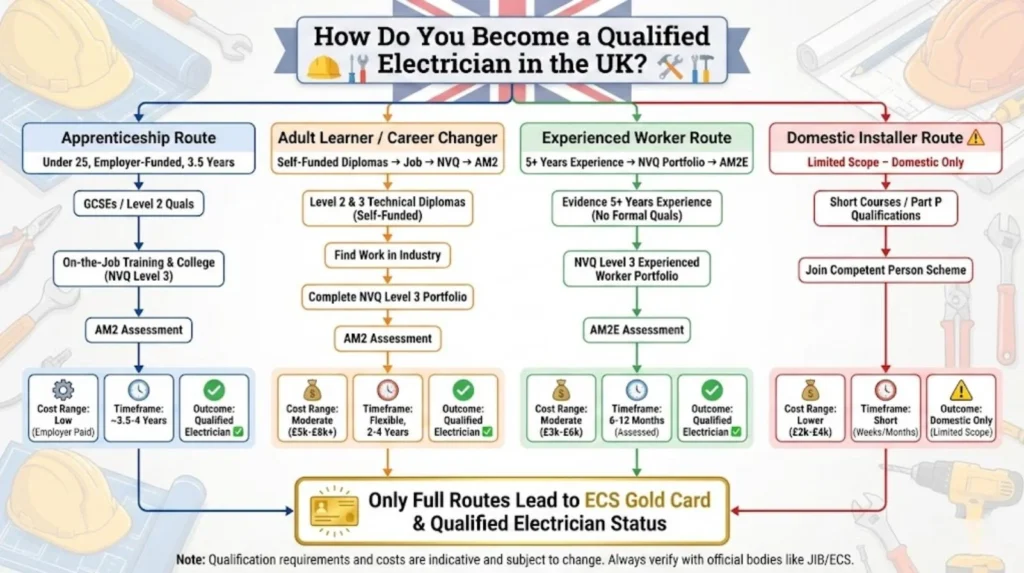
UK electrician qualifications create persistent confusion among career changers, school leavers, and experienced workers attempting to formalize their skills, with misconceptions about qualification requirements causing expensive mistakes, career delays, and employment difficulties when individuals complete partial qualifications believing they’re fully qualified electricians.
The confusion begins with terminology. Training providers advertise “electrician courses” without clarifying whether these deliver knowledge qualifications (diplomas teaching theory), competence qualifications (NVQs proving workplace capability), or both components required for qualified status. Learners completing Level 3 Diploma courses receive certificates, believe they’re now “Level 3 qualified electricians,” then discover employers require ECS Gold Cards which demand additional NVQ completion and AM2 assessment they haven’t undertaken. The 18th Edition BS 7671 qualification compounds confusion because its relatively quick completion (3-5 days) creates impression of substantial qualification progress, when it’s actually supplementary regulations knowledge that doesn’t assess practical competence.
The financial consequences are substantial. Complete electrician qualification pathways cost £10,000-£12,000 including all components, with 2.5-4 year timelines from beginner to qualified status. However, inadequate understanding of requirements causes learners to spend £5,000-£8,000 on diploma qualifications alone, then discover they cannot work as electricians or apply for ECS Gold Cards without additional £5,000-£7,000 and 12-24 months for NVQ competence assessment and AM2 examination. The diploma-only trap leaves thousands of learners annually stranded mid-qualification unable to progress without workplace opportunities enabling NVQ portfolio completion.
The domestic installer diversion adds further complexity. Shorter, cheaper domestic-focused qualifications (Part P courses, domestic installer packages) attract learners seeking faster routes to electrical work, but these restrict career scope to single-phase dwelling installations only, permanently excluding commercial construction sites and industrial facilities unless learners subsequently complete full qualification pathway at additional cost essentially duplicating their initial investment.
This article clarifies the three mandatory qualification components required for electrician status (knowledge, competence, assessment), explains why diploma-only qualifications don’t enable qualified work, positions 18th Edition appropriately as essential but supplementary certification, distinguishes domestic-only qualifications from full electrician credentials, breaks down requirements by route (apprenticeship, adult learner, experienced worker), and prevents expensive misconceptions about ECS Gold Cards, timelines, and employment readiness.
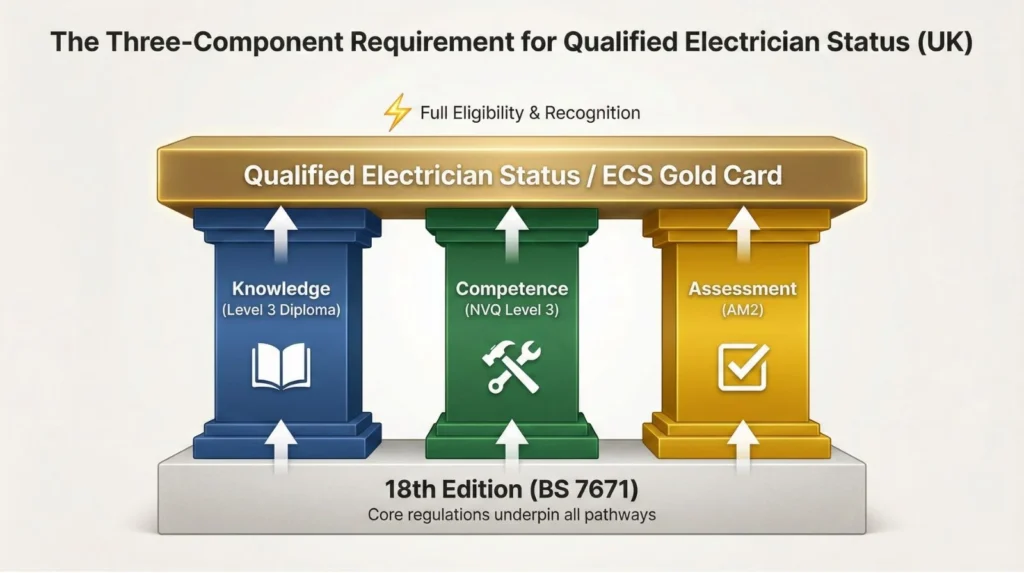
The Three-Component Requirement: Knowledge + Competence + Assessment
Qualified electrician status in UK requires three distinct qualification components, each serving specific verification purpose that cannot be substituted or omitted.
Component 1: Knowledge Qualification (Level 3 Diploma)
Knowledge qualifications prove theoretical understanding of electrical principles, regulations, and design concepts through classroom teaching and examination.
What knowledge qualifications cover:
Electrical theory and calculations (Ohm’s Law, power formulas, circuit analysis, impedance)
BS 7671 wiring regulations interpretation and application
Circuit design principles (load calculations, cable sizing, protection coordination)
Three-phase systems and motor circuits
Earthing arrangements and protection methods
Testing procedures and equipment operation theory
Health and safety requirements and risk assessment
Materials specifications and installation methods
Common Level 3 knowledge qualifications:
City & Guilds 2365 Level 3 Diploma in Electrical Installations
EAL Level 3 Diploma in Electrotechnical Technology
LCL Awards Level 3 qualifications in electrical installation
Integrated apprenticeship qualifications combining knowledge units
Assessment methods:
Written examinations (multiple choice, short answer, complex calculations)
Practical demonstrations on training rigs in controlled workshop environments
Design assignments requiring circuit calculations and specifications
Assignments applying BS 7671 requirements to installation scenarios
Duration and cost:
Full-time intensive: 8-12 weeks, £3,000-£6,000
Part-time: 6-12 months evening/weekend attendance, £3,000-£6,000
Apprenticeship-integrated: Part of overall program, employer-funded
What knowledge qualifications enable:
Enrollment in NVQ Level 3 competence assessment
Employment as skilled improver working under supervision
Understanding electrical principles necessary for safe installation work
Foundation for continuing professional development and specialist qualifications
What knowledge qualifications do NOT enable:
Unsupervised electrical work on construction sites or customer properties
ECS Gold Card application (requires NVQ and AM2 in addition)
Signing electrical installation certificates as competent person
Employment in “qualified electrician” positions requiring complete credentials
Self-employment undertaking electrical contracting independently
The diploma-only trap: Thousands of learners annually complete Level 3 Diploma believing this makes them “Level 3 qualified electricians,” discovering only when applying for jobs or ECS cards that diploma alone is insufficient. The certificate they receive says “Level 3” creating impression they hold Level 3 electrician status, when actually they hold Level 3 knowledge only without Level 3 competence verification.
Component 2: Competence Qualification (NVQ Level 3)
Competence qualifications prove workplace capability through portfolio evidence demonstrating sustained performance in real working environments over extended periods.
What NVQ Level 3 assesses:
Actual installations completed on construction sites or in customer properties
Portfolio documentation showing diverse installation types and complexity levels
Safe working practices consistently applied without constant supervision
Problem-solving capability when encountering unexpected site conditions
Quality of workmanship meeting industry standards for commercial productivity
Professional conduct interacting with customers, contractors, and other trades
Understanding of installation decisions through professional discussions
Common NVQ Level 3 qualifications:
City & Guilds 2357 NVQ Diploma in Installing Electrotechnical Systems and Equipment
EAL Level 3 NVQ in Installing Electrotechnical Systems and Equipment
Integrated apprenticeship NVQs (City & Guilds 5357 or equivalent)
Evidence requirements:
Photographic documentation of installations at various completion stages
Test results and electrical installation certificates from work completed
Assessor observations visiting workplace to evaluate installation quality
Professional discussions explaining design decisions and regulation application
Witness testimonies from supervising electricians or contractors
Coverage spanning multiple NVQ units proving breadth across installation types
Time period: typically 12-24 months accumulating sufficient diverse evidence
Assessment process:
Regular assessor visits to workplace (construction sites, customer properties)
Review of portfolio evidence demonstrating installation progression
Observation of working practices, safety procedures, and technical competence
Professional discussions verifying understanding beyond just following instructions
Verification that you’re performing installations independently, not just assisting
Duration and cost:
Timeline: 12-24 months minimum for evidence accumulation
Assessor costs: £2,000-£4,000 including visits, portfolio review, assessment fees
Requires: Employment or work opportunities enabling portfolio development
What NVQ enables:
Combined with knowledge qualification, enrollment in AM2 assessment
Proof of workplace competence for employer verification
Progression toward ECS Gold Card application after AM2 completion
Demonstration of sustained capability, not just one-off examination performance
What NVQ does NOT enable:
Qualified electrician status without AM2 assessment completion
ECS Gold Card application without AM2 pass and 18th Edition certification
Substitute for knowledge qualifications (requires Level 3 diploma alongside NVQ)
Independent assessment that NVQ alone represents qualified status
The employment catch-22: You need workplace installations to build NVQ portfolio, but employers typically require qualifications for electrical positions. This creates gap where diploma holders struggle securing work enabling NVQ completion. Training providers with strong contractor relationships and in-house recruitment teams eliminate this barrier.
Component 3: Independent Assessment (AM2 or AM2E)
AM2 assessment provides independent verification that you meet competence threshold through standardized practical examination administered separately from your training provider.
What AM2 assesses:
Complete installation from circuit design through testing and certification
Time-constrained work demonstrating commercial productivity standards
Safe isolation procedures and verification (prove-test-prove methodology)
Installation quality meeting BS 7671 requirements and industry standards
Testing sequence execution (continuity, insulation resistance, polarity, earth fault loop impedance)
Results interpretation and compliance verification
Fault-finding on installations with deliberate errors requiring diagnosis
Professional conduct and examination center protocol adherence
Examination structure:
Duration: 2.5 days (approximately 18-20 hours total)
Day 1: Installation work including circuit design, cable installation, termination
Day 2: Testing, fault-finding, certification, and verification procedures
Continuous assessment: Examiners observe working practices throughout
Written components: Knowledge questions, regulation application, calculations
Assessment location:
Approved AM2 centers administered by NET Services (independent organization)
Standardized facilities ensuring consistent examination conditions
NOT conducted by your training provider (ensures objective assessment)
Pass requirements:
Achieve minimum competence threshold across all assessment criteria
No critical safety failures (safe isolation errors typically result in immediate failure)
Complete installation within time constraints demonstrating productivity
Testing results accurate within acceptable tolerance ranges
Fault diagnosis correct with logical troubleshooting methodology
Cost and outcomes:
Fee: £800-£1,000 per attempt
Pass rate: Approximately 75-85% first attempt (15-25% failure rate)
Failed attempts require rebooking at full cost plus potential additional training
Pass result valid for ECS Gold Card application when combined with other requirements
Why independent assessment matters:
Prevents training providers passing inadequately prepared candidates
Ensures consistent standards across all electrician qualifications regardless of training route
Provides employers with confidence in “qualified electrician” designation
Creates accountability that practical competence genuinely meets industry threshold
Common failure reasons:
Testing sequence errors or incorrect results interpretation
Time management problems leaving installation incomplete
Safe isolation mistakes (most serious failure cause)
Poor fault-finding methodology (random component replacement rather than logical diagnosis)
Inadequate understanding of BS 7671 requirements affecting installation decisions
Thomas Jevons, Head of Training:
"The 18th Edition BS 7671 qualification is essential component of electrician qualifications but creates enormous confusion because it's relatively quick to complete—three to five days intensive course plus examination—leading learners to believe this represents substantial qualification progress. In reality, 18th Edition is open-book examination testing your ability to navigate wiring regulations document and apply specific requirements. It doesn't teach installation techniques, doesn't assess practical skills, doesn't verify you can test circuits or diagnose faults. It's mandatory requirement for ECS card applications and demonstrates current regulations knowledge, but having 18th Edition alone no more makes you qualified electrician than passing driving theory test makes you licensed driver. The practical competence assessment—NVQ and AM2—is what actually proves capability."
Thomas Jevons, Head of Training
The Complete Requirement:
Qualified electrician status requires:
Level 3 knowledge qualification (diploma proving theoretical understanding)
Level 3 NVQ competence qualification (portfolio proving workplace capability)
AM2 or AM2E assessment pass (independent verification meeting threshold)
Plus 18th Edition BS 7671 (current wiring regulations knowledge).
All four components are mandatory. Completing three of four components doesn’t make you “75% qualified” or enable partial electrician work. You either hold complete qualifications enabling ECS Gold Card application and qualified electrician employment, or you hold partial qualifications requiring additional components before achieving qualified status.
Why Diploma Alone Doesn't Make You Qualified
The diploma-only misconception causes more career delays and financial waste than any other qualification misunderstanding in electrical training.
What Diploma Certificates Actually Say
When you complete Level 3 Diploma in Electrical Installations, your certificate states:
“City & Guilds Level 3 Diploma in Electrical Installations”
or
“EAL Level 3 Diploma in Electrotechnical Technology”
The certificate prominently displays “Level 3” creating impression you hold Level 3 electrician qualification. However, this is Level 3 knowledge qualification, not Level 3 electrician status. The distinction is critical but easily overlooked.
What Employers Actually Require
When job advertisements request “Level 3 qualified electrician” or “qualified electrician with Level 3 NVQ,” they’re requiring:
Level 3 NVQ competence qualification (not just Level 3 diploma)
AM2 assessment pass
ECS Gold Card proving complete qualification set
Holding Level 3 Diploma alone doesn’t satisfy these requirements even though your certificate says “Level 3.” Employers aren’t being unreasonable or changing requirements after advertising—they always meant complete Level 3 qualification including competence verification, but job advertisement wording doesn’t always clarify this distinction.
The Employment Reality Check
Scenario: Learner completes Level 2 Diploma (£2,000-£4,000, 6-12 months) then Level 3 Diploma (£3,000-£6,000, 8-12 weeks). Total investment: £5,000-£10,000 and 9-18 months.
They apply for “qualified electrician” positions advertising £30,000-£40,000 salaries and requiring “Level 3 qualifications.”
Employer response: “Do you have ECS Gold Card?”
Learner response: “No, but I have Level 3 Diploma.”
Employer clarification: “We need qualified electricians with complete credentials—NVQ Level 3 and AM2 pass. Diploma alone qualifies you for skilled improver positions at £14-£20 per hour, not qualified electrician roles at £18-£25 per hour.”
The learner discovers their £5,000-£10,000 investment and 9-18 months of study have not made them qualified electrician. They now need:
Employment enabling NVQ portfolio development: 12-24 months
NVQ assessor costs: £2,000-£4,000
AM2 examination: £800-£1,000
Additional time: 12-24 months minimum
Additional cost: £3,000-£5,000 minimum
Total to reach actual qualified status: £8,000-£15,000 and 21-42 months from starting Level 2.
Why Training Providers Don’t Always Clarify This
Some training providers emphasize “Level 3 qualification” or “advanced electrical course” in marketing without adequately explaining that diploma alone doesn’t enable qualified electrician work. This happens because:
Competitive pressure: Providers compete for learners by emphasizing what they deliver (diploma teaching), minimizing what they don’t deliver (workplace placements for NVQ)
Payment incentive: Diploma courses generate revenue whether learners complete full pathway or not
Genuine belief: Some providers genuinely believe diploma represents substantial qualification progress (which it does, but it’s incomplete)
Learner optimism: Learners want to believe they’re close to qualified status, so they accept optimistic interpretations
What You Actually Get With Diploma Only:
Employment opportunities:
Electrical improver positions under supervision: £12-£20 per hour
Electrical mate roles assisting qualified electricians: £10-£16 per hour
Apprentice positions if you can secure employer sponsorship: £12,000-£18,000 annually
What you cannot do:
Work unsupervised on electrical installations
Sign electrical installation certificates as competent person
Apply for ECS Gold Card
Accept qualified electrician positions advertised at £30,000-£50,000
Self-employ as electrical contractor without additional supervision
Join Competent Person Schemes (NICEIC, NAPIT) as registered electrician
The Correction Required:
If you’ve completed diploma only, you need:
Secure employment on electrical installations (contractor employment, self-employment with projects, or training provider placement support)
Enroll in NVQ Level 3 assessment with approved assessor
Build portfolio over 12-24 months documenting diverse installations
Complete 18th Edition BS 7671 if not already held
Pass AM2 assessment (£800-£1,000)
Apply for ECS Gold Card with complete qualification set
This is why selecting training providers with guaranteed workplace placement support matters enormously. Understanding electrical qualification pathways in the UK includes recognizing value of in-house recruitment teams providing contractor connections eliminating diploma-to-employment gap.
| What You Think You Have | What You Actually Have | What’s Still Required | Additional Cost | Additional Time |
| “Level 3 Qualified Electrician” after diploma | Level 3 knowledge only, no competence verification | NVQ Level 3 + AM2 + 18th Edition + ECS card | £3,000-£5,000 | 12-24 months |
| “Nearly finished, just need ECS card” | Diploma complete, but NVQ and AM2 not started | Full workplace competence assessment and independent examination | £3,000-£5,000 | 12-24 months |
| “I have all my qualifications” after Level 2 and Level 3 diplomas | Foundation and advanced knowledge, no competence assessment | Everything related to proving workplace capability | £3,000-£5,000 | 12-24 months |
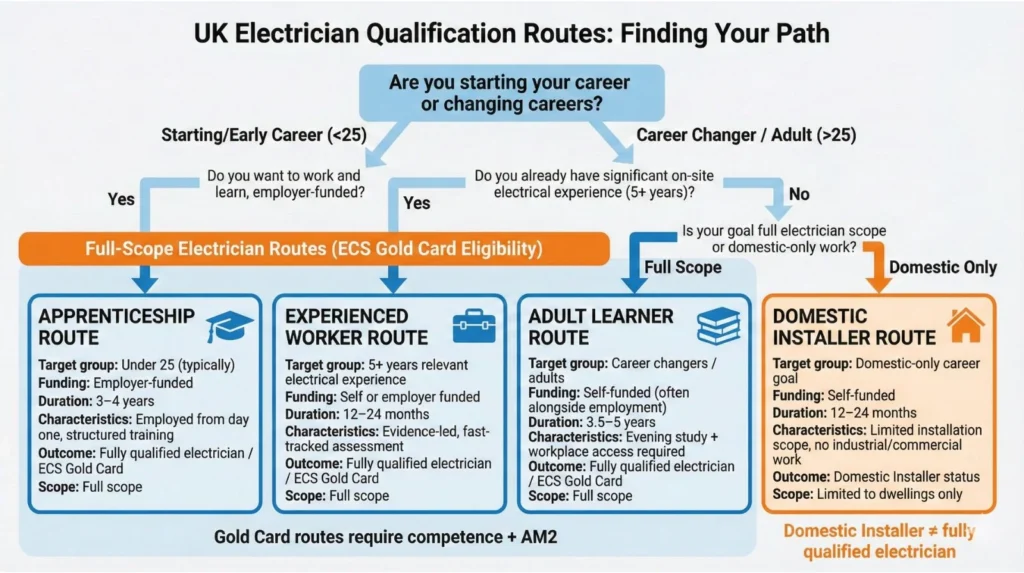
Route-by-Route Qualification Requirements
Different pathways to qualified electrician status have distinct qualification sequences and requirements.
Route 1: Apprenticeship (Standard Pathway for Young Learners)
Who it suits: School leavers, those under 25, people able to commit to apprentice wages for 3-4 years, learners wanting employer-funded training.
Qualification sequence:
Level 2 knowledge units (integrated into apprenticeship)
Level 3 knowledge units (integrated into apprenticeship)
Level 3 NVQ competence (workplace portfolio throughout apprenticeship)
18th Edition BS 7671
AM2 end-point assessment
Apply for ECS Gold Card
Duration: 42 months (3.5 years) typical apprenticeship framework.
Cost to learner: Minimal, employer-funded through apprenticeship levy or government co-investment.
Employment status: Employed throughout as apprentice electrician.
Wages during training:
Year 1: £12,000-£15,000 annually
Year 2: £14,000-£17,000 annually
Year 3-4: £16,000-£20,000 annually
Upon qualification: £25,000-£35,000 entry-level qualified electrician
Advantages:
Seamless pathway with no employment gaps between qualifications
Employer funds qualification costs (£10,000-£12,000 value)
Guaranteed workplace experience for NVQ portfolio
Structured progression from foundation through qualified status
Established employer relationship upon qualifying
Disadvantages:
Requires finding apprenticeship employer (competitive)
Extended period at lower apprentice wages
Less suitable for those over 25 or with family financial responsibilities
Commitment to 3.5-year program with single employer
Mandatory employer requirement: Cannot undertake apprenticeship without employer sponsorship from day one.
Route 2: Adult Learner / Career Changer (Self-Funded Pathway)
Who it suits: Career changers over 25, those unable to secure apprenticeships, learners with existing financial commitments requiring faster income progression, people with savings enabling upfront training investment.
Qualification sequence:
Level 2 Diploma (6-12 months, £2,000-£4,000) – Self-funded
Level 3 Diploma (8-12 weeks, £3,000-£6,000) – Self-funded
Secure employment as electrical improver/mate
18th Edition BS 7671 (3-5 days, £300-£600)
Level 3 NVQ competence (12-24 months workplace portfolio, £2,000-£4,000 assessor costs)
AM2 assessment (2.5 days, £800-£1,000)
Apply for ECS Gold Card
Duration: 2.5-4 years typically from Level 2 start to ECS Gold Card.
Cost to learner: £8,000-£15,000 total depending on provider and support level.
Employment status:
Stages 1-2: Unemployed or working in other field whilst studying
Stage 3 onward: Employed as electrical improver whilst completing NVQ
Income during pathway:
Pre-employment (during diploma study): Previous income or savings
Improver wages during NVQ: £25,000-£35,000 annually
Upon qualification: £30,000-£50,000 qualified electrician
Advantages:
Faster income progression than apprenticeship (reach qualified wages sooner)
More suitable for mature learners with financial responsibilities
Flexibility choosing training providers and employment
Can complete diplomas intensively (faster than apprenticeship pace)
Suitable for those unable to secure apprenticeship positions
Disadvantages:
Substantial upfront investment (£5,000-£10,000 for diplomas before employment)
Risk of diploma-to-employment gap if provider lacks placement support
Self-funded assessor costs during NVQ (£2,000-£4,000)
No guarantee of employment for NVQ completion without provider support
Higher financial risk if unable to complete pathway
Critical success factor: Securing employment enabling NVQ portfolio development after completing diplomas. Providers with guaranteed placement support through contractor partnerships eliminate highest-risk stage of this route.
Route 3: Experienced Worker Assessment (For Unqualified Electricians)
Who it suits: Workers with 5+ years substantial electrical installation experience but no formal qualifications, former electrical mates who’ve performed installations extensively, military electricians transitioning to civilian work, self-employed workers formalizing their status.
Qualification sequence:
Skills assessment determining existing competence level
Bridging units addressing knowledge gaps (if required)
Level 3 NVQ Experienced Worker portfolio from historical work
18th Edition BS 7671 (if not current)
Level 3 Inspection and Testing (often required)
AM2E assessment (Experienced Worker version)
Apply for ECS Gold Card
Duration: 6-18 months typically depending on evidence availability and bridging requirements.
Cost to learner: £3,000-£6,000 for experienced worker assessment program.
Employment status: Typically already working electrically (though not as qualified electrician) throughout assessment.
Advantages:
Much faster than starting from Level 2 beginner position
Recognizes existing competence without repeating known material
Lower cost than complete pathway (£3,000-£6,000 vs £10,000-£15,000)
Suitable for mature workers with substantial experience
Can formalize long-standing competence quickly
Disadvantages:
Requires genuine 5+ years substantial experience (not just helping occasionally)
Must provide historical evidence (photos, certificates, witness statements from years of work)
Breadth requirement: experience must span diverse installation types, not just domestic
Skills assessment may reveal knowledge gaps requiring bridging units
AM2E still required (cannot shortcut independent assessment)
Critical requirements:
Provable experience across multiple installation types over extended period
Witness testimonies from contractors or supervisors confirming your work
Photographic evidence of installations completed
Understanding of BS 7671 and design principles (tested through professional discussions)
Disqualifies if: Your experience is limited to electrical laboring/helping without independent installations, domestic-only work without commercial exposure, short-term or recent experience (less than 5 years), or inability to provide evidence spanning diverse installation types.
Route 4: Domestic Installer (Limited Scope Qualification)
Who it suits: Those certain they only want domestic dwelling work with no commercial ambitions, older learners wanting quicker route to some income, part-time electrical work alongside other employment, property maintenance workers adding electrical capability.
Qualification sequence:
Domestic Installer package (Level 2/3 knowledge units focused on domestic, 4-8 weeks)
18th Edition BS 7671
Part P Building Regulations awareness
Join Competent Person Scheme (NICEIC Domestic Installer, NAPIT, etc.)
Build limited portfolio for domestic work only
Duration: 2-6 months for initial qualifications, then ongoing CPD.
Cost to learner: £2,000-£5,000 for courses plus £400-£700 annual Competent Person Scheme membership.
Scope enabled:
Single-phase installations in dwellings (houses, flats)
Rewiring, consumer unit changes, additional circuits in homes
Domestic electrical testing and certification
Part P notification through Competent Person Scheme
Scope NOT enabled:
Commercial construction sites
Industrial facilities
Three-phase installations
Complex protection systems
ECS Gold Card (requires full Level 3 NVQ pathway)
Commercial electrical contracting
Joshua Jarvis, Placement Manager:
"Learners attracted to domestic installer short courses—Part P qualifications, domestic-focused diplomas—because they're quicker and cheaper than full electrician pathway often don't realize they're limiting career scope permanently. Domestic installer qualifications restrict you to single-phase work in dwellings only. You cannot work on commercial construction sites, industrial facilities, or any installation requiring three-phase systems, complex protection, or commercial containment. When domestic installers later want broader opportunities, they essentially restart qualification journey completing full Level 3 NVQ pathway at additional £8,000 to £12,000 cost. If there's any possibility you'll want commercial work eventually, pursue full qualification pathway from start rather than domestic-only route creating expensive dead-end requiring backtracking."
Joshua Jarvis, Placement Manager
When domestic route makes sense:
You’re absolutely certain you only want domestic work (no commercial ambitions ever)
You have existing property maintenance business adding electrical services
You’re semi-retiring and want part-time domestic electrical work only
You understand and accept career limitations this creates
When full pathway is better choice:
Any possibility you’ll want commercial opportunities eventually
You want maximum employment flexibility
You’re young or mid-career with long-term electrical career planned
You want highest earning potential (commercial rates exceed domestic)
The backtracking cost: If domestic installer later wants full qualification:
Must complete full Level 3 NVQ pathway from beginning
Cannot “upgrade” domestic qualifications to full electrician status
Essentially duplicates initial investment: £8,000-£12,000 additional cost
18 months to 3 years additional time for NVQ and AM2
Previous domestic qualification provides limited credit toward full pathway
Understanding ECS Gold Card Requirements
ECS Gold Card creates confusion because learners view it as qualification to obtain, when actually it’s proof you’ve already obtained required qualifications.
What ECS Gold Card Actually Is
The Electrotechnical Certification Scheme Gold Card is identification card proving to employers and construction sites that cardholder holds verified electrician qualifications meeting JIB (Joint Industry Board) standards.
Card function:
Site access authorization on construction projects
Visual proof of qualified electrician status
Verification that qualification checks completed by JIB with awarding bodies
Professional identification recognized across UK electrical industry
What the card is NOT:
A qualification itself (it represents qualifications you already hold)
Something you can “do a course for” (you must complete full qualification pathway first)
Guaranteed employment (it proves qualifications but doesn’t guarantee jobs)
Replacement for actual qualification certificates (you need underlying credentials first)
How to Apply for ECS Gold Card
Step 1: Verify you hold ALL required qualifications:
Level 3 knowledge qualification (2365 Level 3 Diploma or equivalent)
Level 3 NVQ competence qualification (2357 NVQ or equivalent)
AM2 or AM2E assessment pass certificate
18th Edition BS 7671 current certification (within past 3 years)
Step 2: Complete ECS Health, Safety and Environmental Assessment:
Separate examination covering electrical safety procedures
Different from CITB health and safety test (ECS-specific)
Cost: £25-£35, validity 3 years
Required for all ECS card applications regardless of qualification level
Step 3: Submit application through JIB/ECS:
Online application at ecscard.org.uk
Upload qualification certificates (diploma, NVQ, AM2, 18th Edition)
Provide photo meeting passport standards
Pay application fee (approximately £36 for three-year card)
Step 4: Await verification:
JIB contacts awarding bodies verifying qualification authenticity
Checks ensure certificates are genuine and qualifications meet ECS criteria
Process typically takes 2-4 weeks
Cannot expedite verification period
Step 5: Receive card:
Card valid 3 years from issue date
Expiry date clearly marked
Must renew before expiry to maintain validity
Why You Cannot Get ECS Gold Card Without Complete Qualifications:
JIB verifies every qualification with awarding bodies. You cannot:
Submit diploma only and claim NVQ is “in progress”
Skip AM2 and hope they don’t check
Use expired 18th Edition certification
Submit non-regulated course certificates
Falsify qualification documentation
Verification process catches incomplete qualification sets. Application will be rejected with explanation of what’s missing. You must complete full requirements before ECS Gold Card becomes available.
ECS Card Hierarchy:
Different card colors indicate qualification levels:
Gold: Qualified electrician (NVQ Level 3 + AM2)
Green: Trainee electrician (enrolled in training programs)
Blue: Apprentice electrician (formal apprenticeship)
Yellow/Amber: Electrical laborer (assisting qualified electricians)
White: Related electrical occupations (managers, supervisors without electrical qualifications)
Holding ECS Trainee card (green) whilst working toward qualifications is appropriate. However, green card doesn’t enable qualified electrician positions or rates. Only Gold Card represents complete qualification set.
Card Renewal Requirements:
Every 3 years:
Submit renewal application 3 months before expiry
Provide updated ECS Health, Safety and Environmental Assessment pass
Verify 18th Edition remains current (renew if expired)
Pay renewal fee (approximately £36)
Maintain continuous professional development
Letting card expire creates gaps in site access authorization. Most employers require current valid cards for employment.
What Individual Qualifications Actually Prove
Understanding what each qualification component proves (and doesn’t prove) prevents misconceptions.
18th Edition BS 7671 Wiring Regulations
What it proves:
Ability to navigate BS 7671 wiring regulations document
Understanding of current regulation requirements
Knowledge of protective measures, earthing arrangements, special locations
Capability to look up specific requirements when needed
Assessment method: Open-book examination, typically online, 3-5 day course then 2-hour exam with access to regulations book.
What it does NOT prove:
Installation techniques or practical skills
Testing procedures or equipment operation
Fault diagnosis or problem-solving
Design capabilities or circuit calculations
Workplace competence of any kind
Cost: £300-£600 for course and examination.
Validity: Approximately 3-4 years (when new edition published, must update).
Common misconception: “I’ve done my 18th Edition so I’m nearly qualified.” Reality: 18th Edition is supplementary qualification required alongside NVQ and AM2, not progress toward them. Having 18th Edition moves you 0% closer to NVQ portfolio completion or AM2 readiness.
Level 2 Diploma
What it proves:
Foundation electrical theory understanding
Basic circuit design knowledge
Elementary testing awareness
Health and safety basics
Assessment method: Exams and workshop practicals on training rigs.
What it does NOT prove:
Readiness for qualified electrician work
Competence beyond supervised improver roles
Ability to work independently
Cost: £2,000-£4,000.
Duration: 6-12 months.
Common misconception: “Level 2 makes me half-qualified.” Reality: Level 2 is foundation only, not 50% progress. You still need Level 3 knowledge, Level 3 NVQ, and AM2 for qualified status.
Level 3 Diploma (Knowledge)
What it proves:
Advanced electrical theory understanding
Complex circuit design knowledge
Detailed BS 7671 application
Inspection and testing theory
Assessment method: Advanced exams and workshop practicals.
What it does NOT prove:
Workplace competence on real installations
Ability to work independently without supervision
Commercial productivity meeting site standards
Qualification for ECS Gold Card
Cost: £3,000-£6,000.
Duration: 8-12 weeks intensive, 6-12 months part-time.
Common misconception: “Level 3 Diploma makes me Level 3 qualified electrician.” Reality: Level 3 Diploma is knowledge component only. Still need NVQ and AM2 for qualified status.
NVQ Level 3 (Competence)
What it proves:
Sustained workplace competence over extended period
Ability to complete installations independently
Safe working practices consistently applied
Problem-solving in real-world situations
Quality workmanship meeting commercial standards
Assessment method: Portfolio evidence, assessor observations, professional discussions spanning 12-24 months.
What it does NOT prove:
Independent verification of competence threshold (requires AM2 for that)
Qualification without knowledge component (requires Level 3 diploma alongside)
Immediate productivity (newly qualified electricians still developing efficiency)
Cost: £2,000-£4,000 assessor costs.
Duration: 12-24 months minimum.
Common misconception: “Once NVQ is done I’m qualified.” Reality: NVQ plus AM2 plus diploma plus 18th Edition equals qualified status. NVQ alone is incomplete.
AM2 Assessment
What it proves:
Independent verification meeting competence threshold
Ability to complete installations under time pressure
Testing procedures executed correctly
Fault-finding capability
Safe isolation and verification
Assessment method: 2.5-day practical examination at approved centers.
What it does NOT prove:
Knowledge without diploma
Workplace sustained performance (NVQ proves that)
Mastery of specialized installations beyond standard scope
Cost: £800-£1,000 per attempt.
Pass rate: 75-85% first attempt.
Common misconception: “AM2 is just formality after NVQ.” Reality: 15-25% fail first attempt. It’s rigorous independent assessment with substantial failure consequences.
Understanding complete electrician training pathways includes recognizing how individual qualification components combine into complete requirement set, preventing diploma-only misconceptions and 18th Edition overvaluation.
Realistic Timelines From Start to Qualified
Understanding accurate timelines prevents disappointment from marketing claims about rapid qualification.
Complete Beginner to Qualified Electrician
Apprenticeship route:
Duration: 42 months (3.5 years) standard framework
Continuous employment throughout
Employer-funded qualifications
Earn approximately £12,000-£20,000 during apprenticeship
Upon completion: Qualified electrician earning £25,000-£35,000 entry level
Adult learner route:
Level 2 Diploma: 6-12 months
Level 3 Diploma: 2-6 months
Employment seeking: 1-6 months (variable, depends on provider placement support)
NVQ Level 3 portfolio: 12-24 months
AM2 preparation and examination: 1-3 months
Total: 2.5-4 years minimum
Why it cannot be faster:
NVQ requires 12-24 months workplace evidence accumulation (cannot compress)
Portfolio must demonstrate diverse installation types (requires time encountering variety)
Competence assessment verifies sustained performance (not one-off demonstrations)
Learning consolidation between levels prevents dangerous knowledge gaps
Experienced Worker to Qualified
With genuine 5+ years substantial experience:
Skills assessment: 1-2 months
Bridging units (if required): 2-6 months
Portfolio assembly from historical work: 2-4 months
Inspection & Testing qualification: 1-2 months
AM2E preparation and assessment: 1-2 months
Total: 6-18 months typically
Why it’s faster:
Leverages existing competence (no need repeating foundational learning)
Historical work provides evidence (not building from scratch)
Focused on formalization rather than learning from beginning
Domestic Installer to Full Qualification
If starting from domestic-only credentials:
Recognize domestic qualification provides limited credit
Must complete full Level 3 NVQ pathway: 18 months-3 years
Cannot “top up” domestic to full qualification
Essentially starting qualification journey from early stage
Total: 18 months-3 years from domestic background to full qualified status
Why domestic doesn’t transfer directly:
Domestic scope excludes commercial/industrial experience
Three-phase systems, complex protection, commercial containment not covered
NVQ breadth requirements cannot be met with domestic-only experience
Must accumulate commercial evidence from beginning
Part-Time vs Full-Time Study Impact
Full-time intensive study:
Diplomas faster (Level 2 in 6 months, Level 3 in 2-3 months)
But NVQ still requires 12-24 months (cannot compress workplace evidence)
Overall: 2.5-3 years minimum complete beginner to qualified
Part-time evening/weekend study:
Diplomas slower (Level 2 in 12-24 months, Level 3 in 6-12 months)
NVQ same timeline (12-24 months regardless of diploma pace)
Overall: 3-4 years complete beginner to qualified
Why Marketing Claims of “Qualified in 12 Weeks” Are Misleading:
These claims typically refer to:
Level 3 Diploma knowledge delivery only (8-12 week intensive courses)
NOT complete qualification including NVQ and AM2
No mention of 12-24 month NVQ portfolio requirement after diploma
No explanation of AM2 assessment following NVQ
Technically accurate (you can complete diploma in 12 weeks) but deliberately misleading about overall qualification timeline
The honest timeline messaging:
Diploma completion: 2-12 months depending on route
Then NVQ portfolio: 12-24 months
Then AM2 assessment: Immediate after NVQ
Total: 2.5-4 years beginner to qualified is realistic expectation
| Starting Point | Route | Minimum Timeline | Typical Timeline | Compressed Timeline Possible? |
| Complete beginner, under 25 | Apprenticeship | 42 months | 42 months | No (set framework) |
| Complete beginner, over 25 | Adult learner | 30 months | 36-48 months | Only diploma stage (NVQ cannot compress) |
| 5+ years substantial experience | Experienced worker | 6 months | 12-18 months | Somewhat (depends on evidence availability) |
| Domestic installer background | Bridging to full | 18 months | 24-36 months | No (must accumulate commercial evidence) |
| Level 2 already completed | Continuing to qualified | 24 months | 30-36 months | Only Level 3 diploma stage |
| Level 3 diploma already completed | NVQ and AM2 | 12 months | 18-24 months | No (portfolio requires time) |
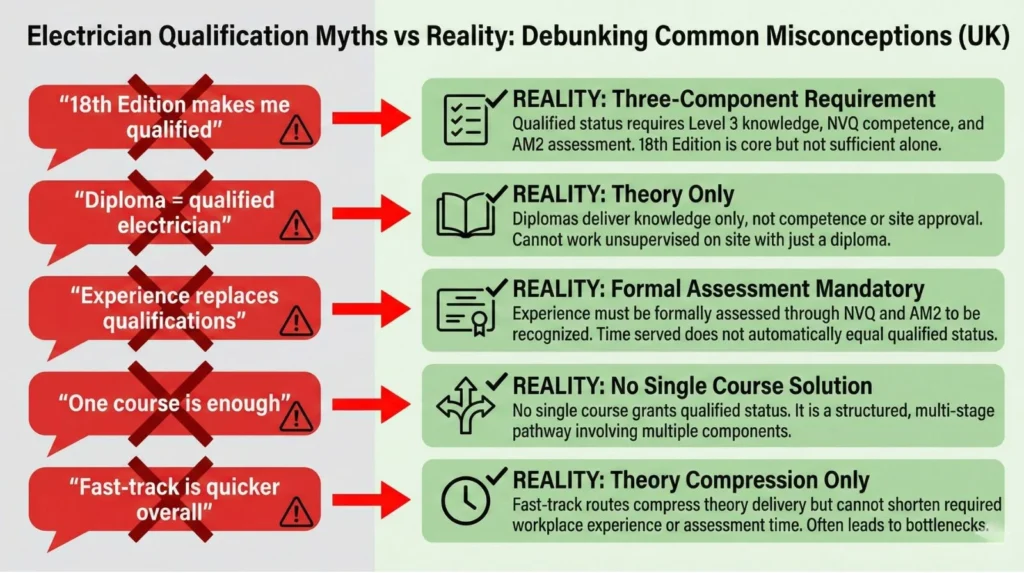
Common Qualification Misconceptions Debunked
Clearing up frequent misunderstandings prevents expensive mistakes.
Misconception 1: “One Course Makes Me Qualified”
Reality: No single course provides complete electrician qualification. All routes require multiple components: knowledge qualification, competence qualification, independent assessment, and current regulations certification. Shortest legitimate pathway (experienced worker route) still requires 6-18 months and multiple assessment components.
Misconception 2: “18th Edition = Qualified Electrician”
Reality: 18th Edition is 3-5 day course on regulations document. It teaches nothing about installation techniques, testing procedures, or fault diagnosis. Having 18th Edition without NVQ and AM2 is like having driving theory test pass without practical driving test—proves regulations knowledge but not capability to actually perform work.
Misconception 3: “Experience Replaces Need for Qualifications”
Reality: Experience enables Experienced Worker Assessment route, but you still need formal assessment proving that experience meets standards. Cannot self-declare qualified status based on years worked. Must complete portfolio assessment and AM2E examination verifying competence.
Misconception 4: “All Level 3s Are Same”
Reality: “Level 3 Diploma” (knowledge) fundamentally differs from “Level 3 NVQ” (competence). Both are Level 3 but assess completely different things. Job advertisements requesting “Level 3 qualified” typically mean NVQ, not diploma. Always clarify which Level 3 is required.
Misconception 5: “Cards Equal Qualifications”
Reality: ECS cards represent qualifications but aren’t qualifications themselves. You cannot “take a course to get Gold Card.” You must first obtain underlying qualifications (diploma, NVQ, AM2, 18th Edition), then apply for card as proof of those qualifications.
Misconception 6: “Domestic Experience = Site Competence”
Reality: Domestic installations cover limited scope (single-phase, basic circuits, simple protection). Commercial and industrial work requires three-phase systems, complex protection coordination, extensive containment, and different working practices not covered in domestic experience. Cannot transfer directly without substantial additional training and evidence accumulation.
Misconception 7: “I Can Do NVQ in Training Center”
Reality: NVQs must be assessed in actual workplace environments on real installations. Training centers can deliver knowledge qualifications (diplomas) but cannot deliver NVQs. You must be working on construction sites, in customer properties, or on actual projects to build NVQ portfolio.
Misconception 8: “Fast-Track Equals Better Value”
Reality: Fast-track typically refers to diploma delivery speed only, not complete qualification pathway. NVQ cannot be fast-tracked (requires 12-24 months regardless). Fast-track often means compressed diploma teaching that may be too rapid for effective learning, with same NVQ timeline afterward making overall pathway no faster.
Misconception 9: “Inspection & Testing Required to Start”
Reality: Inspection and Testing (City & Guilds 2391 or equivalent) is post-qualification specialist certification, not entry requirement. You complete it after becoming qualified electrician, not before. Attempting 2391 before solid Level 3 foundation results in high failure rates.
Misconception 10: “Military Route Automatically Qualifies for Civilian Sites”
Reality: Military electrical qualifications don’t automatically transfer to civilian credentials. Veterans typically need civilian qualification assessment (often Experienced Worker route), mapping military training to NVQ requirements, and completing AM2 assessment. Military experience is valuable but requires formal civilian qualification verification.
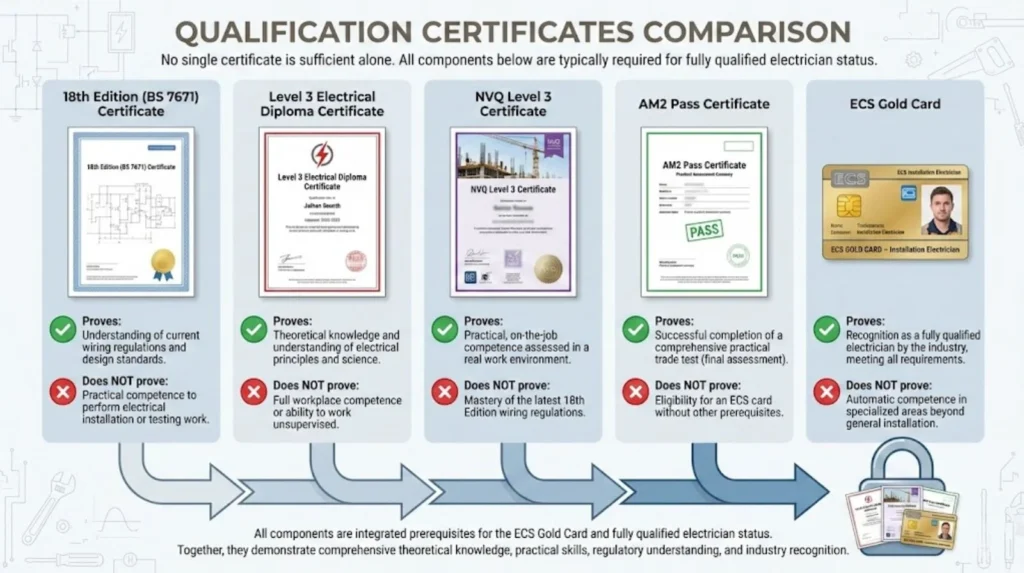
Cutting through confusion to provide definitive requirements for electrician qualification in UK.
Mandatory Qualifications:
Level 3 Knowledge Qualification (City & Guilds 2365 Level 3, EAL equivalent, or integrated apprenticeship qualification) – Proves theoretical understanding
Level 3 NVQ Competence Qualification (City & Guilds 2357, EAL equivalent, or apprenticeship NVQ) – Proves workplace capability
AM2 or AM2E Assessment Pass – Independent verification meeting competence threshold
18th Edition BS 7671 Current – Wiring regulations knowledge
All four required simultaneously. Three of four doesn’t equal 75% qualified. You’re either qualified (all four components) or not qualified (missing any component).
Typical Costs:
Apprenticeship route: Employer-funded (£10,000-£12,000 value)
Adult learner route: £8,000-£15,000 self-funded
Experienced worker route: £3,000-£6,000 self-funded
Typical Timelines:
Apprenticeship: 42 months (3.5 years)
Adult learner: 30-48 months (2.5-4 years)
Experienced worker: 6-18 months
What Qualified Status Enables:
Unsupervised electrical installation work
ECS Gold Card application and site access
Employment in qualified electrician positions at £30,000-£50,000
Self-employment as electrical contractor
Competent Person Scheme registration (NICEIC, NAPIT)
Signing electrical installation certificates
What Partial Qualifications Enable:
Diploma only: Skilled improver positions £14-£20 per hour under supervision
NVQ without AM2: Nothing additional beyond diploma-only (AM2 required for qualified status)
18th Edition only: Nothing beyond regulations knowledge awareness
Critical Success Factors:
Understand complete requirements before starting – Don’t discover mid-pathway you’re missing components
Budget for full pathway – £10,000-£15,000 adult learner, not just diploma costs
Plan 2.5-4 year timeline – Not 12 weeks or 6 months marketed claims
Secure workplace opportunities for NVQ – Choose providers with placement support
Don’t stop at diploma – It’s one-third of requirements, not finish line
Contact Elec Training on 0330 822 5337 to discuss complete electrician qualification requirements appropriate for your starting point. We’ll explain the three mandatory components (knowledge qualification, competence assessment, independent examination) and how they combine for qualified electrician status and ECS Gold Card eligibility. Our programs include guaranteed workplace placement support through 120+ contractor partnerships, eliminating the diploma-to-employment gap that strands many learners mid-pathway unable to complete NVQ requirements. We provide transparent information about full qualification costs (£10,000-£12,000 typically) and realistic timelines (2.5-4 years for complete beginners), preventing diploma-only misconceptions that cause employment difficulties when learners discover their partial qualifications don’t enable qualified electrician work. Whether you’re complete beginner requiring full pathway, experienced worker needing formalization, or domestic installer wanting commercial scope expansion, we’ll clarify exact qualification requirements and pathway appropriate for your situation.
References
- ECS Card Types and Requirements: https://www.ecscard.org.uk/card-types
- ECS Recognised Qualifications: https://www.ecscard.org.uk/content/jib-recognised-electrical-theory-qualifications
- JIB Grading Definitions Section 4: https://www.jib.org.uk/wp-content/uploads/2024/01/JIB_Handbook_2024_Section_4.pdf
- NET Services AM2 Assessment: https://www.netservices.org.uk/am2/
- NET Services AM2E Assessment: https://www.netservices.org.uk/am2e/
- City & Guilds 2365 Specification: https://www.cityandguilds.com/
- City & Guilds 2357 NVQ Specification: https://www.cityandguilds.com/
- City & Guilds 2346 Experienced Worker: https://www.cityandguilds.com/
- EAL Electrotechnical Qualifications: https://eal.org.uk/
- LCL Awards Electrical Qualifications: https://lclawards.co.uk/
- Ofqual Register of Regulated Qualifications: https://register.ofqual.gov.uk/
- GOV.UK Apprenticeship Standard ST0152: https://www.instituteforapprenticeships.org/
- National Careers Service – Electrician: https://nationalcareers.service.gov.uk/job-profiles/electrician
- Electrical Experienced Worker Assessment: https://www.electrical-ewa.org.uk/
- Elec Training – Domestic vs Qualified: https://dev.elec.training/news/domestic-installer-vs-fully-qualified-electrician-whats-the-real-difference/
- Elec Training – How to Become Electrician: https://dev.elec.training/news/how-to-become-an-electrician-in-the-uk-2026/
Note on Accuracy and Updates
Last reviewed: 2 January 2026. This article reflects UK electrician qualification requirements, three-component structure (knowledge, competence, assessment), route distinctions, and ECS Gold Card eligibility criteria as of December 2025. Qualification specifications occasionally change as awarding bodies update frameworks (City & Guilds, EAL, LCL Awards revise NVQ units or diploma content), JIB modifies grading criteria affecting ECS card requirements, or AM2 assessment structure evolves through NET Services updates. Course costs represent approximate December 2025 pricing across various training providers but vary significantly by region (London higher than regional centers), delivery mode (full-time intensive versus part-time evening), and provider type (private training versus further education colleges). Timeline estimates (2.5-4 years complete beginner to qualified) reflect typical progression but individual circumstances vary based on learning pace, workplace opportunity availability, part-time versus full-time study, and assessment success rates. The three-component requirement (Level 3 knowledge + Level 3 NVQ + AM2) remains consistent across all routes but specific qualification codes and assessment methods may update periodically. Learners planning electrical careers should verify current requirements on Ofqual Register for regulated qualifications, confirm ECS card criteria on ecscard.org.uk, check awarding body specifications directly for detailed unit requirements, and assess training provider quality beyond claimed qualification delivery. We update content as qualification frameworks, competence assessment requirements, JIB grading criteria, and industry standards evolve.