

Overseas Electricians: Getting Your Non-UK Qualifications Recognised and Working Toward a Gold Card
You're a qualified electrician with years of experience. You've wired commercial buildings, troubleshot complex faults, supervised apprentices. Then you move to the UK and discover your qualifications don't automatically translate into a Gold Card and site access. Frustrating? Absolutely. But the UK's recognition system isn't designed to dismiss overseas training. It's built around a specific principle: demonstrated competence to British standards, not just paper qualifications.

- Technical review: Thomas Jevons (Head of Training, 20+ years)
- Employability review: Joshua Jarvis (Placement Manager)
- Editorial review: Jessica Gilbert (Marketing Editorial Team)
- Last reviewed:
- Changes: Updated with 2026 ECS/JIB recognition pathways and current Ecctis requirements
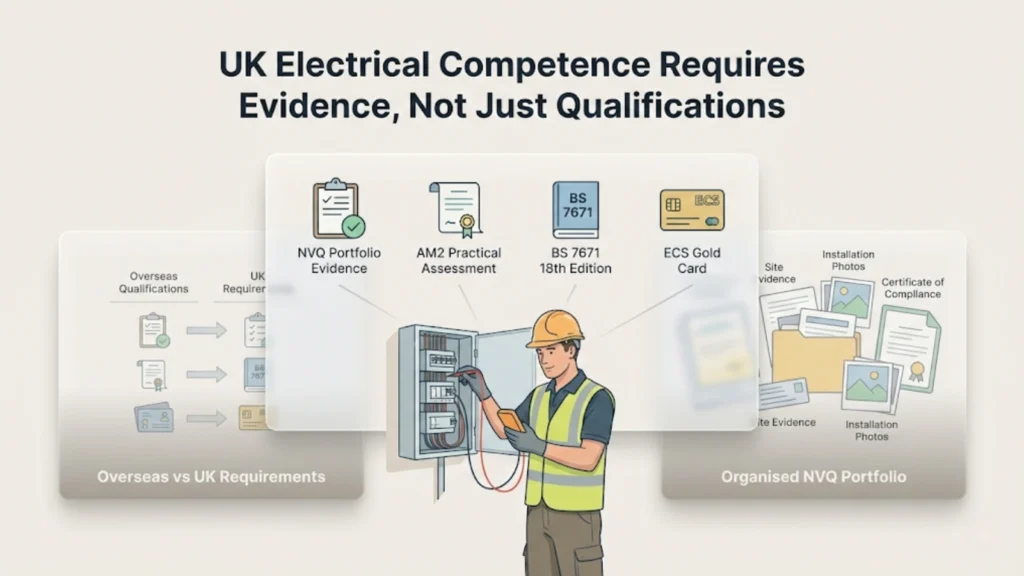
You’re a qualified electrician with years of experience. You’ve wired commercial buildings, troubleshot complex faults, supervised apprentices. Then you move to the UK and discover your qualifications don’t automatically translate into a Gold Card and site access.
Frustrating? Absolutely. But the UK’s recognition system isn’t designed to dismiss overseas training. It’s built around a specific principle: demonstrated competence to British standards, not just paper qualifications.
This guide breaks down what overseas electricians actually need to work legally in the UK, why the system works the way it does, and what pathways exist to get from “qualified abroad” to “Gold Card holder.” No sugar-coating, no false shortcuts. Just the reality of navigating UK electrical qualification recognition in 2026.
What Recognition Actually Means in the UK
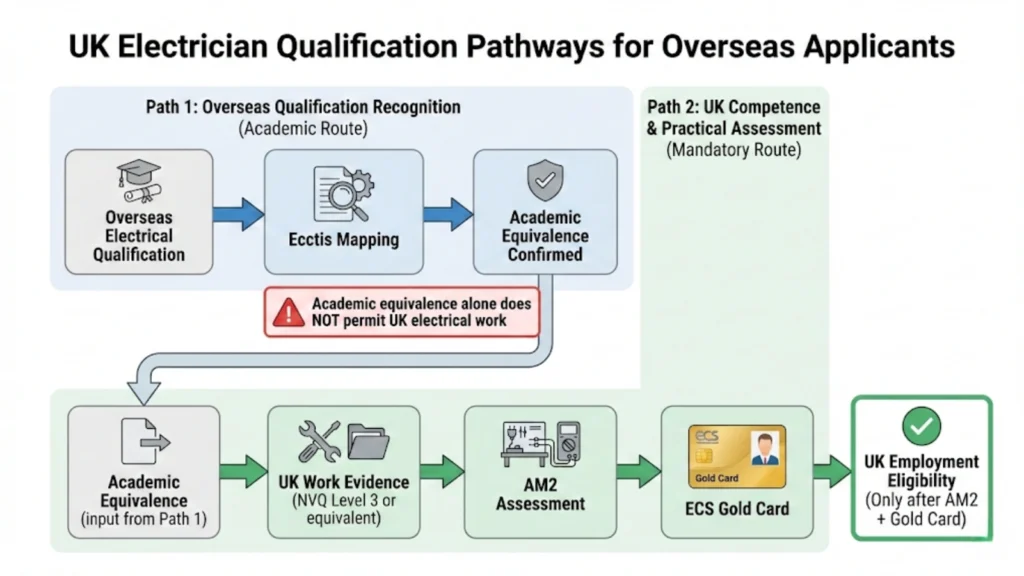
Academic recognition compares your overseas diploma or certificate to UK educational levels. This is handled by Ecctis (formerly UK NARIC). They’ll assess your qualifications and produce a Statement of Comparability confirming, for example, that your electrical engineering diploma is equivalent to a UK Level 3 qualification.
Useful for visa applications? Yes. Enough to work as an electrician? Not even close.
Occupational competence recognition is handled by JIB (Joint Industry Board) and ECS (Electrotechnical Certification Scheme). They don’t assess paper qualifications in isolation. They assess whether you can demonstrate practical skills aligned with BS 7671:2018+A2:2022, understand UK statutory requirements like the Electricity at Work Regulations 1989, and can complete work to British installation standards. This is the recognition that matters for employment.
Here’s where overseas electricians often hit confusion: Ecctis might confirm your qualification is academically equivalent to UK Level 3, but JIB/ECS will still require UK-based competence assessment before issuing a Gold Card. Academic equivalence doesn’t prove occupational competence, especially when regulatory frameworks differ between countries.
The UK system isn’t unique in this approach. Australia requires Skills Assessment from Trades Recognition Australia. Canada uses provincial apprenticeship authorities. New Zealand operates through the Electrical Workers Registration Board. Most developed countries separate academic credential comparison from trade competence verification.
The key difference: UK electrical work isn’t licensed by government (unlike, say, plumbing or gas work). Instead, competence is verified through the industry-managed ECS card scheme, which contractors and sites recognize as proof of assessed ability. No Gold Card typically means no site access, regardless of your experience level.
Understanding approved electrician earnings also helps clarify why UK employers prioritize Gold Card status. Higher-paid roles require demonstrated UK-standard competence, not just overseas credentials.
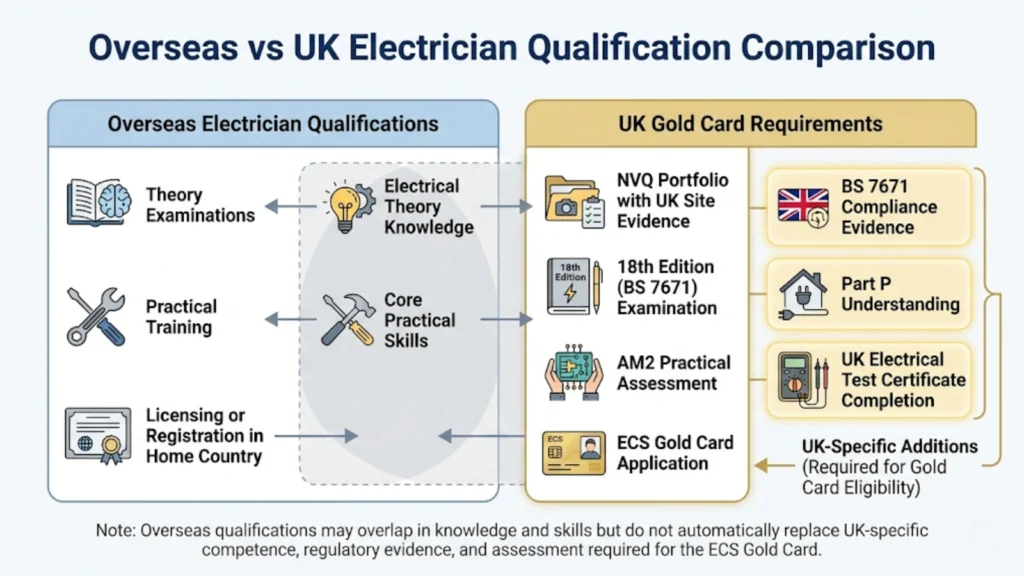
This dual-recognition system (academic + occupational) exists because electrical standards genuinely differ between countries. Voltage systems, earthing arrangements, notification procedures, test methodologies, and even cable color codes vary. Respecting your overseas qualification doesn’t mean assuming it covers UK-specific requirements.
Why the UK Requires NVQ + AM2
If you’ve researched UK electrical qualification pathways, you’ve seen these terms repeatedly: NVQ Level 3 (specifically the 2357 qualification) and AM2 (or AM2E). Both are mandatory for a Gold Card, and both frustrate overseas electricians who feel their existing experience should be sufficient.
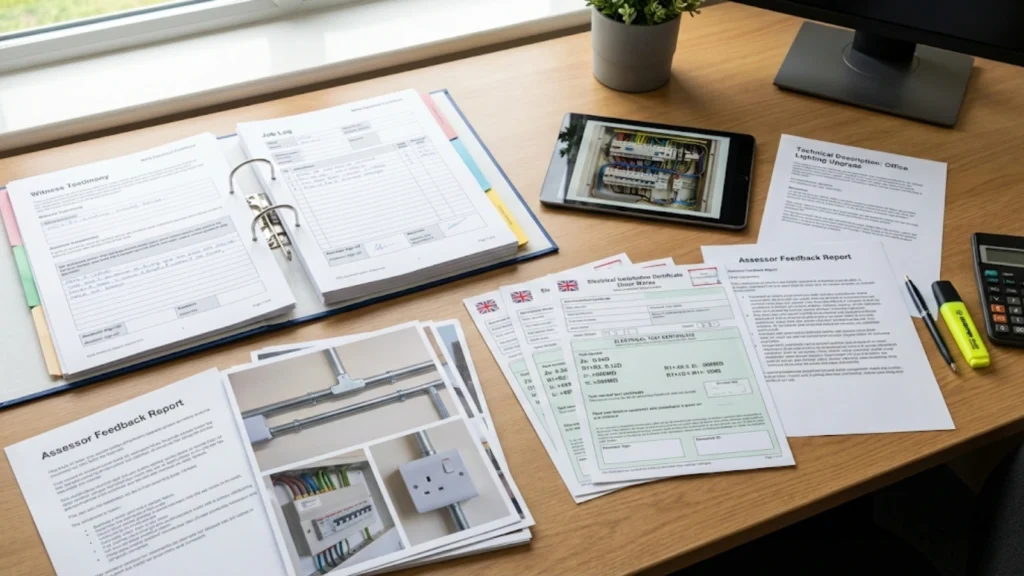
The NVQ Level 3 requires workplace evidence. Not theoretical knowledge tests or classroom exams, but documented proof that you’ve performed specific tasks on UK sites to British standards. This portfolio must demonstrate competence across installation, inspection, testing, fault diagnosis, and certification, all aligned with Ofqual-regulated assessment criteria.
Why can’t overseas work experience substitute for this? Because UK assessors need to see UK-compliant installations. You might have 20 years installing electrical systems, but can you prove you understand Part P notification requirements for domestic work in England and Wales? Do you know how to complete an Electrical Installation Certificate correctly, including the specific test results BS 7671 requires? Can you demonstrate proper containment methods using UK-standard trunking and conduit systems?
These aren’t trivial differences. A contractor hiring you needs confidence that you won’t create compliance issues, fail inspections, or produce work that doesn’t meet building control standards. The NVQ portfolio provides that evidence.
The AM2 (or AM2E for experienced workers) functions as the industry’s standardized practical assessment. In a controlled test environment, you’ll complete tasks covering installation, fault-finding, inspection, and testing. Every Gold Card holder in England and Wales has passed this identical assessment, regardless of their training route.
It’s not about doubting your competence. It’s about ensuring consistent standards across the entire workforce. Australian electricians, South African electricians, Canadian electricians, and British apprentices all take the same AM2. The assessment doesn’t care where you learned your skills. It only verifies you can apply them to UK requirements.
"Twenty years wiring buildings in another country is valuable experience, but UK assessors need to see UK-compliant work. You might know isolation procedures, but can you prove you understand BS 7671's specific requirements for RCD protection in domestic circuits? That's what the evidence portfolio demonstrates."
Thomas Jevons, Head of Training
Experience without UK-based evidence leaves gaps. Those gaps might seem minor to you (after all, isolation is isolation, right?), but BS 7671 has specific requirements for proving dead, documenting test results, and selecting protective devices that differ from other countries’ regulations. The NVQ + AM2 requirement ensures those gaps are closed before you start working independently.
This system prioritizes public safety over convenience. The Electricity at Work Regulations 1989 place legal responsibility on employers to ensure workers are competent for the electrical work they perform. Documented NVQ evidence and AM2 results provide that legal assurance in ways overseas qualifications alone cannot.
How Your Overseas Experience Counts
Overseas experience isn’t dismissed or ignored. It’s used to determine which pathway you qualify for and how much UK evidence you’ll need to gather.
The Experienced Worker Assessment (EWA) route exists specifically for people with 3-5+ years of practical electrical experience. Unlike a full apprenticeship (which takes 4 years), EWA fast-tracks you through assessment of existing skills while filling UK-specific knowledge gaps.
To access EWA, you’ll typically need Ecctis to map your overseas qualifications first, confirming they meet minimum Level 3 equivalence. Then an EWA provider conducts a Skills Scan, essentially a technical interview assessing your knowledge against UK standards. This identifies what you already know (which can reduce some assessment requirements) and what needs addressing.
Here’s the critical limitation: while overseas experience counts for EWA eligibility, you cannot use overseas work as evidence for the NVQ performance units. Your portfolio must contain UK site work, documented and assessed according to British standards.
Why this restriction? Because assessors need to verify you’re working within UK regulatory contexts. Installing circuits in a country without Part P notification requirements doesn’t prove you understand when UK domestic work requires building control involvement. Wiring buildings where test certificates aren’t legally required doesn’t demonstrate you can complete Electrical Installation Certificates correctly.
Certain experiences translate more easily than others. If you’ve worked in countries with similar standards (for example, Ireland, Australia, or New Zealand with comparable voltage systems and earthing arrangements), the technical transition is smoother. If you’re coming from countries with significantly different electrical frameworks (like North American 110V split-phase systems or different earthing philosophies), expect more substantial learning curves.
Your overseas experience also affects how quickly you can build your UK portfolio. An experienced electrician who understands installation fundamentals will complete NVQ units faster than someone learning trade skills from scratch. But “faster” still means months of documented UK site work, not weeks.
The EWA route typically takes 6-12 months depending on how quickly you secure UK employment and gather required evidence. Some people complete it faster with intensive support and consistent site access. Others take longer if they struggle to find employers willing to hire during the assessment period.
Typical Routes for Overseas Electricians
Most overseas electricians follow one of three main pathways to a UK Gold Card. Your specific route depends on your existing qualifications, years of experience, and whether you can secure UK employment during the assessment process.
Route 1: Ecctis Statement + Experienced Worker Assessment (Most Common)
Start by obtaining an Ecctis Statement of Comparability for your overseas electrical qualifications. This document maps your credentials to UK qualification levels, typically confirming Level 3 equivalence if you have a trade diploma or certificate.
Next, enroll with an EWA provider (organizations like EIT, TESP, or similar assessment centers). They’ll conduct a Skills Scan to evaluate your existing knowledge, then guide you through completing City & Guilds 2346 Performance Units. This involves building a portfolio of UK site work while demonstrating competence across installation, inspection, testing, and fault diagnosis.
You’ll also need to pass the 18th Edition Wiring Regulations exam (BS 7671:2018+A2:2022 knowledge test) and complete the AM2E practical assessment. Once all elements are verified, you can apply for your Gold Card through ECS.
Timeline: 6-12 months typically. Cost: £5,000-£8,000 depending on provider, location, and support level.
Route 2: NVQ Level 3 Bolt-On (If You Have Equivalent Theory Qualification)
If Ecctis confirms your overseas qualification already covers the theoretical knowledge component of UK Level 3 (for example, you have an electrical engineering diploma with substantial technical content), you might qualify to complete just the NVQ performance units without repeating classroom theory.
This route still requires UK site work evidence and AM2 assessment, but skips the Level 2 and Level 3 classroom courses. You’ll work with an NVQ assessor to document on-site tasks, then take AM2 once your portfolio is complete.
Timeline: 9-18 months depending on employment access. Cost: Variable, but typically £3,000-£5,000 for assessment and AM2.
Route 3: Provisional Card While Building Competence
You can apply for a provisional ECS card (such as an ECS Trainee card) while working toward Gold Card requirements. This allows you to work on UK sites under supervision while gathering NVQ evidence.
The provisional card signals to employers that you’re actively pursuing full qualification. It doesn’t give you the same earning potential or independence as a Gold Card, but it solves the catch-22 of needing UK employment to build your portfolio while needing a portfolio to gain employment.
Combine this with any of the above routes. Work under supervision, document your tasks for NVQ assessment, complete 18th Edition and AM2, then upgrade to Gold Card.
Timeline: Adds to whatever route you choose. Cost: Minimal (provisional cards cost £25-£50 annually).
The pathway that includes advanced electrical systems training becomes relevant once you’ve secured your Gold Card and want to specialize in commercial or industrial sectors where BMS knowledge increases employability.
Regardless of route, the critical factor is securing UK employment. Without site access, you cannot gather NVQ evidence. Without evidence, you cannot progress toward AM2. Without AM2, you don’t get a Gold Card. This is where structured placement support makes an enormous practical difference.
What the Gold Card Actually Represents
The ECS Gold Card is the UK electrical industry’s benchmark for fully qualified electrician status. But it’s important to understand exactly what it proves, and what it doesn’t.
What the Gold Card Demonstrates:
The card confirms you’ve completed an industry-recognized qualification pathway (NVQ Level 3 or equivalent), passed the 18th Edition Wiring Regulations exam, and successfully completed the AM2 practical assessment. This combination proves you possess both theoretical knowledge of BS 7671 and demonstrated practical competence in installation, testing, and inspection work.
Employers and principal contractors trust the Gold Card because every holder has met identical assessment standards. Whether you trained through a traditional apprenticeship or came through the experienced worker route makes no difference. The card represents verified competence to British standards.
On commercial and industrial sites, the Gold Card often serves as the minimum entry requirement. Site managers use it as quick verification that workers have appropriate qualifications without needing to assess individual credentials case-by-case. This is particularly important on large projects with hundreds of subcontractors.
What the Gold Card Doesn’t Guarantee:
The card doesn’t guarantee employment. Contractors still assess experience, references, reliability, and whether you’re a good fit for their specific work. A newly qualified Gold Card holder fresh from AM2 will earn less than someone with 10 years post-qualification experience, even though both hold the same card.
It’s not a legal license. Unlike gas work (which requires Gas Safe registration) or certain driving categories (which require government-issued licenses), electrical work in the UK doesn’t require a legal license for most installations. The Gold Card is an industry scheme, not a government-mandated credential. However, its industry-wide acceptance makes it effectively mandatory for accessing most legitimate employment.
The card doesn’t automatically cover specialist areas. Certain types of electrical work (like high-voltage installations, hazardous areas, or specific industrial systems) require additional qualifications beyond the Gold Card. Think of it as your foundation credential that proves core competence, not your complete professional credential for all electrical work.
It also doesn’t indicate membership level within the JIB grading structure. Gold Card holders can be classified as Electricians, Advanced Electricians, Approved Electricians, or Technicians depending on additional qualifications and experience. These distinctions affect pay scales but aren’t visible on the card itself.
Why People Get Frustrated (And Why the System Works This Way)
If you search online forums or social media, you’ll find plenty of overseas electricians expressing frustration about UK qualification recognition. The complaints are understandable: you’ve spent years training, passed rigorous exams in your home country, worked on complex projects, and then the UK tells you that’s not enough.
Three misconceptions drive most of the frustration:
Misconception 1: “The UK Doesn’t Value My Qualification”
Your qualification is valued, but value doesn’t equal automatic equivalence. A medical degree from one country is valuable, but doctors still need to pass UK licensing exams before practicing here. The same principle applies to trades with public safety implications.
The UK system respects your overseas training by using it to determine which pathway you’re eligible for. Your experience gets you into EWA instead of a 4-year apprenticeship. That’s recognition, even if it’s not the instant acceptance you might have hoped for.
Misconception 2: “Experience Should Count More Than Assessments”
Experience matters, but undocumented experience is difficult to verify. An employer can’t assess whether your 15 years of electrical work in another country included proper testing, correct certification, or compliance with safety standards without some form of evidence.
The NVQ portfolio and AM2 assessment provide that evidence in a standardized format. They don’t dismiss your experience; they verify it through a common framework UK contractors understand and trust.
Misconception 3: “This Is Just Bureaucracy to Protect UK Workers”
Electricians’ work carries genuine public safety risk. Incorrect installations cause fires, faulty testing misses dangerous faults, poor isolation procedures lead to electrocution. BS 7671 exists because electrical work done wrong kills people.
The competence assessment system isn’t protectionism. Every UK-trained electrician goes through identical NVQ and AM2 requirements. Overseas electricians aren’t being singled out for additional barriers. They’re being held to the same standard as everyone else, which happens to require UK-specific evidence when regulations differ between countries.
"Yes, there's a skills shortage. Yes, employers need electricians. But that doesn't mean they'll compromise on competence standards. If anything, the current demand makes employers even more careful about hiring, because one incompetent worker can damage their reputation and create safety risks they can't afford."
Joshua Jarvis, Placement Manager
The emotional toll of the process is real. Moving countries is already difficult, and discovering your professional credentials require additional validation adds stress. The costs involved (which we’ll break down in the next section) create financial pressure. The time investment delays your ability to earn at the level your experience warrants.
These frustrations are valid. But understanding why the system exists doesn’t make it arbitrary or unfair. It makes it a necessary quality control mechanism in a safety-critical industry.
Real Talk: What This Process Actually Costs
Let’s be direct about the financial and time investment overseas electricians face when pursuing UK qualification recognition.
Financial Costs (Typical Range: £5,000-£8,000)
Ecctis Statement of Comparability: £150-£250 depending on qualification complexity and turnaround time required.
18th Edition Course and Exam: £200-£400 if you need formal training, or £150-£200 for exam-only if you’re confident self-studying BS 7671.
EWA Provider Registration and Assessment: £2,500-£4,500 depending on organization, support level, and whether you need classroom top-up training for UK-specific content.
AM2/AM2E Assessment: £700-£1,000 including registration, test center fees, and any required preparation materials.
ECS Card Application: £40-£50 annually (relatively minor but worth noting for completeness).
Lost Earnings During Transition: This is the hidden cost that catches people off guard. If you’re working in lower-paid roles or provisional positions while building your portfolio, you’re potentially earning £10,000-£20,000 less than you would with a Gold Card. Over a 6-12 month qualification period, this represents significant opportunity cost.
Time Investment (Typical Range: 6-12 Months)
The timeline varies dramatically based on:
How quickly you secure UK employment that provides opportunities to gather NVQ evidence. If you find supportive employers immediately, you can complete portfolios in 4-6 months. If you struggle to find placement opportunities, the process extends to 12-18 months.
Whether you need UK-specific knowledge top-ups. Electricians from countries with very similar standards (like Ireland or Australia) might breeze through 18th Edition exams. Those from countries with substantially different regulations need more study time.
How efficiently you document your work. Some people are naturally good at gathering photos, completing assessment paperwork, and organizing evidence. Others find the administrative burden slows them down significantly.
AM2 test center availability. In some regions, test slots book up months in advance. Waiting for your AM2 appointment can add 2-3 months to your timeline even after your portfolio is complete.
No Guarantees
Here’s the uncomfortable truth: paying £6,000 and investing a year doesn’t guarantee a Gold Card at the end. If your NVQ portfolio doesn’t demonstrate sufficient competence, assessors will request additional evidence. If you fail AM2, you’ll need to retake it (additional cost: £700+). If your site experience doesn’t cover all required unit outcomes, you’ll need more time gathering evidence.
This isn’t meant to discourage you. Most overseas electricians with genuine experience do successfully complete the process. But understanding it’s not a simple “pay money, receive card” transaction matters for realistic planning.
The financial investment becomes worthwhile when you consider UK earning potential. Gold Card electricians working for contractors typically earn £30,000-£45,000 annually depending on location and experience. Self-employed electricians in areas like London and the South East can invoice at rates that generate £50,000-£70,000+ annual income with good client bases.
Recent 2026 wage increases under the JIB agreement further improved earnings for qualified electricians, making the return on your qualification investment faster than in previous years.
If you’re committed to working in the UK long-term, the costs pay back within the first year of Gold Card employment. If you’re uncertain about staying, or hoping to return to your home country after a few years, the investment calculation becomes less straightforward.
Bottom Line: What You Should Do
If you’re an overseas electrician considering UK work, here’s the practical path forward:
Step 1: Get Your Qualifications Assessed
Contact Ecctis and request a Statement of Comparability for your electrical qualifications. This costs £150-£250 and takes 2-4 weeks. Don’t skip this step. You need documentary proof of your educational equivalence before most EWA providers will even speak with you.
Step 2: Research EWA Providers
Organizations like EIT (Electrical Installation Training), TESP (The Electrical Safety Partnership), NET (National Electrotechnical Training), and others offer experienced worker routes. Compare their costs, support offerings, and success rates. Ask about placement assistance specifically. Providers that help you find UK site work during assessment are worth paying slightly more for.
Step 3: Secure Employment Early
Start applying for UK electrical jobs before you’re fully qualified. Be upfront that you’re working toward your Gold Card through EWA. Some contractors specifically hire overseas electricians in provisional roles because they understand the pathway and want to support workers through it.
Having employment lined up before you start formal assessment makes the entire process smoother. You’ll gather portfolio evidence faster, earn income during the transition, and demonstrate commitment that makes passing assessments easier.
Step 4: Study BS 7671 Thoroughly
Don’t underestimate the 18th Edition exam. BS 7671:2018+A2:2022 is 600+ pages of technical regulations, and the exam tests detailed knowledge. Overseas electricians sometimes assume their existing experience will carry them through, then fail because British wiring regulations have specific requirements their home countries don’t.
Dedicate genuine study time to this. Use official IET resources, take practice exams, and if possible, attend a structured course that covers not just the regulations but how they’re applied in UK installation work.
Step 5: Document Everything
From day one of your UK site work, photograph everything, keep notes on tasks performed, record test results, save copies of certificates you’ve completed. Your NVQ assessor will need comprehensive evidence. Having too much documentation is better than scrambling to recreate evidence months later.
Step 6: Prepare for AM2 Properly
The AM2 practical assessment fails a significant percentage of first-time candidates. Don’t treat it casually. Find AM2 preparation courses (many EWA providers offer these), practice the specific tasks in the assessment, and if possible, visit an assessment center beforehand to see the setup.
Common fail reasons include: poor time management, incorrect test procedures, incomplete documentation, and safety violations. All of these are preventable with proper preparation.
The UK qualification recognition system respects overseas training while prioritizing safety through verified competence to British standards. It’s not the instant acceptance many hope for, but it’s a legitimate pathway that thousands of overseas electricians successfully navigate each year.
Call us on 0330 822 5337 to discuss overseas qualification recognition and how our NVQ Level 3 pathway supports electricians transitioning to UK standards. We’ll explain exactly what your existing credentials count toward, which route suits your experience level, and how our in-house placement team helps secure the UK site work you need for portfolio evidence. No hype. No unrealistic timelines. Just practical guidance on navigating the Gold Card pathway as an overseas-trained electrician.
References
- ECS Card – Non-UK Qualifications: https://www.ecscard.org.uk/content/If-you-have-non-UK-qualifications
- Electrical Worker Assessment (EWA): https://www.electrical-ewa.org.uk/
- JIB Overseas Qualifications: https://www.jib.org.uk/overseas-qualifications
- Ecctis (UK ENIC): https://www.ecctis.com/
- City & Guilds 2357 NVQ: https://www.cityandguilds.com/qualifications-and-apprenticeships/building-services-industry/electrical-installation/2357-electro-technical-technology
- NET Services AM2E: https://www.netservices.org.uk/am2e/
- TradeSk
- ills4U Overseas Guide: https://www.tradeskills4u.co.uk/blog/a-guide-for-overseas-electricians-recognising-non-uk-electrical-qualifications
Note on Accuracy and Updates
Last reviewed: 09 February 2026. This page is maintained; we correct errors and refresh sources as UK qualification recognition requirements and ECS/JIB standards change. Overseas electricians should verify current Ecctis fees and EWA provider costs directly, as these can change annually.