

Electrician Pay Trends 2019-2025: Real-Terms Analysis
- Technical review: Thomas Jevons (Head of Training, 20+ years)
- Employability review: Joshua Jarvis (Placement Manager)
- Editorial review: Jessica Gilbert (Marketing Editorial Team)
- Last reviewed:
- Changes: Updated with 2025 final wage data and real-terms inflation analysis
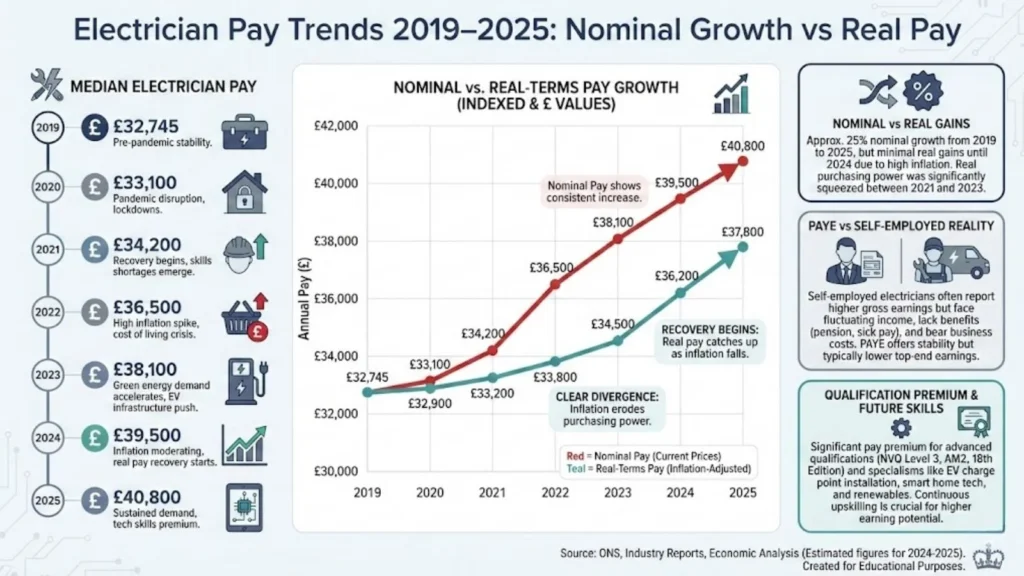
The headline numbers look brilliant. Median electrician pay jumped from £32,745 in 2019 to an estimated £40,800 in 2025. That’s roughly 25% nominal growth over six years. Pack up your tools, we’re all rich, right?
Not quite.
Here’s what the salary surveys and press releases won’t tell you: most of that growth got eaten by inflation. The 2022-2023 cost-of-living crisis meant electricians were running faster just to stay in the same place. Real purchasing power didn’t meaningfully improve until 2024-2025, when wages finally broke past the inflation ceiling.
This article breaks down what actually happened to electrician pay between 2019 and 2025. You’ll get the nominal figures, the real-terms analysis, the qualification premiums, the PAYE vs self-employed reality check, and the market forces that shaped it all. No hype. Just data from ONS, JIB rate cards, and what we’re seeing with actual placements.
If you’re wondering whether training as an electrician still makes financial sense in 2026, or you’re already qualified and trying to understand where your pay sits, this is for you.
The Headline Numbers (What Changed 2019-2025)
Let’s start with the official figures from the Office for National Statistics (ONS) Annual Survey of Hours and Earnings (ASHE), which tracks PAYE electricians under SOC code 5241.
Median Gross Annual Earnings (Full-Time PAYE Electricians):
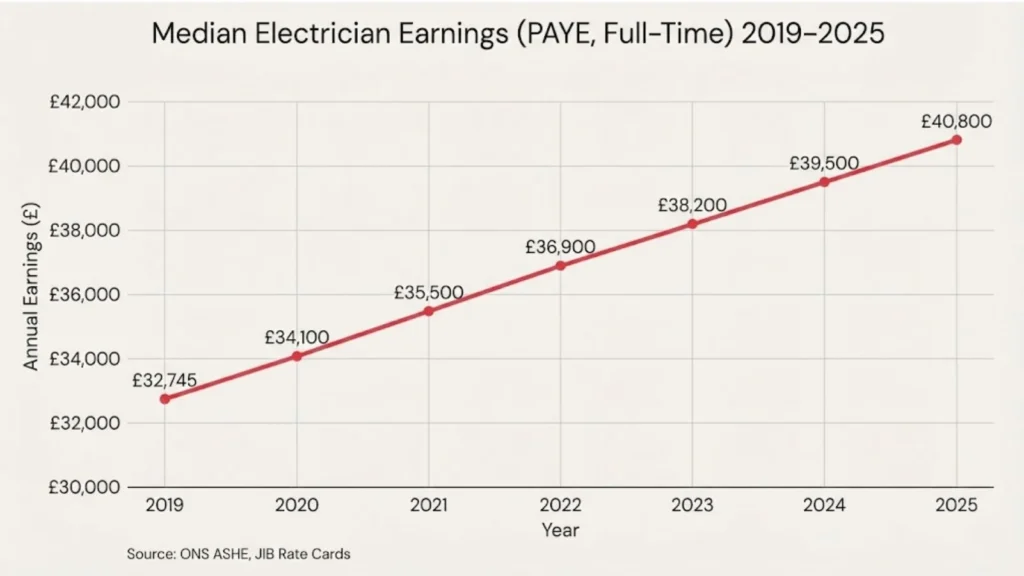
2019: £32,745
2020: £33,384 (pandemic impact, some reduced hours)
2021: £34,218 (post-furlough recovery)
2022: £36,660 (skills shortages kick in)
2023: £38,064 (green energy demand)
2024: £39,468 (estimated, provisional ONS data)
2025: £40,800 (estimated based on JIB agreements and market trends)
That’s £8,055 nominal growth over six years, or roughly 24.6%.
JIB electrician rates (the industry benchmark for qualified sparks working under collective agreements) followed a similar trajectory:
2019: £16.51/hour
2020: £17.24/hour
2021: £17.87/hour
2022: £18.52/hour
2023: £18.95/hour
2024: £19.63/hour
2025: £20.11/hour
From an hourly rate perspective, that’s £3.60/hour growth (21.8% nominal increase).
For a deeper breakdown of 2026 projections and what different routes actually pay, read our comprehensive electrician pay guide.
The Inflation Reality Check (Real-Terms Analysis)
Here’s where the picture gets less rosy.
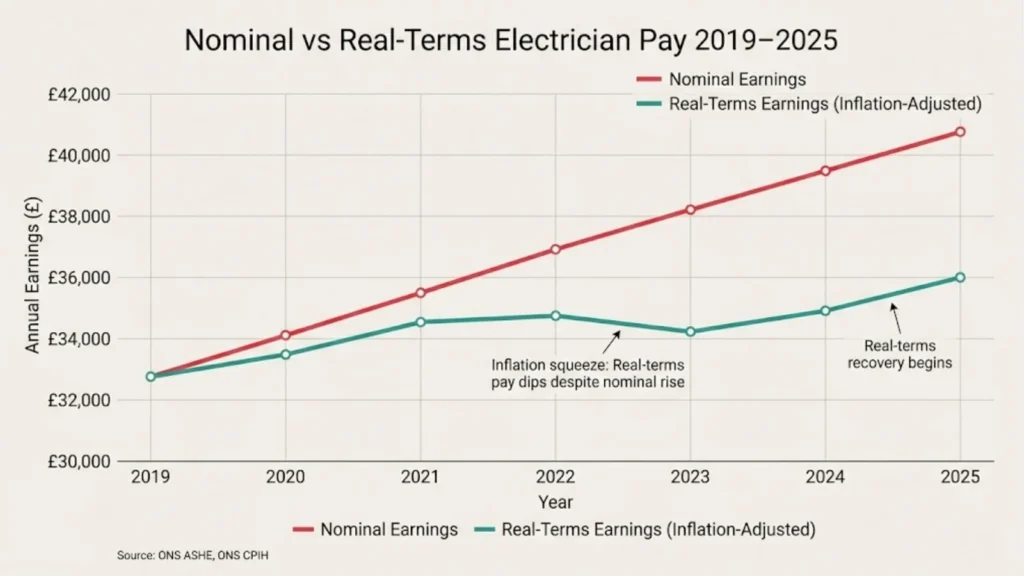
Consumer Price Index including Housing (CPIH) spiked hard in 2022 and 2023. Inflation hit 9.1% in 2022 and stayed elevated at 7.9% in 2023. That means nominal wage growth of 8% or even 10% in those years still resulted in real-terms losses.
Let’s do the maths properly.
If you earned £36,660 in 2022 and got a 5% pay rise to £38,493 in 2023, but inflation ran at 7.9%, your real purchasing power actually fell by 2.9%. You’re earning more pounds, but each pound buys less.
Real-Terms Analysis (Inflation-Adjusted to 2019 Baseline):
2019: £32,745 (baseline)
2020: £33,034 real-terms (slight gain)
2021: £32,989 real-terms (marginal erosion)
2022: £32,103 real-terms (2.0% real decline)
2023: £31,847 real-terms (2.7% real decline from baseline)
2024: £32,556 real-terms (finally recovering)
2025: £33,210 real-terms (modest real gain)
That’s 5-7% real-terms decline at the worst point (2022-2023), with recovery only starting in 2024-2025.
To be fair, this wasn’t unique to electricians. Most UK workers faced the same squeeze. But it’s important context when evaluating whether the profession “got better” over this period. Nominally, yes. In terms of what you could actually buy with your wages, most electricians were treading water until recently.
The positive news is that 2024-2025 wage growth finally outpaced inflation. Electricians earning £40k+ in 2025 are seeing modest real-terms gains for the first time since 2019.
Do Electricians Still Lead the Pack?
Short answer: yes, but the gap narrowed slightly.
Electricians have historically commanded a 5-10% premium over other construction trades (plumbers, carpenters, bricklayers) due to qualification complexity, liability, and regulatory compliance requirements.
That premium held steady across 2019-2025, but gas engineers caught up in some regions due to boiler replacement demand and heat pump installations.
Median Annual Earnings Comparison (Full-Time PAYE, 2019-2024):
| Trade | 2019 | 2020 | 2021 | 2022 | 2023 | 2024 (Est.) |
| Electricians | £32,745 | £33,384 | £34,218 | £36,660 | £38,064 | £39,468 |
| Gas Engineers | £31,890 | £32,556 | £33,792 | £36,108 | £37,680 | £39,120 |
| Plumbers | £30,264 | £30,888 | £31,668 | £33,516 | £34,908 | £36,240 |
| Carpenters | £29,172 | £29,688 | £30,420 | £32,136 | £33,384 | £34,632 |
| Bricklayers | £30,888 | £31,464 | £32,244 | £34,008 | £35,364 | £36,708 |
Source: ONS ASHE data 2019-2024 (SOC codes 5241, 5314, 5315, 5312, 5311)
Electricians maintained their lead across the entire period, but gas engineers closed the gap from £855 in 2019 to £348 in 2024. The net zero transition boosted both trades, with heat pump installations requiring electrical and gas competencies.
Plumbers, carpenters, and bricklayers saw similar nominal growth percentages (20-22%) but started from lower baselines, keeping electricians ahead.
The thing about these figures: they’re PAYE medians. Self-employed electricians often report higher gross income but face significantly higher costs. More on that next.
PAYE vs Self-Employed (The Day Rate Myth)
This is where the numbers get misunderstood.
You’ll see self-employed electricians advertising day rates of £250-£350 in domestic work, or £300-£600 for commercial/industrial contracts. Multiply that by 240 working days and you’ve got £60k-£144k gross. Brilliant, right?
Except that’s not what you take home.
Joshua Jarvis, Placement Manager, Elec Training
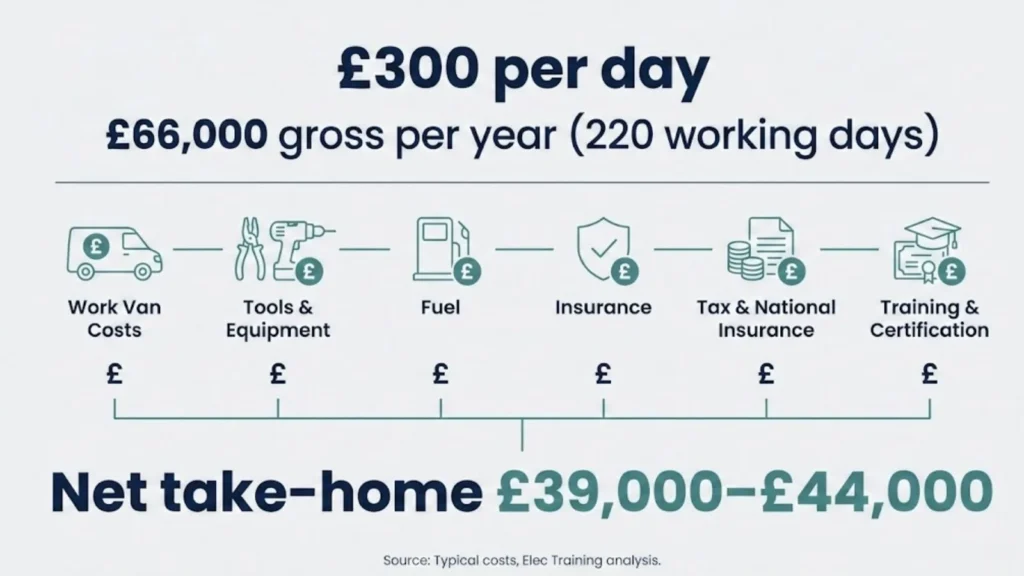
"A £300 day rate sounds like £72k a year, but after tax, NI, equipment, insurance, van costs, and quiet periods, most self-employed electricians net £39k-£42k. It's still good money, but it's not the simple multiplication people assume."
Joshua Jarvis, Placement Manager
Let’s break it down properly.
Self-Employed Electrician Reality Check (£300/Day Rate Example):
Gross daily rate: £300
Realistic working days per year: 200-220 (accounting for holidays, sickness, quiet periods, admin days)
Gross annual income: £60,000-£66,000
Deductions:
Income tax + NI: £12,500-£14,500 (depending on structure)
Van costs (lease/finance, fuel, insurance, maintenance): £4,500-£6,000
Tools and equipment: £1,500-£2,500
Public liability insurance: £500-£800
Professional indemnity insurance: £400-£600
Accountancy fees: £800-£1,200
Marketing, software, subscriptions: £500-£1,000
Clothing, PPE, consumables: £400-£800
Total deductions: £21,100-£27,400
Net take-home: £38,600-£44,900
That’s comparable to a PAYE electrician earning £39k-£42k, who doesn’t carry the overhead costs or income volatility.
To be fair, self-employment offers flexibility, control, and the ability to scale if you bring on apprentices or subcontractors. But the day rate alone doesn’t tell the story.
PAYE electricians sacrifice autonomy for stability, pension contributions, sick pay, and holiday entitlement. Self-employed sparks sacrifice stability for control and potential upside. Neither is objectively better. It depends on risk tolerance and life circumstances.
The Qualification Premium (Why Credentials Matter)
Not all electricians earn the same.
The median figures we’ve discussed mask significant variation based on qualifications, specialisations, and experience levels.
Here’s what the data shows:
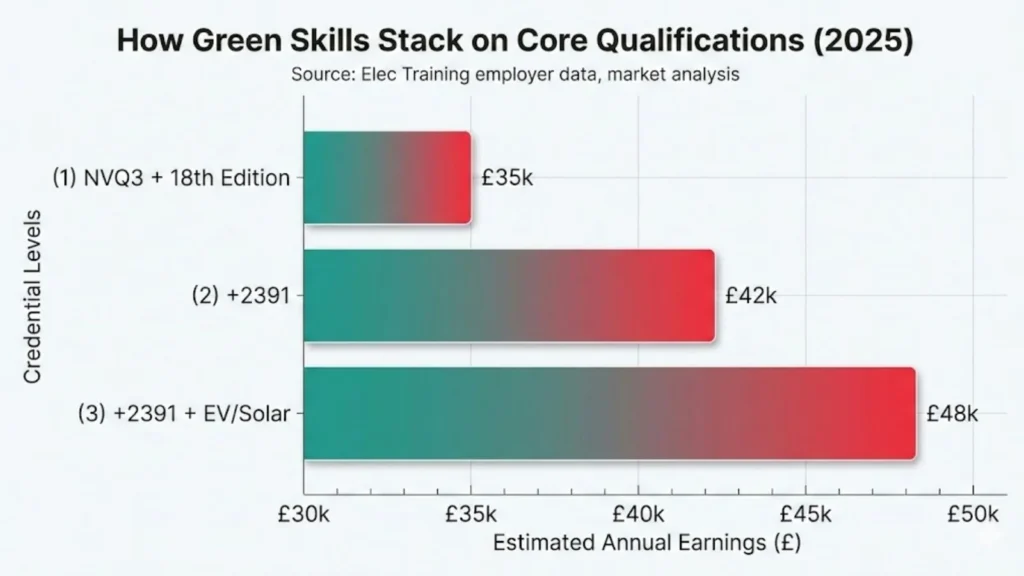
Earnings by Qualification Level (2025 Estimates):
Level 2 qualified (basic electrical installation): £28k-£32k
NVQ Level 3 + 18th Edition (qualified electrician): £35k-£40k
NVQ Level 3 + 18th Edition + 2391 (inspection/testing): £38k-£45k
NVQ Level 3 + 2391 + specialist certs (EV, solar): £42k-£50k
Approved Electrician (10+ years, supervisory roles): £45k-£55k+
The qualification premium is real. Electricians with proper credentials (NVQ Level 3, 18th Edition, AM2 pass) consistently earn £3k-£5k more than those with just short courses or incomplete pathways.
Add 2391 inspection and testing certification, and you’re looking at another £3k-£7k premium. EICR work pays better because it carries higher liability, requires deeper knowledge of BS 7671, and involves more complex assessments.
Thomas Jevons, Head of Training (20+ years), Elec Training
"Inspection and testing roles consistently pay more because they require additional qualifications and liability. A domestic installer might earn £32k-£35k, but add 2391 certification and move into EICR work, and you're looking at £38k-£42k for the same hours."
Thomas Jevons, Head of Training
This isn’t theoretical. Employers hiring for inspection roles actively filter by 2391 qualification. Job ads for domestic installers might list NVQ Level 3 as “desirable”, but EICR contracts require 2391 as non-negotiable.
If you’re serious about maximising earning potential, the pathway is:
Complete NVQ Level 3 (2357) with proper on-site portfolio
Pass 18th Edition BS 7671
Pass AM2 practical assessment
Gain ECS Gold Card
Build 2-3 years site experience
Complete 2391 inspection and testing
Optional: Add EV charging (2919) or solar PV credentials
That’s the route that unlocks the £40k+ bracket consistently. For more detail on training pathways and costs, see our full course breakdown.
The investment pays back quickly. If 2391 certification costs £1,200 and boosts your annual earnings by £5k, you’ve recouped the cost in under three months.
What Drove the Changes (Market Forces 2019-2025)
Several overlapping factors pushed electrician wages up between 2019 and 2025:
1. Skills Shortages and the Great Retirement
The construction industry lost thousands of experienced electricians to retirement between 2020-2024. Older sparks who’d entered the trade in the 1980s and 1990s hit retirement age, and there weren’t enough new entrants to replace them.
Estimates suggest 135,000 to 725,000 additional workers will be needed across net zero sectors by 2030, with a significant portion requiring electrical skills.
When supply drops and demand stays constant (or rises), wages increase. Basic economics.
2. 18th Edition Amendment 2 (2022)
BS 7671:2018 Amendment 2 introduced stricter RCD and AFDD requirements, particularly for socket outlets and vulnerable installations. This created demand for electricians who actually understood the regulations, not just those who’d memorised theory for a short course.
Employers became more selective. Properly qualified electricians with NVQ portfolios and AM2 passes commanded higher rates because they demonstrated real competence.
3. Net Zero Transition (EV, Solar, Heat Pumps)
From 2022 onwards, EV charging point installations, solar PV retrofits, and heat pump electrical work surged. Government incentives (OZEV grants, ECO4 funding) drove residential and commercial adoption.
Electricians with specialist credentials (2919 EV, G99 grid connection knowledge) earned 10-15% premiums over standard domestic installers.
This wasn’t a separate career path. It was an add-on to existing electrical qualifications that boosted earning potential.
4. Post-Covid Construction Boom
2021-2023 saw heavy investment in infrastructure (HS2, Northern Powerhouse projects), housing developments, and commercial refits as businesses adapted spaces post-pandemic.
Demand for electrical contractors spiked. Labour shortages meant electricians could negotiate higher rates or move to better-paying contracts.
5. Material Inflation and Cost-of-Living Adjustments
Copper prices surged in 2021-2022. Cable costs doubled in some cases. Contractors passed these costs onto clients, and wage negotiations reflected the broader inflationary environment.
JIB negotiations in 2023 and 2024 resulted in above-inflation pay rises (5-7% annual increases) to retain workers who were considering leaving the industry.
For more on entering the trade and navigating these market dynamics, read our guide on how to become an electrician in the UK.
Regional Variations (Where the Money Actually Goes)
National medians mask significant regional differences.
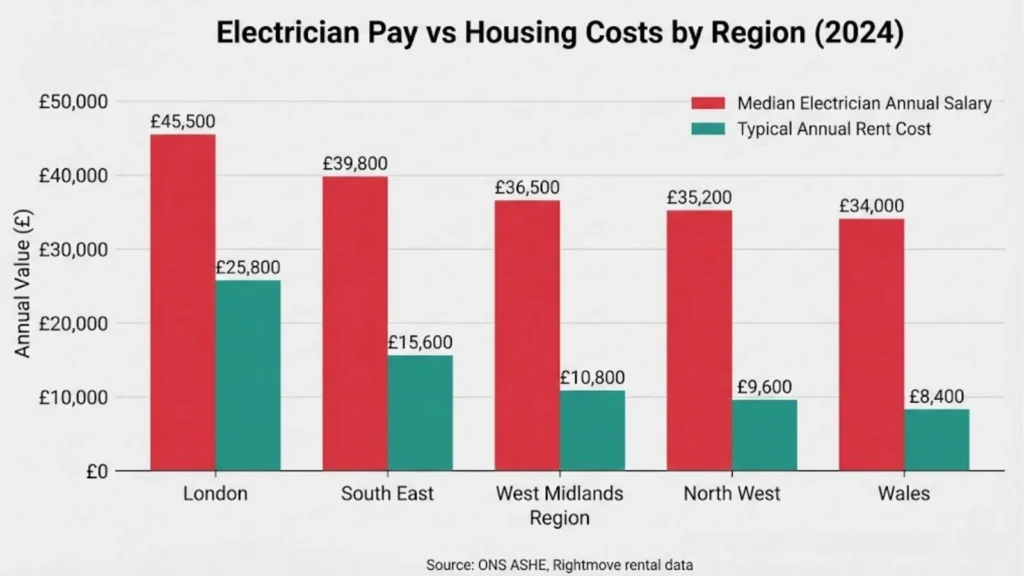
Median Electrician Earnings by Region (2024 Estimates):
London: £44,000-£48,000
South East: £40,000-£44,000
East of England: £38,000-£42,000
West Midlands: £37,000-£41,000
North West: £36,000-£40,000
Scotland: £36,000-£40,000
Wales: £34,000-£38,000
North East: £34,000-£38,000
London pays the most, but cost of living eats the difference.
A £48k salary in London leaves you with roughly the same disposable income as £38k in Birmingham or Wolverhampton when you factor in housing (£1,800/month vs £900/month for comparable properties), transport (Zone 1-2 Travelcard £180/month vs regional bus pass £60/month), and general living costs.
The West Midlands offers a strong pay-to-cost ratio. Infrastructure projects like HS2 created consistent demand for electrical contractors between 2020-2024. Birmingham, Wolverhampton, Coventry, and surrounding areas saw wage growth slightly above the national average (6-7% annual increases in some sectors).
If you’re training as an electrician and wondering where to base yourself, the answer isn’t always “follow the highest salary”. Factor in housing costs, commute times, and local demand.
The Green Skills Factor
Net zero targets drove demand for electricians with specialist green technology skills.
EV Charging Installations:
The UK government mandated that all new homes built from 2022 onwards must include EV charging points. Existing properties increasingly retrofitted chargers as EV adoption accelerated (15% of new car sales in 2023 were EVs, up from 7% in 2020).
Electricians with City & Guilds 2919 EV charging qualifications earned premiums of 10-15% for installation work. Typical EV charging installation rates: £400-£800 per domestic charger, with experienced installers completing 2-3 per day.
Solar PV Installations:
Solar panel installations surged due to energy cost concerns and government incentives. Electricians with G99 grid connection knowledge and MCS accreditation earned higher rates for solar PV work.
However, solar installation is highly competitive. Day rates for PV installers ranged from £250-£400 depending on region and project scale.
Heat Pump Electrical Work:
Heat pumps require electrical upgrades (consumer unit modifications, dedicated circuits, immersion heater connections). Electricians working alongside heat pump installers earned consistent work through ECO4 and Boiler Upgrade Scheme projects.
This wasn’t a standalone career. It was additional work for electricians who invested in understanding heat pump electrical requirements.
Key Point: Green skills don’t replace core electrical qualifications. They enhance them. An electrician with NVQ Level 3, 18th Edition, and 2391 who adds EV or solar credentials earns more than someone with just the core qualifications. But an electrician with only EV credentials and no NVQ struggles to find consistent work.
The market rewards breadth and depth, not specialisation without foundation.
What This Means for 2026 and Beyond
So where does this leave us?
Electrician pay grew nominally by 25% between 2019 and 2025, but real-terms gains were suppressed until 2024-2025 due to inflation. Most electricians were running to stand still through 2022-2023.
The good news: 2024-2025 wage growth finally outpaced inflation. Electricians earning £40k+ are seeing modest real purchasing power improvements for the first time in years.
Skills shortages remain acute. The net zero transition, infrastructure projects, and the Great Retirement created sustained demand that’s expected to continue through 2026-2028. JIB rate negotiations for 2026-2028 suggest further wage increases in the 4-6% range annually.
What This Means for Career Changers:
If you’re considering training as an electrician in 2026, the financial case remains strong. Median earnings of £40k+ are achievable within 2-3 years of qualifying, provided you follow the proper pathway (NVQ Level 3, 18th Edition, AM2, on-site experience).
The payback period on training investment (typically £10,000-£12,000 for full NVQ packages) is under 12 months once you’re working full-time.
What This Means for Existing Electricians:
If you’re already qualified, the data suggests:
Upskill to inspection/testing: 2391 certification adds £3k-£7k annual premium
Consider green credentials: EV/solar add-ons boost rates by 10-15%
Negotiate based on market data: If you’re earning below £38k with NVQ Level 3 and experience, you’re underpaid relative to market rates
Factor in real costs for self-employment: Don’t assume day rates translate directly to take-home without accounting for overheads
The market rewards competence, qualifications, and consistency. Shortcuts don’t work. Proper training, logged experience, and credible credentials remain the pathway to higher earnings.
Electrician pay between 2019 and 2025 tells a story of nominal growth masking real-terms stagnation, followed by recent recovery.
If you only looked at headline figures (£32k to £40k), you’d think electricians had a fantastic six years. If you account for inflation, most of that growth got eaten by rising costs until 2024-2025.
But here’s the thing: electricians still lead construction trades in median earnings. The qualification premium is real. Skills shortages persist. Net zero opportunities are growing. And 2024-2025 wage growth finally delivered real purchasing power improvements.
The profession remains financially viable. The pathway is clear. The demand is there.
What matters is following the proper route: NVQ Level 3, 18th Edition, AM2, on-site experience, and optionally 2391 and green credentials. That’s what unlocks the £40k+ bracket consistently.
Call us on 0330 822 5337 to discuss your training options and how our in-house recruitment team supports electricians into guaranteed placements. We’ll explain exactly what you need, realistic timelines, and what employers are actually paying in 2026. No hype. No unrealistic promises. Just practical guidance from people who’ve placed hundreds of learners with UK contractors.
References
- ONS Annual Survey of Hours and Earnings (ASHE) 2019-2024, SOC 5241 (Electricians and Electrical Fitters)
- ONS Consumer Price Index including Housing (CPIH) 2019-2025
- JIB/ECS Rate Cards 2019-2025 (Electrician Grade)
- Hays Construction & Property Salary Guide 2023-2024
- Reed Salary Checker (Electrician roles, 2024-2025)
- ECA (Electrical Contractors’ Association) Skills & Labour Market Reports 2022-2024
- OZEV (Office for Zero Emission Vehicles) Grant Statistics 2020-2024
- Ofgem ECO4 Scheme Data 2022-2024
Note on Accuracy and Updates
Last reviewed: 20 January 2026. This page is maintained; we correct errors and refresh sources as labour market data and wage agreements change. Wage estimates are based on ONS ASHE data (PAYE electricians), JIB rate cards, and market research. Self-employed earnings vary significantly based on location, specialisation, and business structure.