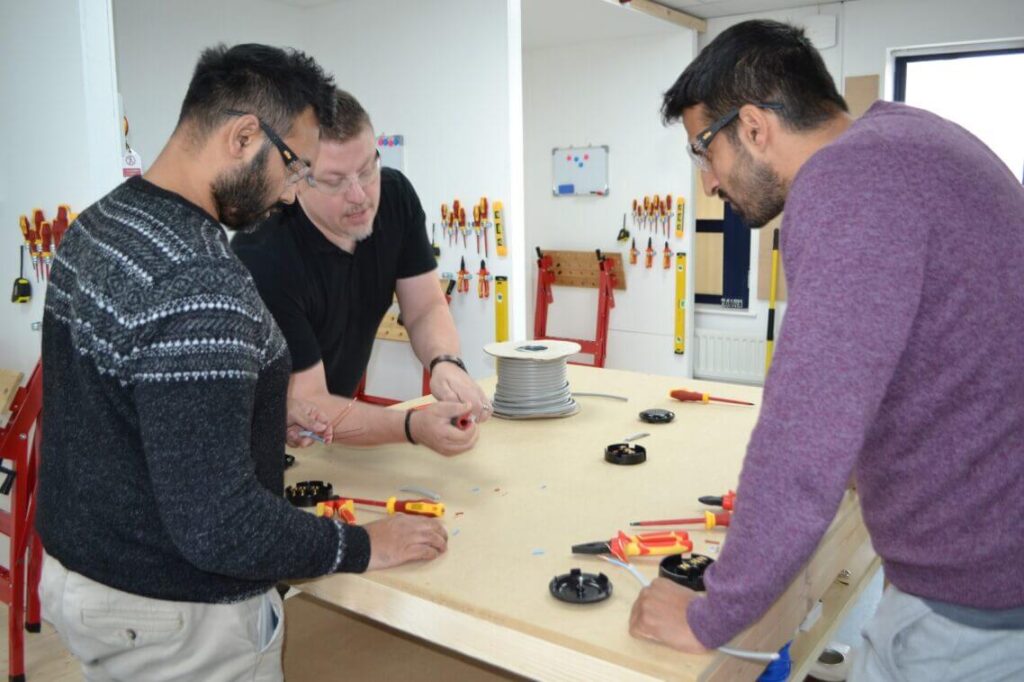

Technology and AI in Vocational Education: What’s Actually Changing (And What’s Just Hype)
- Technical review: Thomas Jevons (Head of Training, 20+ years)
- Employability review: Joshua Jarvis (Placement Manager)
- Editorial review: Jessica Gilbert (Marketing Editorial Team)
- Last reviewed:
- Changes: Updated for Skills England launch, Growth and Skills Levy details, and January 2026 Energy Skills Passport launch
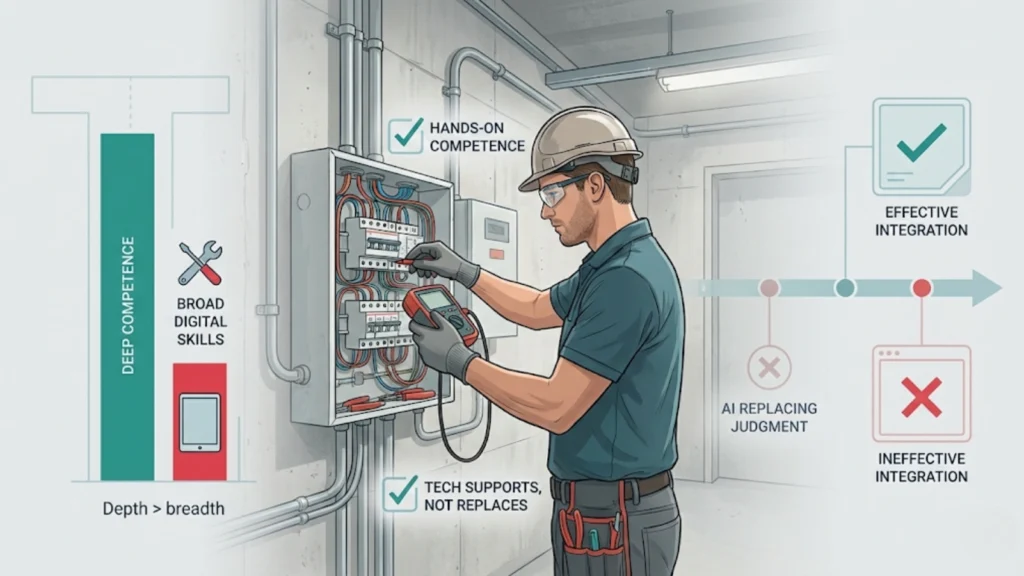
“AI will replace vocational trainers.”
“VR means apprentices don’t need workshop time.”
“Digital credentials make traditional qualifications obsolete.”
You’ve seen these claims. Technology companies, training providers, and media coverage often present vocational education as undergoing radical transformation where physical skills become secondary to digital fluency.
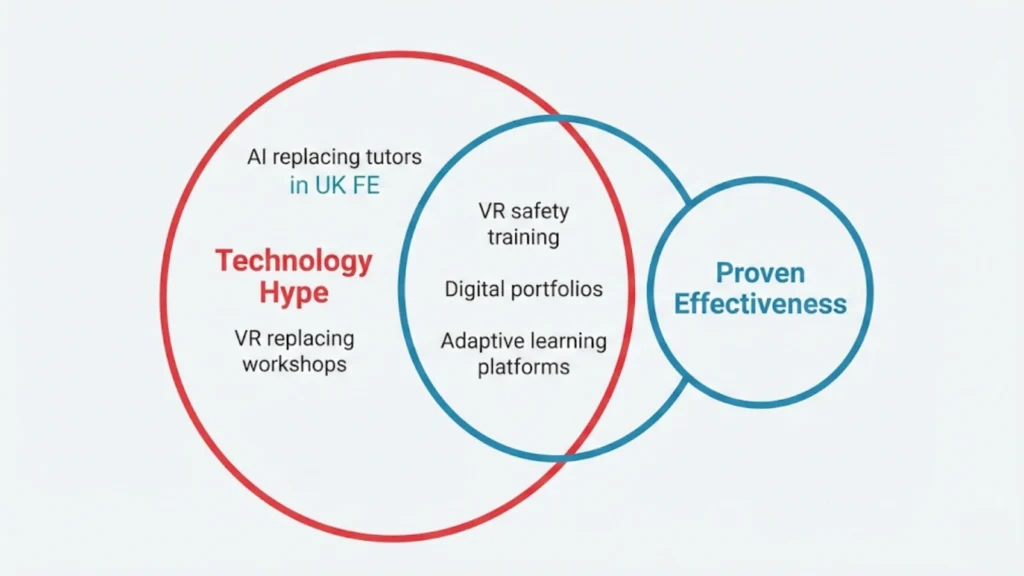
Here’s what’s actually happening: Technology is augmenting vocational training in specific, measurable ways. VR simulators provide safe practice for high-risk scenarios (high-voltage work, working at height). Digital portfolios enable remote assessment verification. Adaptive learning platforms personalize theory delivery. AI handles administrative tasks and provides instant feedback on knowledge assessments.
What technology isn’t doing: Replacing hands-on workshop time. Signing off safety-critical practical competence (UK regulators explicitly prohibit this). Teaching the nuanced judgment that comes from years of experience. Eliminating the need for qualified human instructors.
The distinction matters because understanding what technology genuinely improves, what it can’t replace, and where the hype exceeds reality affects training decisions, career preparation, and employer expectations. For electricians specifically, it determines whether you invest time learning BIM navigation and digital evidence management (increasingly required) or chasing AI programming skills (largely irrelevant to electrical work).
This isn’t about technology being “good” or “bad.” It’s about understanding what’s changing substantively versus what’s marketing, what skills employers actually need, and how global forces (aging workforce, net-zero transition, automation) are driving specific technology adoption patterns.
What's Actually Changing in UK Vocational Education
Let’s be specific about what technology is doing in 2026.
Blended learning becomes standard:
The UK vocational education model now operates on approximately 70% hands-on practical, 30% digital theory delivery. Platforms like Canvas and Moodle host theory content, multiple-choice assessments, and supplementary resources. Apprentices access modules remotely, complete knowledge tests online, then apply learning in physical workshops.
This isn’t revolutionary. It’s digitizing what was previously paper-based theory while maintaining the practical emphasis that defines vocational training.
VR and AR for high-risk scenarios:
Virtual reality simulators now provide practice for scenarios that are dangerous, expensive, or impractical to replicate physically. Electrical apprentices practice high-voltage switching procedures without risk. Construction trainees work at virtual height before accessing real scaffolding. Engineering students troubleshoot complex machinery failures in simulation.
Evidence: PwC and CITB data (2025) shows VR-trained learners report 275% higher confidence in safety-critical procedures compared to classroom-only instruction. This doesn’t mean VR replaces physical practice; it means learners arrive at real scenarios better prepared.
Digital portfolio systems:
Platforms like OneFile and Smart Assessor enable apprentices to upload photographic and video evidence of work performed on-site. Assessors can verify competence remotely rather than traveling to job sites. This accelerates assessment cycles and reduces carbon emissions per qualification.
"Digital portfolios through platforms like OneFile are standard now, but quality varies enormously. Some learners upload blurry photos with no context or annotation. Others provide detailed evidence that makes assessment straightforward. The technology enables remote verification, but the learner's understanding of what constitutes good evidence determines whether it's useful."
Thomas Jevons, Head of Training
Adaptive learning for knowledge acquisition:
AI-powered platforms adjust content difficulty and pacing based on learner performance. If an apprentice struggles with Ohm’s Law, the system provides additional practice and explanations before progressing to circuit design. If they demonstrate mastery quickly, content accelerates.
Evidence: Century Tech and similar platforms report approximately 30% reduction in time-to-competence for theory components. This frees more time for hands-on practice.
Learning analytics for early intervention:
Digital platforms flag when learners haven’t engaged with content, are struggling with specific modules, or show patterns indicating potential dropout risk. Tutors receive dashboards highlighting which apprentices need intervention.
This isn’t AI making pedagogical decisions. It’s data visualization helping human tutors allocate attention effectively.
What AI Is Actually Doing (And Critically, What It's NOT Doing)
The gap between AI capabilities and AI marketing claims is substantial. Let’s be clear.
What AI is doing in UK vocational education:
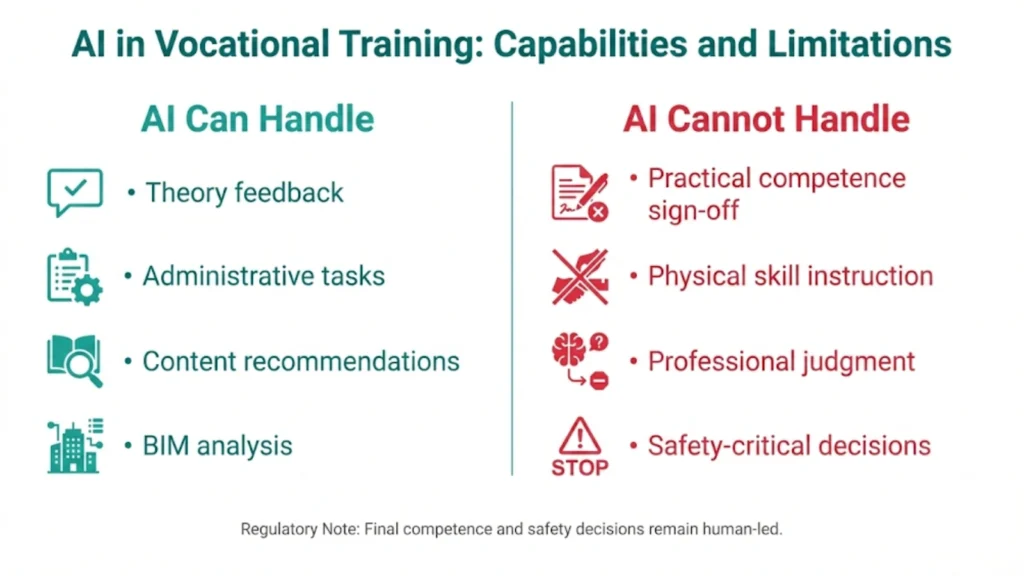
Automated administrative tasks: Lesson planning templates, attendance tracking, basic record-keeping. Tutors report approximately 20% reduction in administrative workload, freeing time for actual teaching.
Personalized feedback on theory: AI tutors provide instant feedback on circuit diagrams, multiple-choice assessments, functional skills (English/Maths) exercises. Available 24/7, allowing learners to practice and receive corrections outside classroom hours.
Content recommendations: Based on learner performance and course requirements, AI suggests additional resources, practice exercises, or prerequisite review materials.
BIM and site planning: AI analyzes Building Information Models to identify potential electrical/plumbing/mechanical conflicts before installation begins. This is increasingly relevant for electricians working on commercial projects.
What AI is NOT doing (and UK regulators prohibit):
Signing off practical competence: Ofqual and IfATE explicitly require human verification for safety-critical skills. No AI system can certify that an apprentice has safely isolated a circuit, tested installations correctly, or demonstrated the judgment needed for real electrical work.
Replacing qualified instructors: AI cannot teach the nuanced feel of proper cable termination, the sound of a loose connection, or the visual cues of substandard installation work. These require human mentorship and years of experience.
Assessing judgment and professionalism: Client interaction, problem-solving under pressure, ethical decision-making, and adapting to unexpected site conditions cannot be evaluated by AI. These competencies require human assessment.
Guaranteeing technical accuracy: AI language models occasionally “hallucinate” technical facts or provide incorrect wiring advice. Learners must cross-reference AI outputs against official standards (BS 7671 for electrical work) to ensure safety compliance.
The pattern: AI handles knowledge transfer, administrative burden, and pattern recognition. Humans handle competence verification, mentorship, and professional judgment development.
Global Forces Actually Driving Technology Adoption
Technology adoption in vocational education isn’t random. Three forces are driving specific changes. Short-duration courses focusing on specific technologies like smart home integration or EV charging are increasingly common, but understanding their value requires distinguishing between what can be learned in days versus what requires sustained practical experience
Aging workforce and knowledge capture:
Approximately 20% of UK tradespeople are nearing retirement. Technology (particularly VR and digital repositories) is being used to capture expert knowledge before experienced professionals leave the industry.
Example: Expert electricians demonstrate complex fault-finding procedures on camera. These recordings become training resources, preserving techniques and judgment calls that might otherwise disappear.
Net-zero transition and electrification skills:
The UK’s commitment to decarbonization requires an estimated 250,000+ green-skilled workers by 2030. This includes electricians qualified in heat pump electrical interfaces, EV charger installation, solar PV integration, and battery storage systems.
Technology addresses this through: Accelerated theory delivery via adaptive learning. VR practice for new equipment types before physical access. Digital credentialing for modular upskilling (you don’t repeat full qualifications; you add specialist modules).
Automation augmenting (not replacing) trades:
McKinsey estimates 70% of current trade skills will be “augmented” by AI and robotics by 2030. This doesn’t mean replacement; it means electricians using AI-enhanced diagnostic tools, BIM models for pre-installation planning, and automated testing equipment.
The skills shift: From pure manual execution to combining manual competence with digital tool proficiency.
UK Policy Response: Skills England and the Growth and Skills Levy
Government policy is adapting to technology-enabled training models.
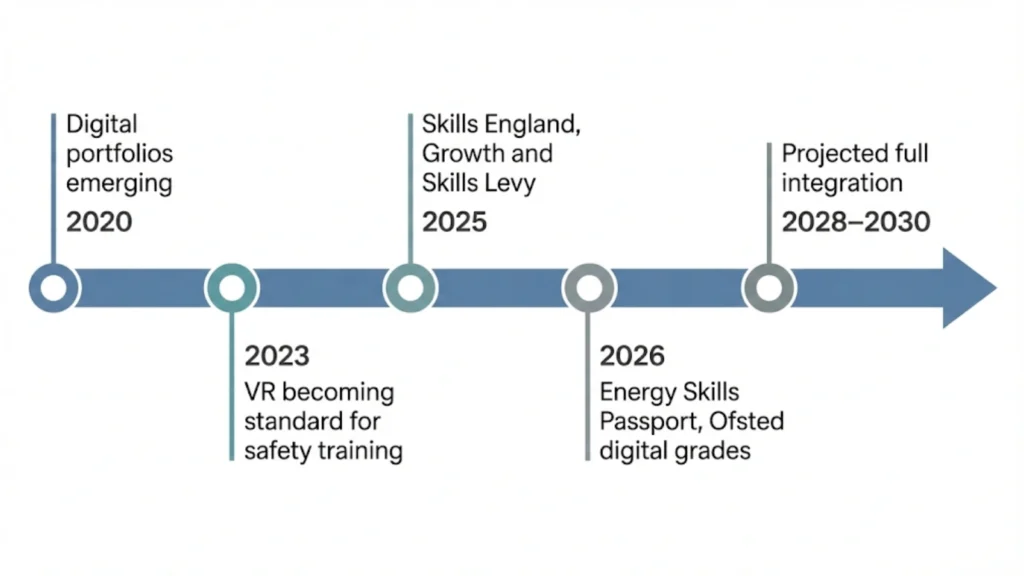
Skills England (launched 2025):
New executive agency consolidating skills policy across England. Focus: Identifying skills gaps, coordinating training provision, and enabling flexible qualification pathways that incorporate digital credentials.
Growth and Skills Levy (replaced Apprenticeship Levy in 2025):
Key change: Employers can now use 50% of levy funds for “shorter, modular digital courses” rather than only full 3-4 year apprenticeships. This enables upskilling in specific technologies (EV charging, heat pump installation, BIM navigation) without requiring complete re-qualification.
Impact for electricians: Qualified electricians can access funded modular training in emerging technologies without sacrificing income for years-long programs.
Energy Skills Passport (launched January 2026):
Digital credential system allowing tradespeople to map and transfer skills between oil, gas, and renewable energy sectors. Electricians with fossil fuel experience can demonstrate transferable competencies and identify specific upskilling needs for renewable work.
Ofsted “Digital Quality” assessments:
From late 2025, Further Education providers receive specific grades on their digital learning environments. This incentivizes investment in technology infrastructure and quality control for digital delivery.
Lifelong Learning Entitlement (LLE):
Now fully operational, allowing adults to take out loans for modular learning units rather than only full qualifications. Example: An electrician can study a 2-week BIM for electrical contractors module without committing to a full Level 4 qualification.
The pattern: Policy is enabling bite-sized, technology-delivered upskilling for existing workers while maintaining rigorous standards for initial qualification.
What Electricians Actually Need (Digital Skills vs Hype)
Let’s be specific about what “digital skills” means for electrical work.
What employers actually want:
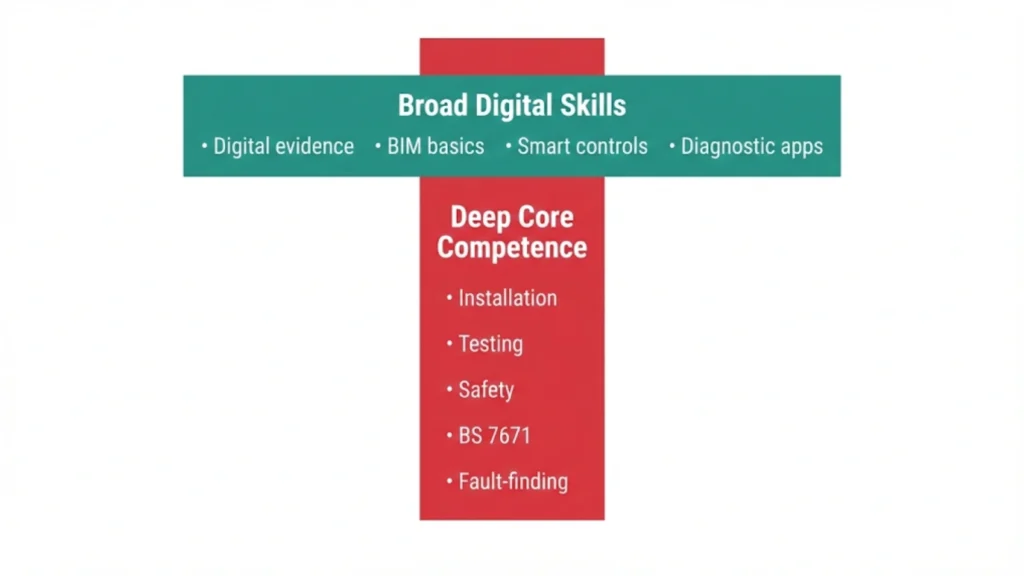
Digital evidence management: Ability to photograph installations properly, annotate images, record videos showing correct procedures, and upload organized evidence for NVQ portfolios or quality assurance. This is baseline, not advanced.
Basic BIM navigation: Understanding how to read Building Information Models to identify where electrical installations will integrate with plumbing, HVAC, and structural elements. Not creating BIM models; reading them. Adult training programs in areas like Wolverhampton increasingly incorporate digital skills alongside traditional practical training, but the emphasis remains on hands-on competence with technology as an enabler rather than the focus.
Smart building control familiarity: Comfort working with Building Management Systems (BMS), basic understanding of IoT (Internet of Things) connected devices, knowledge of how smart home systems integrate with electrical installations.
Diagnostic app usage: Using manufacturer apps for troubleshooting equipment, accessing technical specifications, and following diagnostic procedures. Similar to using a manual but digital.
"When job specs say 'AI literacy,' they usually mean comfort using AI-enhanced diagnostic tools or understanding how building management systems work, not programming AI models. It's about being able to work effectively in digitally-enhanced environments, which is very different from being a tech specialist."
Joshua Jarvis, Placement Manager
How these skills are acquired:
Not through separate “digital skills courses” but integrated into standard electrical training. You learn digital evidence management by building NVQ portfolios. You learn BIM basics when working on commercial projects that use them. You learn diagnostic apps when manufacturers provide training on their equipment.
The key: Digital skills enhance core electrical competence; they don’t substitute for it. An electrician who can’t properly test an installation but knows BIM inside-out isn’t employable. An electrician with solid practical skills who also understands digital tools is increasingly valuable.
The Digital Divide Reality (Access Isn't Universal)
Technology-enabled training assumes universal access. That assumption is wrong.
The infrastructure gap:
5G and high-speed fiber rollout varies dramatically across the UK. Urban areas (Birmingham, London, Manchester) have reliable connectivity. Rural and some semi-rural areas lack adequate infrastructure for bandwidth-intensive applications like VR training or video portfolio uploads.
Result: Apprentices in rural areas struggle with online learning modules, portfolio uploads, and remote assessment. This isn’t a skills issue; it’s an infrastructure limitation.
The home access gap:
Approximately 1 in 10 UK apprentices lack adequate home Wi-Fi, according to Jisc data (2025). For learners from disadvantaged backgrounds, this creates barriers to completing theory modules, accessing support resources, and uploading evidence.
Providers increasingly need to provide: On-site computer access outside class hours. Mobile data allowances for portfolio uploads. Physical spaces for video recording and uploading.
The device gap:
Many apprentices access learning through smartphones rather than laptops or tablets. This works for some applications but creates challenges for others (complex BIM models, detailed circuit diagrams, extensive written work).
Regional variation in opportunity:
An apprentice in Birmingham has access to providers with cutting-edge VR labs, multiple high-speed internet options, and abundant on-site learning spaces. An apprentice in rural Wales may have limited provider choice, inconsistent connectivity, and fewer technology-enhanced options.
This creates what’s been termed an “innovation lottery”—where learning opportunities depend heavily on geographic location.
Common Myths About Technology in Vocational Education
Let’s address misconceptions directly.
Myth: “AI will replace vocational tutors within 5 years.” Reality: AI handles administrative tasks and provides instant feedback on theory. Human tutors remain essential for: demonstrating physical techniques, mentoring professional development, assessing practical competence, and providing the nuanced feedback that comes from experience. UK regulators explicitly prohibit AI from safety-critical competence sign-off.
Myth: “VR training means we don’t need physical workshops anymore.” Reality: VR is excellent for high-risk scenarios (high-voltage switching, working at height) where physical practice carries danger. It cannot replace the muscle memory, tactile feedback, and material familiarity that comes from actual installation work. The standard remains 70% hands-on practical, with VR supplementing specific scenarios.
Myth: “Digital credentials make traditional qualifications obsolete.” Reality: Digital badges and micro-credentials are valuable for demonstrating modular upskilling (you’ve completed EV charger installation training). They don’t replace foundation qualifications like NVQ Level 3. Employers filter for NVQ + AM2 + Gold Card; digital badges add to this, not substitute for it.
Myth: “All electricians need to learn coding now.” Reality: Electricians need comfort with digital tools (BIM navigation, diagnostic apps, smart building controls). They don’t need programming skills. The “AI literacy” appearing in job specs means using AI-enhanced tools, not building AI systems.
Myth: “Technology makes training faster overall.” Reality: Technology accelerates theory delivery (adaptive learning reduces time-to-competence by approximately 30% for knowledge components). It doesn’t reduce the time needed for hands-on practical experience, portfolio building, or developing professional judgment. Total qualification timeline remains similar.
Myth: “Simulators are just games with no educational value.” Reality: High-quality VR simulators provide stress-testing in scenarios that would be illegal or dangerous in real workshops. PwC/CITB data shows 275% confidence improvement. These are evidence-based training tools, not entertainment.
Myth: “The digital divide will be solved soon, so we don’t need to address it.” Reality: 5G and fiber rollout to rural areas is years away. Current apprentices face access barriers now. Providers need practical solutions (on-site access, data allowances) rather than waiting for infrastructure improvements.
What Learners Should Actually Focus On
Forget the hype. Here’s practical guidance.
Master foundational competence first:
Your priority is developing solid practical skills in your trade. For electricians: safe isolation, proper termination, testing procedures, BS 7671 compliance, fault-finding, installation quality. Digital skills are useless without this foundation.
Learn digital evidence management naturally:
You’ll build this skill through NVQ portfolio development. Focus on: Taking clear, well-lit photos showing work details. Annotating images explaining what you did and why. Recording brief videos demonstrating procedures. Organizing evidence logically by unit requirements.
This isn’t a separate “course”—it’s integrated into qualification completion.
Understand your sector’s digital tools:
For electricians, this means: Basic BIM navigation for commercial projects. Manufacturer diagnostic apps for equipment troubleshooting. Smart building control systems if working in commercial installations. Digital job management systems used by your employer.
You learn these on-the-job as needed, not through isolated study.
Develop critical AI evaluation:
When using AI tools (ChatGPT for research, AI-enhanced diagnostics, automated recommendations): Always cross-reference technical advice against official standards (BS 7671). Verify wiring configurations through multiple sources. Don’t trust AI blindly for safety-critical information.
AI is a useful assistant, not an authoritative source for electrical work.
Maintain hands-on focus:
If a provider is marketing “digital-first” programs with reduced workshop time, be skeptical. The 70/30 split (70% practical, 30% digital theory) exists because physical practice is irreplaceable for trade competence. Government initiatives like the £820m Youth Guarantee are funding pathways into electrical training, with increasing emphasis on combining traditional apprenticeship structures with flexible digital upskilling modules.
Build lifelong learning habits:
Technology’s main advantage: It enables ongoing upskilling without years-long program commitments. Use the Growth and Skills Levy, modular digital courses, and micro-credentials to add specialist skills (EV charging, heat pump installation, smart building controls) throughout your career. But foundation competence comes first.
The Bottom Line on Technology and Vocational Training
Technology is changing vocational education in specific, measurable ways. It’s not revolutionizing training; it’s enhancing and enabling.
What’s genuinely useful:
VR for high-risk safety scenarios before physical practice. Digital portfolios enabling remote assessment and reducing travel. Adaptive learning accelerating theory acquisition. Analytics helping tutors identify struggling learners early. Modular digital credentials enabling flexible upskilling.
What remains unchanged:
The need for extensive hands-on practice. Human verification of safety-critical competence. Mentor-apprentice relationships for professional development. The primacy of physical skill over theoretical knowledge. The requirement for qualified human instructors.
What electricians actually need:
Core competence in electrical installation, testing, and safety. Digital evidence management skills (portfolio building). Basic familiarity with BIM, smart controls, and diagnostic apps. Critical evaluation of AI outputs against official standards. Lifelong learning mindset for ongoing technological change.
What they don’t need:
Coding or programming skills. AI system development knowledge. Advanced tech specialist capabilities. To sacrifice hands-on training time for digital content.
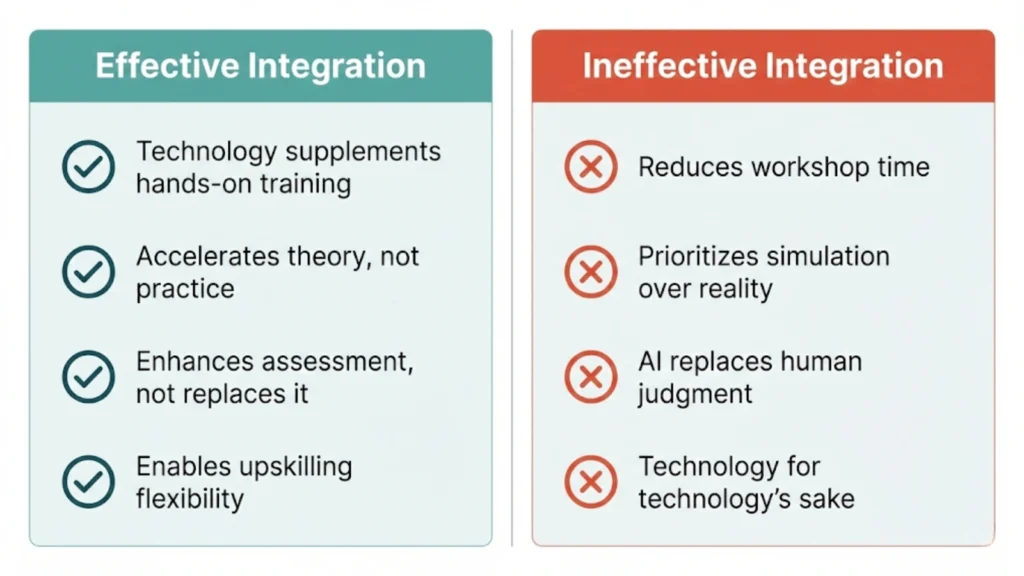
Technology enhances electrical training when it supplements practical experience, accelerates knowledge transfer, and enables flexible upskilling. It undermines training when it reduces workshop hours, overpromises capability, or substitutes simulation for real installation experience.
The electricians thriving in 2026 and beyond will combine deep practical competence with comfort using digital tools. Not tech specialists who dabble in electrical work, but electricians who leverage technology to enhance their core trade skills.
Ready to Navigate Technology Changes Practically?
Call us on 0330 822 5337 to discuss how technology is affecting electrical training pathways, what digital skills employers actually require, and why hands-on practical competence remains the foundation despite technological advances.
What we’re not going to tell you:
- That AI will replace qualified electrical instructors
- That VR can substitute for workshop practice hours
- That you need coding skills to work as an electrician
- That digital credentials replace NVQ Level 3 + AM2
What we will tell you:
- How digital portfolio systems work in NVQ assessment
- What “AI literacy” actually means in electrical job specs (using tools, not coding)
- Why the 70/30 practical-to-digital ratio remains standard
- Which digital skills enhance employability (BIM basics, evidence management)
How Skills England and Growth and Skills Levy enable flexible upskilling
No technology hype. No overselling digital transformation. Just honest guidance on preparing for electrical work in technology-enhanced environments while maintaining the practical competence employers actually require.
References
Primary Official Sources
- DfE AI in Education Evidence and Guidance 2024-2026: https://www.gov.uk/government/publications/ai-in-education-evidence-and-guidance
- Skills England National Skills Strategy 2025/26: https://www.gov.uk/government/organisations/skills-england
- IfATE Occupational Standards Digital Integration 2025: https://www.instituteforapprenticeships.org/developing-new-apprenticeships/digital-skills/
- GOV.UK Apprenticeship Statistics 2024/25: https://explore-education-statistics.service.gov.uk/find-statistics/apprenticeships/2024-25
- OECD Skills Outlook 2025: https://www.oecd.org/en/publications/2025/12/oecd-skills-outlook-2025_ac37c7d4.html
Technology and Training Research
- CITB A New Reality: Immersive Learning in Construction 2025: https://www.citb.co.uk/media/subhmsxp/t1438-rr-citb-a_new_reality_report.pdf
- Digital Badging Commission Report October 2025: https://www.thersa.org/wp-content/uploads/2025/10/Digital-Badging-Commission-Recommendations-2025-v1.1.pdf
- Gatsby Foundation Generative AI in Further Education: https://www.gatsby.org.uk/app/uploads/sites/2/2025/12/generative-ai-in-further-education.pdf
- Edge Foundation EdTech in FE Colleges: https://www.edge.co.uk/documents/264/EdTech_in_FE_Colleges_FINAL.pdf
Skills and Labour Market Analysis
- ETF Impact Report: How AI Will Impact Teaching and Learning: https://set.et-foundation.co.uk/resources/how-artificial-intelligence-ai-will-impact-teaching-and-learning
- City & Guilds Apprenticeships Plugging Digital Skills Gap: https://www.cityandguilds.com/en/news/May-2024/apprenticeships-plugging-the-digital-skills-gap
- PwC Green Jobs Barometer 2023: https://www.pwc.co.uk/who-we-are/purpose/green-jobs-barometer-2023.pdf
- NFER Skills Imperative 2035: https://www.nfer.ac.uk/media/ybkcqvuz/the_skills_imperative_2035_working_paper_2_headline_report.pdf
- CIPD Lifelong Learning in the Reskilling Era: https://www.cipd.org/globalassets/media/knowledge/knowledge-hub/reports/2025-pdfs/8930-lifelong-learning-in-the-reskilling-era-report-web.pdf
Sector-Specific Technology Insights
- WorldSkills UK Green Skills Report 2022: https://www.worldskillsuk.org/wp-content/uploads/2022/07/GreenSkillsReport-2022_v3c.pdf
- Energy Skills Partnership (ESP): https://energyskillspassport.org.uk/
Academic Research on AI in Education
- Frontiers in Education AI Impact Research: https://www.frontiersin.org/journals/education/articles/10.3389/feduc.2024.1463208/full
- MDPI Automation and Assessment Ethics: https://www.mdpi.com/2227-7102/15/3/343
Note on Accuracy and Updates
Last reviewed: 31 January 2026. This page is maintained; we correct errors and refresh sources as technology capabilities, policy frameworks, and training standards evolve. Skills England launch, Growth and Skills Levy details, Energy Skills Passport launch (January 2026), and Ofsted digital quality assessments reflect current government policy. PwC/CITB VR effectiveness data (275% confidence improvement) and Jisc digital access statistics (1 in 10 apprentices lacking adequate home Wi-Fi) represent latest available research. Next review scheduled following any significant updates to IfATE digital competency standards or vocational AI regulation changes.