
Kitchen Extension Electrical Requirements UK: Load Calculations, Circuit Design and Why Extensions Beat Standard Domestic Work
- Technical review: Thomas Jevons (Head of Training, 20+ years)
- Employability review: Joshua Jarvis (Placement Manager)
- Editorial review: Jessica Gilbert (Marketing Editorial Team)
- Last reviewed:
- Changes: Complete technical guide covering kitchen extension electrical requirements, load diversity calculations per BS 7671 Appendix 15, circuit design strategies for modern high-load appliances, RCD/RCBO protection specifications, lighting zone design, Part P compliance pathways, island power solutions, and business case analysis for electricians specializing in domestic extension work.
Kitchen extensions represent the most profitable segment of domestic electrical work available to qualified electricians in 2026. With over 50% of UK homeowners undertaking renovation projects and kitchen extensions dominating the £11.2 billion home improvement market, the work is there. The question is whether you’re positioned to win it, price it properly, and deliver it without the margin-destroying retrofits that turn decent jobs into breakeven disasters.
This isn’t standard domestic installation. Extension work demands load assessment competence that most new-build electricians never develop, design-phase involvement that separates you from sparks who just pull cable, and Part P compliance understanding that protects your professional reputation when properties change hands. Get it right and you’re commanding £250-£350 daily rates with referrals that compound over decades. Get it wrong and you’re retrofitting circuits through finished stone worktops at your own expense.
If you’re a qualified electrician considering specializing in extension work, or you’re currently doing extensions but pricing them like standard domestic callouts, this guide covers the technical requirements, business realities, and professional positioning that make kitchen extensions sustainable high-value work rather than occasional nightmare jobs.
Why Kitchen Extensions Are Different From Standard Domestic Work
The Load Profile Has Changed Fundamentally
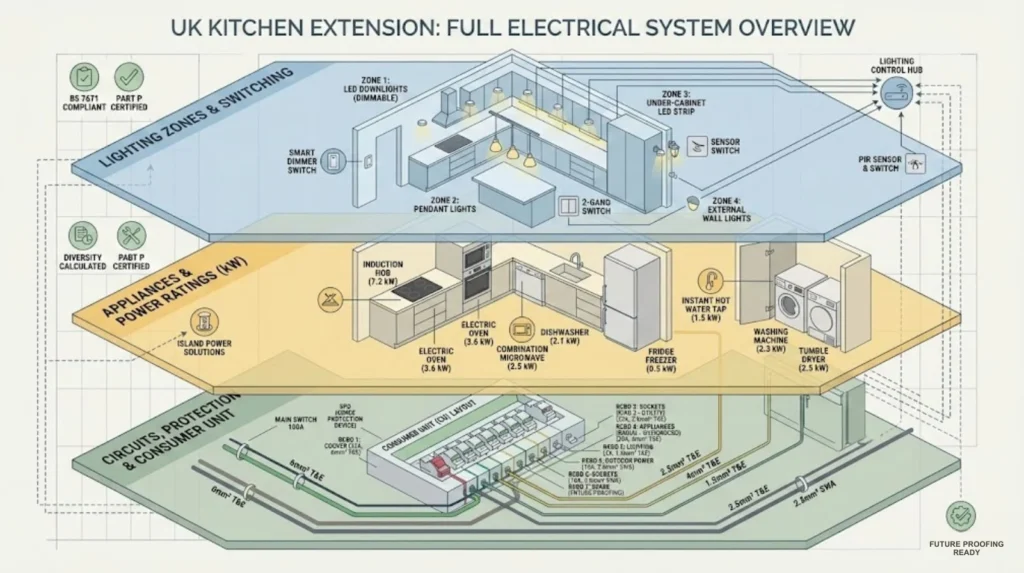
A 1990s kitchen ran on a 32A ring final for sockets and a 6A lighting circuit. Job done. A 2026 kitchen extension client specification looks like this:
Induction hob: 7.4kW (32A dedicated circuit)
Built-in double oven: 5kW (20A circuit, potentially shared if diversity allows)
Dishwasher: 2.5kW
Boiling water tap: 3kW (often forgotten until after first-fix)
Wine fridge: 150W continuous
American-style fridge-freezer: 500W
Integrated coffee machine: 1.5kW
Microwave drawer: 1kW
Under-unit lighting: 200W LED (but requires compatible dimming)
Island sockets: Variable load, plan for 13A simultaneous use minimum
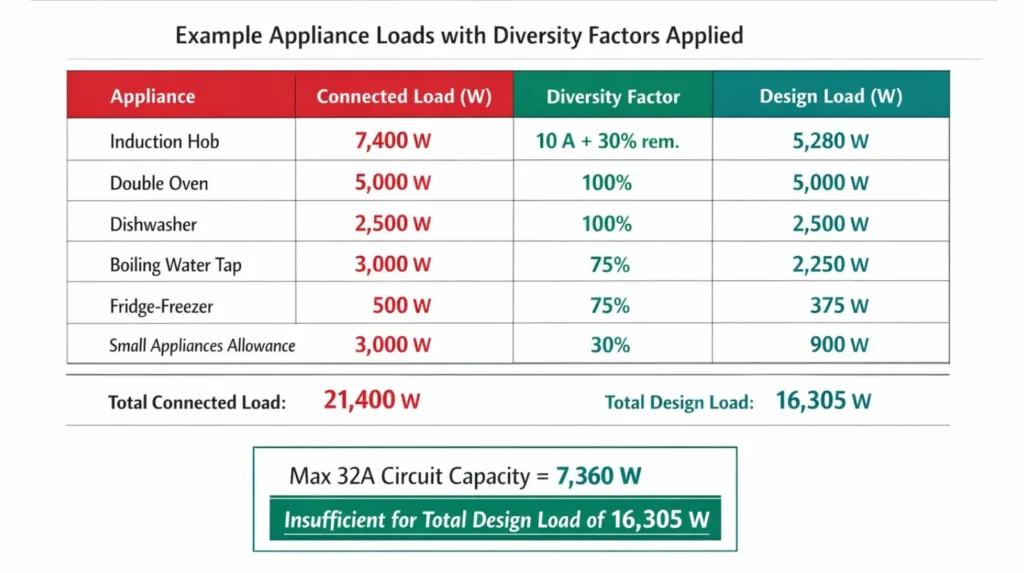
That’s approaching 23kW of installed load before you account for small appliances, phone chargers, laptops, or the inevitable “we’re adding a TV” conversation that happens during second-fix. If you’re spec’ing this on a single 32A radial and hoping diversity saves you, you’ve already lost control of the job.
Diversity Factors Are Your Margin Protection
BS 7671 Appendix 15 provides diversity guidance, but kitchen extensions require judgment calls that new-build electricians rarely face. You cannot realistically assume all appliances will operate simultaneously at full load, but you also cannot assume 1990s cooking habits in a home installing a £5,000 range cooker.
Typical diversity application for extension work:
Cooking appliances: 10A + 30% of remainder + 5A if socket outlet provided (Appendix 15 guidance)
Socket outlets: 100% first socket + 40% second + 30% third onward (ring finals historically assumed, but radials require tighter calculation)
Fixed appliances: 100% of largest two, 75% of third onward
Lighting: 66% final circuit load (LED reduces this significantly but driver compatibility matters)
Thomas Jevons, Head of Training at Elec Training, explains the client communication gap:
"Kitchen extension clients consistently underestimate their appliance load. They'll mention an induction hob and a dishwasher, then six weeks into the job you discover they've ordered a 3kW boiling water tap, a wine fridge, and an American-style fridge-freezer pulling 500W. If you haven't assessed diversity factors properly and planned dedicated circuits at first-fix, you're facing change orders that eat your margin. I've seen sparks spec a single 32A radial for the entire island, then spend three days retrofitting a second circuit after the stone worktop's installed."
Thomas Jevons, Head of Training
This is why competent extension electricians get involved during the design phase, not when the kitchen supplier has already confirmed appliance positions and the builder has closed the walls.
Circuit Design Strategy: Rings, Radials and Reality
The Ring vs Radial Decision
BS 7671 doesn’t mandate ring finals for domestic installations, but they remain common in UK practice due to historical precedent and material cost efficiency. For kitchen extensions, the decision requires more analysis.
Ring finals (32A MCB protection):
Advantages: Higher load capacity distributed across two cable routes, socket flexibility anywhere on ring
Disadvantages: Requires proper testing (R1+R2, end-to-end resistance verification), more complex fault-finding, potential for overload if ring integrity compromised
Best for: General socket provision across large extension footprints where appliance positions aren’t fixed
Radial circuits (16A, 20A, or 32A MCB protection):
Advantages: Simpler fault diagnosis, lower loop impedance, easier to calculate maximum load
Disadvantages: Load limited by protective device rating, requires more circuits for same socket provision
Best for: Dedicated high-load appliances (induction hobs, ovens), island circuits where load is predictable
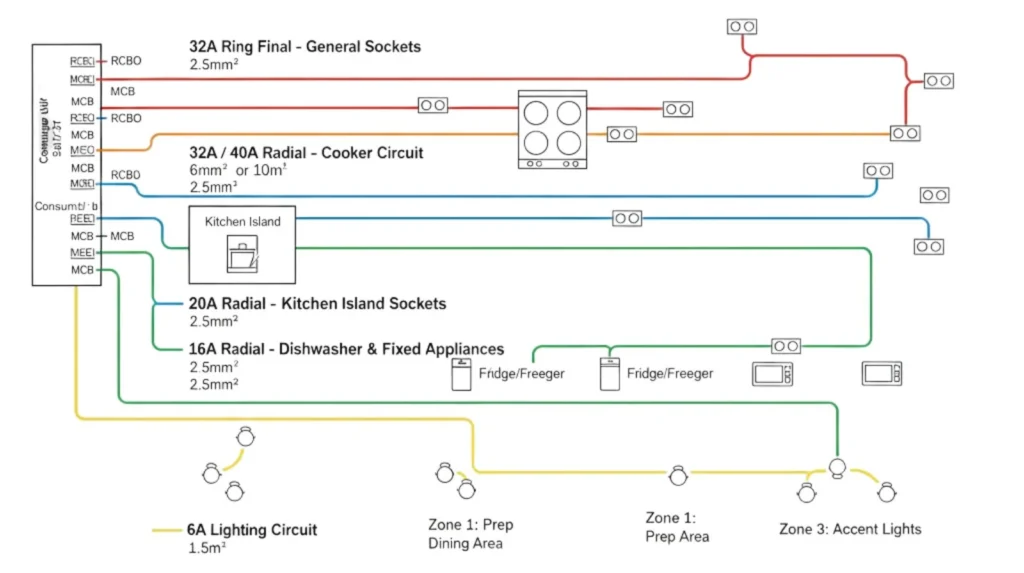
Recommended Extension Circuit Strategy:
Ring final for general sockets (32A): Feeds worktop sockets, non-fixed appliance positions
Dedicated radial for cooker (32A or 40A depending on load): Direct from consumer unit to cooker control unit
Dedicated radial for island (20A minimum): Separate circuit prevents tripping from simultaneous small appliance use
Appliance radials as required (16A-20A): Dishwasher, washing machine if relocated, boiling tap if high-load model
Lighting circuit (6A or 10A): Separate zones on RCBOs for nuisance trip isolation
This provides redundancy (general ring failure doesn’t kill island sockets), predictable load management, and compliance headroom for Building Control inspection.
Cable Sizing Beyond Table 4D5
Most extension work uses 2.5mm² T&E for socket radials and 1.5mm² T&E for lighting, referencing BS 7671 Table 4D5 (Method C clipped direct). But extensions introduce complications:
Insulation contact: Ceiling insulation over cable runs (Method A derating applies, potentially requiring 4mm²)
Ambient temperature: Underfloor heating raises ambient conditions (derating factor from Table 4B1)
Grouping: Multiple circuits in same containment (Table 4C1 grouping factors)
Voltage drop: Long cable runs to garden room extensions (maximum 3% lighting, 5% other uses per Appendix 4)
For a 20m run to an island on a 32A radial, voltage drop calculation:
Cable: 2.5mm² copper, 18mV/A/m
Load: 20A (assumed diversity)
Drop: (18mV × 20A × 20m) / 1000 = 7.2V
Percentage: 7.2V / 230V = 3.13%
That’s within the 5% limit but approaching it. If the client later wants a higher-load appliance, you’re uncomfortably close. Speccing 4mm² for the island radial adds cable cost but eliminates voltage drop concerns and future-proofs for load increases.
RCD and RCBO Protection: Compliance and Nuisance Trip Avoidance
The Regulation 411.3.3 Requirement
Socket outlets rated 20A or less must have additional protection via a 30mA RCD (Regulation 411.3.3). For kitchen extensions, this typically means:
All socket circuits protected by 30mA RCD
Cooker circuit if socket outlet provided at cooker control unit
Fixed equipment generally does not require RCD protection unless specific circumstances apply (outdoor, bathroom zones, buried cables <50mm)
The Nuisance Trip Problem
Kitchen extensions concentrate high-load switching events (induction hob startup transients, compressor motor starts) that can cause nuisance RCD trips. If your entire extension is on a single RCD protecting multiple circuits, a fridge compressor fault can kill lighting, sockets, and cooking simultaneously.
RCBO Strategy for Extensions:
Modern consumer units should use RCBOs (combined MCB + RCD in single module) for each final circuit rather than a single RCD protecting multiple MCBs. This provides:
Selective tripping: Only the faulted circuit disconnects
Easier fault diagnosis: No hunting through four circuits to find which one tripped the RCD
Consumer unit space efficiency: 18mm RCBOs vs dual RCD + MCB boards
For a typical extension:
Island sockets: 20A RCBO (Type A for induction compatibility)
General sockets: 32A RCBO (Type A)
Cooker: 32A RCBO (Type A if induction, Type AC acceptable for resistive loads)
Lighting zones: 6A RCBOs (allows zone isolation without losing all lights)
Fixed appliances: MCBs or RCBOs depending on RCD requirement
Type AC vs Type A RCBOs
Type AC RCBOs detect AC residual currents only. Type A detects AC plus pulsating DC up to 6mA. Amendment 2 to BS 7671:2018 requires Type A protection for circuits supplying equipment likely to produce DC residual currents, including:
Induction hobs (switching power supplies generate DC components)
EV chargers
Inverter-driven appliances (some fridges, heat pumps)
For extension work, specifying Type A RCBOs for socket and cooker circuits adds minimal cost (£10-£15 per device premium) and ensures compliance without second-guessing appliance types.
Lighting Design: Beyond Downlights
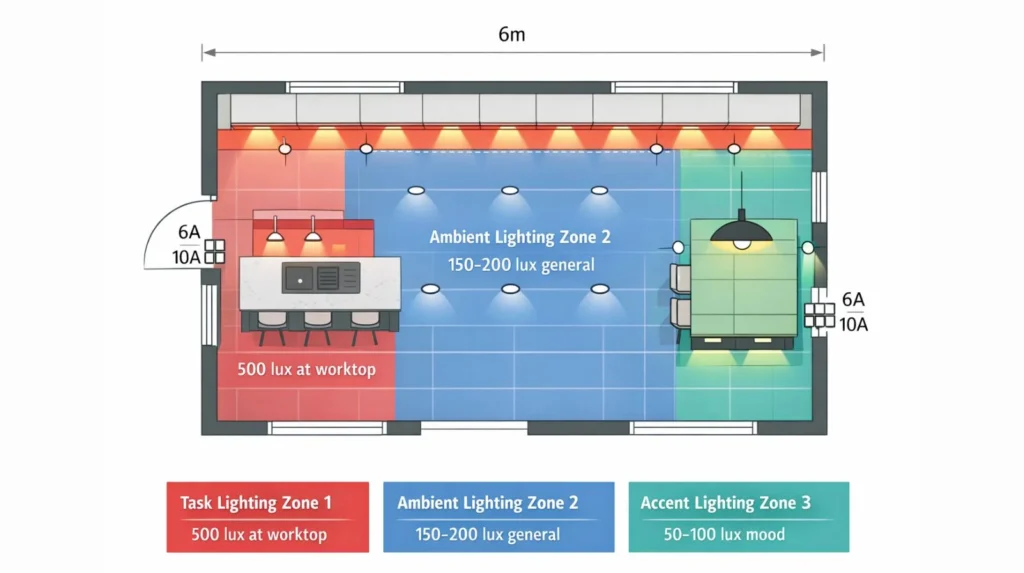
The Three-Zone Approach
Kitchen extension lighting failures stem from treating it as “stick downlights in the ceiling.” Professional lighting design for extensions requires three distinct zones:
Zone 1: Task Lighting (500 lux minimum at worktop level)
Purpose: Adequate illumination for food preparation, reading recipes, detailed work
Implementation: LED strip under wall units, directional downlights over islands, pendant task lights
Circuit: Dedicated 6A circuit, dimmable if LED drivers support it (check compatibility)
Switching: Independent control, often two-way from entrance and island
Zone 2: Ambient Lighting (150-200 lux general space)
Purpose: Overall room illumination, circulation safety, background light during entertaining
Implementation: Recessed downlights on 1.5-2m centers, architectural coving with LED tape
Circuit: Shared 10A circuit acceptable if load calculated
Switching: Separate from task, often integrated with mood zone on dimmer
Zone 3: Accent/Mood Lighting (variable, typically 50-100 lux)
Purpose: Architectural feature emphasis, dining ambiance, evening relaxation
Implementation: Pendant lights over tables, plinth lighting, glazed cabinet internals
Circuit: Can share with ambient if total load permits
Switching: Always dimmable, increasingly integrated with smart home systems
LED Driver Compatibility and Dimming
The shift to LED has introduced compatibility challenges electricians trained on incandescent systems may not anticipate. Key issues:
Minimum load: Many dimmers require 40W minimum load; six 5W LED downlights (30W total) may not dim reliably
Driver compatibility: Not all LED drivers work with trailing-edge dimmers (check manufacturer specifications)
Flickering: Mismatched dimmer and LED combination causes visible flicker annoying to clients
Inrush current: LED driver capacitors can cause nuisance trips on older RCDs
Specification approach:
Use LED-compatible dimmers rated for the actual LED load (not the lamp equivalent wattage)
Check driver data sheets for dimming compatibility before ordering
Consider 1-10V dimming systems for large installations (separate control circuit, no compatibility issues)
Install dimmable LED-rated RCBOs if experiencing nuisance trips
Two-Way and Intermediate Switching
Large extension spaces require switching at multiple locations. The building regulations don’t mandate this, but usability demands it. For a 6m × 4m extension:
Entrance switching: Controls ambient and task lighting independently
Island switching: Repeats entrance controls (two-way wiring)
Garden door switching: Controls external lighting and optionally internal zones (intermediate if required)
Two-way switching (two locations) uses standard two-way switches and three-core + earth cable. Intermediate switching (three+ locations) requires intermediate switches at middle positions. With smart lighting systems, this can be replaced by wireless switching reducing cable requirements, but adds equipment cost and potential future compatibility issues.
The Kitchen Island Power Challenge
Why Islands Are Different
Kitchen islands are structural, decorative, and functional. They’re also an electrical headache if not planned correctly. Problems:
No adjacent walls for traditional socket mounting
Worktop penetration required for any integrated solution
Aesthetic expectations (clients don’t want visible trunking or surface-mounted sockets)
Load uncertainty (laptops, phone chargers, small appliances, potential high-load additions later)
Solution Options and Trade-Offs
Option 1: Floor-Mounted Socket Boxes
Implementation: Recessed floor boxes with hinged lids, fed via conduit in screed
Advantages: Clean worktop, flexible positioning, can include USB and data
Disadvantages: IP rating requirements (especially if underfloor heating), higher cost (£80-£150 per box), must be positioned before floor finishes
Best for: Islands without fixed seating, commercial-style residential kitchens
Option 2: Pop-Up Worktop Sockets
Implementation: Spring-loaded or motorized units recessed into worktop, pop up when needed
Advantages: Invisible when not in use, integrated into worktop aesthetic
Disadvantages: Worktop cutout must be precise (no adjustment post-installation), mechanical failure risk, expensive (£150-£400 per unit), limited socket quantity
Best for: Stone or engineered worktops where floor boxes aren’t feasible
Option 3: Cabinet End/Back Panel Sockets
Implementation: Standard sockets on island cabinet ends or back panel if accessible
Advantages: Standard components, easy maintenance, lower cost
Disadvantages: Visible, can clash with cabinet design, requires cabinet manufacturer coordination
Best for: Islands with overhang or accessible back panels, budget-conscious clients
Circuit Requirements
Regardless of socket solution, islands require:
Minimum 20A dedicated radial (preferably 32A if space for future high-load appliances)
Type A RCBO protection
Separate from general socket ring (prevents nuisance trips affecting critical appliances)
Cable route planned during structural stage (floor screed pour, cabinet installation sequence)
Specifying a single 13A spur for an island is a false economy. Clients will use laptops, charge phones, run blenders, and potentially add higher-load equipment. A dedicated 20A or 32A circuit costs £50-£80 more in materials but eliminates the retrofit nightmare when they discover limitations.
Part P Compliance and Building Control Notification
What’s Notifiable in Kitchen Extensions
Part P of the Building Regulations requires notification for:
New circuits from consumer unit to extension (whether radial or ring)
Consumer unit changes (adding RCBOs, upgrading to RCD protection)
Work in special locations (if extension includes bathroom zones)
Not typically notifiable:
Socket additions to existing circuits (if not in special locations)
Lighting alterations within existing circuits
Like-for-like replacements (replacing damaged sockets, switches)
For kitchen extensions, the work is almost always notifiable because you’re adding new circuits. Notification routes:
Route 1: Registered Competent Person Scheme
You’re registered with NICEIC, NAPIT, ELECSA, or equivalent
You self-certify work and issue Building Regulations compliance certificate
You notify Building Control within 30 days
Advantage: No Local Authority fee, faster process
Requirement: Maintain registration (£400-£600 annually)
Route 2: Building Control Notification
You notify Local Authority before starting work
They inspect first-fix and final installation
They issue completion certificate
Advantage: No registration overhead
Disadvantage: £200-£400 notification fee per job, inspection scheduling delays
For electricians doing multiple extension jobs annually, Competent Person registration is cost-effective and professional positioning. For occasional extension work, Building Control notification is simpler.
The Insurance and Resale Reality
Non-compliant electrical work in extensions creates problems years later. When homeowners sell:
Surveyors question recent renovations without certification
Solicitors request Building Regulations compliance certificates
Buyers demand indemnity insurance (£2,000-£5,000) or price reductions (5-10% on extension cost)
Mortgage lenders may refuse lending if compliance uncertain
Your professional reputation depends on providing valid certification. The electricians who skip Part P notification to undercut compliant competitors damage the entire trade and create liability time bombs.
The Business Case: Why Extensions Beat Standard Domestic Work
The Day Rate Reality
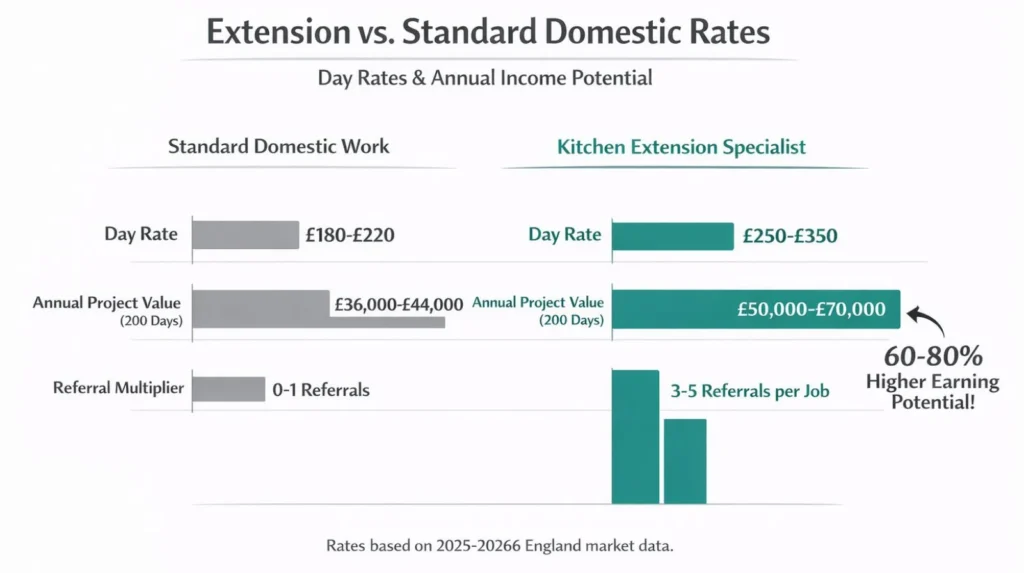
Standard domestic callouts: £180-£220 daily rate, reactive work, price-sensitive clients comparing quotes
Kitchen extension work: £250-£350 daily rate, project-based relationships, clients prioritizing competence over lowest price
The rate differential exists because extension work requires:
Design competence (load calculations, circuit strategy, lighting design)
Coordination skill (working with architects, builders, kitchen fitters, Building Control)
Professional certification (Gold Card, NVQ Level 3, 2391 testing qualification)
Business insurance (professional indemnity, public liability adequate for project values)
Clients investing £50,000-£100,000 in an extension aren’t shopping for the cheapest electrician. They’re assessing competence markers: qualifications, previous work examples, ability to explain technical decisions in plain language. If you’re competing on price alone, you’re positioned wrong.
Joshua Jarvis, Placement Manager at Elec Training, explains the long-term career advantage:
"For electricians looking at 10-15 year career trajectories, kitchen extensions offer something commercial work doesn't: relationship-based repeat business. You're working directly with homeowners who'll need electrical updates, EV charger installations, solar integration, and maintenance over decades. Commercial contracts are transactional, extensions are relational. The electricians building sustainable domestic businesses focus on extensions because each job is a long-term client relationship, not a one-off callout."
Joshua Jarvis, Placement Manager
The Referral Multiplier Effect
A well-executed kitchen extension generates approximately 3-5 referrals within the homeowner’s social circle over the following 12-18 months. They show off the space, mention their “brilliant electrician,” and provide your contact details when friends start planning their own projects.
This compares to standard domestic work where referrals are rare (emergency callouts aren’t impressive stories) and commercial work where you’re invisible to end clients. Extension work compounds because each satisfied client becomes a referral source for years.
The Technical Competence Filter
Kitchen extensions naturally filter out incompetent electricians. You cannot blag:
Load diversity calculations that Building Control inspectors will verify
RCD/RCBO selection that must comply with Amendment 2 requirements
Cable sizing accounting for installation method derating
Testing competence (R1+R2, Zs, insulation resistance, polarity) with valid 2391 qualification
Clients investing heavily want to see ECS Gold Card status, evidence of NVQ Level 3 competence, 2391 certification, and insurance appropriate to project scale. This barrier to entry keeps margins higher than general domestic work where any spark with a van can compete.
For electricians considering whether to position themselves as extension specialists, the qualification pathway matters. Electrician courses that include NVQ portfolio development and 2391 testing competence provide the credentials clients expect in extension work. Elec Training offers structured pathways from foundational electrical installation through to advanced competencies including inspection, testing, and design skills required for complex domestic projects.
For career changers entering the trade, understanding that extension work represents the high-value end of domestic electrical services helps clarify training priorities. The fast-track electrician route can accelerate classroom learning, but extension competence ultimately requires workplace experience assessing real load conditions, coordinating with other trades, and managing client expectations through multi-week projects.
Common Extension Mistakes and How to Avoid Them
Mistake 1: Single Island Circuit
Problem: Speccing one 13A spur or single 20A radial for kitchen islands Consequence: Circuit trips when clients use multiple appliances simultaneously, requires retrofit through finished worktop Solution: Minimum two dedicated circuits to islands (one for sockets, one for potential high-load additions), preferably 32A capacity on socket circuit
Mistake 2: Undersized Cooker Circuit
Problem: Installing 32A circuit for induction hobs pulling 7.4kW continuous Consequence: Voltage drop issues, cable overheating, nuisance trips Solution: Calculate actual load including diversity, use 40A or 45A MCB with appropriately sized cable if exceeding 7.2kW
Mistake 3: Type AC RCDs for Induction
Problem: Using standard Type AC RCDs/RCBOs for circuits feeding induction hobs Consequence: Non-compliance with BS 7671 Amendment 2, potential nuisance trips Solution: Specify Type A devices for all circuits potentially feeding inverter-driven appliances
Mistake 4: Inadequate Lighting Zones
Problem: Single lighting circuit with no zone separation or dimming Consequence: No mood control, all-or-nothing lighting, client dissatisfaction Solution: Minimum three zones (task, ambient, accent) with independent dimming on ambient and accent circuits
Mistake 5: Late Involvement
Problem: Being called after architectural drawings finalized and structural work started Consequence: Suboptimal cable routes, inadequate circuit provision, change orders reducing margin Solution: Request involvement during architectural drawing phase, provide cable route input before builders start
Mistake 6: Ignoring Voltage Drop
Problem: Long cable runs to garden room extensions without voltage drop calculation Consequence: LED dimming issues, appliance underperformance, non-compliance Solution: Calculate voltage drop for all circuits, upsize cable where approaching 3% (lighting) or 5% (other) limits
Mistake 7: No Consumer Unit Capacity Planning
Problem: Adding extension circuits to fully populated consumer units Consequence: Requiring consumer unit replacement mid-project, unplanned cost and delay Solution: Assess consumer unit capacity during quotation, budget for upgrade if required
Technical Specification Checklist for Extension Quotes
Load Assessment:
- Full appliance schedule obtained from client including wattages
- Diversity factors applied per BS 7671 Appendix 15
- Total connected load calculated
- Existing supply capacity verified (100A typical, may need DNO upgrade for large extensions)
Circuit Design:
- General sockets: Ring final or radial (specify)
- Cooker circuit: Dedicated radial sized to actual load (32A/40A)
- Island circuit(s): Minimum 20A dedicated, preferably two circuits
- Fixed appliances: Separate circuits where load warrants
- Lighting zones: Minimum three zones with independent control
Protection:
- RCD/RCBO protection for all socket circuits (30mA, Type A)
- RCD/RCBO protection for cooker if socket present at control unit
- RCBOs specified rather than dual RCD consumer unit (nuisance trip reduction)
- AFDD consideration for sleeping accommodation circuits if extension includes bedrooms
Cable Specification:
- Cable sizes calculated with derating factors (insulation, grouping, ambient temperature)
- Voltage drop verified within limits (3% lighting, 5% other)
- Cable routes planned avoiding structural conflicts
- Containment specified (conduit for floor routes, clipped direct where accessible)
Lighting:
- Task lighting specified with appropriate lux levels
- Ambient lighting designed for general illumination
- Accent/mood lighting included if client requirement
- Dimming compatibility verified (LED drivers and dimmer switches)
- Two-way/intermediate switching planned for large spaces
Compliance:
- Part P notification route confirmed (Competent Person or Building Control)
- Testing requirements planned (R1+R2, Zs, insulation resistance, polarity, RCD trip times)
- Certification costs included in quote
- Client informed of Building Control inspection schedule if applicable
Island Power:
- Socket solution agreed (floor box, pop-up, cabinet-mount)
- Worktop material confirmed (affects cutout feasibility)
- Cable route to island planned (floor screed, cabinet void, suspended floor access)
- IP rating verified if underfloor heating present
Kitchen extension electrical work offers qualified electricians a sustainable high-value business opportunity that standard domestic callouts and commercial contracting cannot match. The work demands design competence, proper load assessment, Part P compliance understanding, and coordination skills that filter out less capable competitors, maintaining premium day rates in a sector increasingly dominated by price competition.
The technical requirements are straightforward for electricians with proper training: apply diversity factors accurately, size circuits and cables correctly, specify RCD/RCBO protection per current regulations, design lighting zones appropriately, and plan island power during structural stages. The professional positioning matters more: involvement during design phase rather than as an afterthought, clear communication of technical decisions to non-technical clients, valid certification protecting long-term reputation, and relationship development that generates referral business for decades.
For electricians currently doing occasional extension jobs but not systematically pursuing them, the market opportunity is substantial. Over 50% of UK homeowners undertook renovation projects in 2024, with kitchen extensions representing the largest single category in the £11.2 billion home improvement sector. Regional demand concentrates in the South East and London where high property values and moving costs make extending preferable to relocating, but the work exists nationwide.
The barrier to entry is competence, not location. Clients investing £50,000-£100,000 in extensions assess electricians on qualifications (ECS Gold Card, NVQ Level 3, 2391 testing competence), previous work examples, professional insurance, and ability to explain technical requirements clearly. Positioning yourself as an extension specialist rather than a general domestic electrician commands £250-£350 daily rates versus £180-£220 for standard callouts, provides longer project durations for income stability, and creates relationship-based repeat business that compounds over careers rather than one-off transactional jobs.
The electricians building sustainable domestic businesses focus on extensions because each job represents not just immediate income but a long-term client relationship requiring electrical updates, EV charger installations, solar integration, maintenance, and referrals to their social circle. That’s the difference between trading time for money and building a business that generates value beyond the hours worked.
References
Tier 1 (Official Legislation, Standards, and Government Data)
- BS 7671:2018+A2:2022 (IET Wiring Regulations): https://www.theiet.org/
- Building Regulations Approved Document P (Electrical Safety): https://www.gov.uk/government/publications/electrical-safety-approved-document-p
- English Housing Survey 2024-25: https://www.gov.uk/government/collections/english-housing-survey
- Office for National Statistics (Household Expenditure on Home Improvements): https://www.ons.gov.uk/
Tier 2 (Industry Reports, Professional Bodies, Market Analysis)
- UK Home Improvement Market Report 2024 (Hillarys): https://www.hillarys.co.uk/static/home-renovation-statistics/
- Nationwide Building Society House Price Index (Extension Value Analysis): https://www.nationwidehousepriceindex.co.uk/
- NICEIC Technical Guidance on Domestic Alterations: https://www.niceic.com/
Tier 3 (Forum Patterns, Practitioner Sentiment – Qualitative Signals)
- ElectriciansForums.net (Kitchen Extension Technical Discussions): https://www.electriciansforums.net/
- Reddit r/DIYUK (Homeowner Extension Experiences): https://www.reddit.com/r/DIYUK/
- BuildHub Forum (Extension Project Documentation): https://forum.buildhub.org.uk/
Note on Accuracy and Updates
Last reviewed: 11 January 2026. This technical guide reflects current BS 7671:2018+A2:2022 requirements, Part P Building Regulations compliance pathways, typical UK market rates for extension electrical work, and load calculation methodologies per BS 7671 Appendix 15. Amendment 3 to BS 7671 is expected in 2026 with potential changes to RCD requirements and AFDD mandates; this guide will be updated upon publication. Cable sizing examples use BS 7671 Table 4D5 (Method C installation) with appropriate derating factors; always verify installation method and apply relevant correction factors. Day rates cited reflect 2025-2026 market conditions in England and may vary by region. Always confirm local Building Control requirements as notification processes vary by authority.