
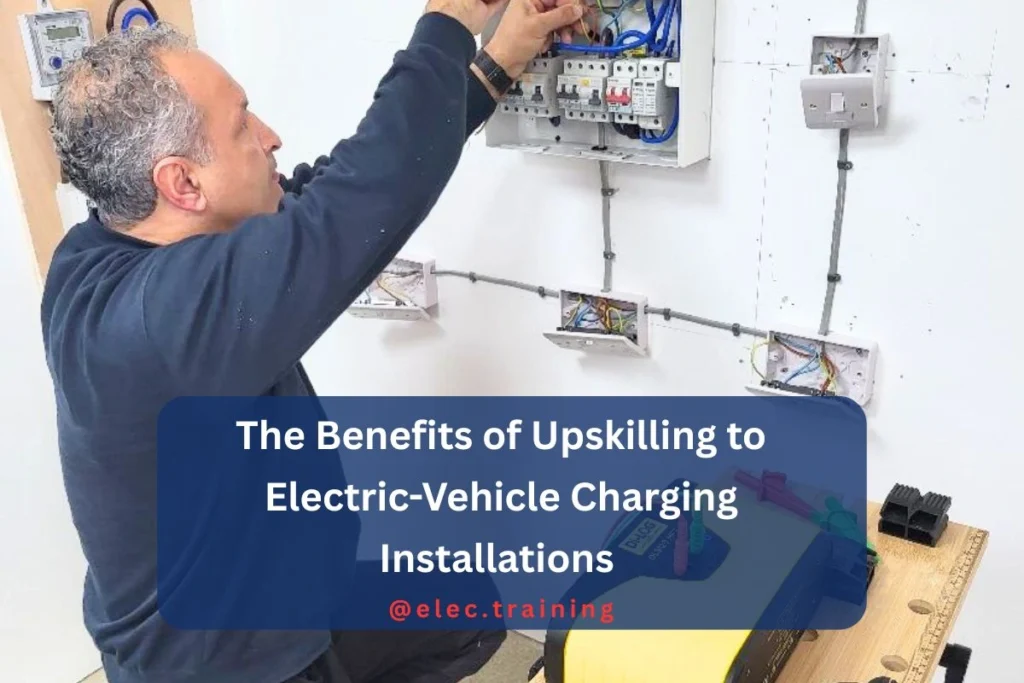
The Benefits of Upskilling to Electric-Vehicle Charging Installations

Electric vehicles are moving from niche curiosity to d riveway staple, and that shift is rewriting the electrical contractor’s business model. Public policy, grant schemes and customer demand now align around one reality: qualified installers able to specify, fit and maintain EV charge points will not be short of work for the next decade. Here’s why adding a C&G 2921-34 ticket to your tool belt can super-charge both your earnings and your long-term career security—and how Elec Training Birmingham can take you there step-by-step.
1 | Demand Is Surging—Everywhere
Between the ban on new petrol cars (2035) and the Local Electric Vehicle Infrastructure (LEVI) Fund, councils, landlords and home-owners all need sockets in the ground fast. Workplace-parking rules are tightening too: from April 2025 most new commercial builds must allocate at least 20 % of bays to EV charging. Add the Electric Vehicle Homecharge Scheme (EVHS) grant and the phone is already ringing for installers who can sign off with an OZEV registration number.
2 | Financial Upside: Numbers That Make Sense
Install Type | Typical Labour Fee | Materials Margin | Time on Site |
7 kW home wallbox | £250 – £300 | 12 – 15 % | 3–4 hrs |
Two-bay work-shop charger | £600 – £750 | 15 % | 1 day |
22 kW three-phase pedestal | £1,400 + | 18 % | 1–2 days |
One or two domestic installs a week can equal, or exceed, the income from a full re-wire—without the plaster dust or customer-decor stress.
3 | Future-Proofing Your Career
The UK’s net-zero pathway demands quick adoption of battery cars, smart grids and home energy-storage. Upskilling now means you are already competent when Part S of the Building Regs expands, or when PEN-fault devices become m andatory nationwide. Put simply: the earlier your CV lists “EV-charge-point specialist,” the longer you stay at the profitable end of the trade.
4 | Stepping-Stone Training at Elec Training
4.1 C&G 2921-34 EV Charging Course
A three-day blend of theory, live rigs and DNO paperwork:
- Load-diversity and PME solutions
- 6 mA DC RCD selection and testing
- OCPP back-office onboarding for public chargers
- Safe isolation and customer hand-over packs
All assessments map into your nvq level 3 electrical portfolio, saving you duplicate site evidence.
4.2 Bolt-On Funding
Many learners trigger 80–100 % Skills-Bootcamp grants for green technology; call 0800 856 4448 for eligibility.
5 | Entry Routes—Choose Your Starting Line
- Absolute beginner? Read How to become an electrician for the full journey: Level 2 classroom, site placement, NVQ logbook and AM2E.
- Time-served but paper-light? The Experienced-Worker Assessment converts five years’ evidence into the NVQ without restarting at Level 2.
- Already graded? Drop straight onto the 2921-34 week and bolt EV skills onto your existing electrician course record.
And yes—if you worry about incoming amendments, bookmark our explainer on 19th edition rumours so you know exactly when refresher sessions really matter.
6 | Common Questions Answered
Do I need a van packed with new tools before starting?
No. Centre rigs supply everything up to calibrated RCD leads. Buy once the new revenue stream justifies outlay.
What about OZEV registration?
Pass 2921-34, provide proof of insurance, and you can apply for the installer number—the course includes the form-filling tutorial.
Will spelling mistakes in my risk assessment fail me?
Assessors grade safety and completeness, not literary flair. Clear p hotos and correct PEN-fault disconnection values trump misplaced commas.
7 | Five-Week Fast-Track Timeline
Week | Action |
0 | Book course; secure Skills-Bootcamp funding |
1 | Complete pre-study e-learning & mock quiz |
2 | Attend three-day 2921-34 block at Elec Training |
3 | First supervised home-charger install; log evidence |
4 | Upload test sheets; assessor signs NVQ units |
5 | Invoice £280 labour, order your own RCD tester |
Final Circuit
Electric-vehicle charging isn’t “extra work” any more—it’s core electrical infrastructure, heavily subsidised and urgently needed. Gaining the 2921-34 qualification through Elec Training Birmingham positions you at exactly the right junction: compliant with future regulation, attractive to eco-minded clients and ready to command higher day rates. Whether you’re starting with a full electrician course, upgrading through the nvq level 3 electrical pathway, or converting years of hands-on experience via the Experienced-Worker route, the time to plug into EV is now. The cables are waiting—will you be the one to connect them?
FAQs